A Relation between the Protocol Partition Number and the Quasi-Additive Bound
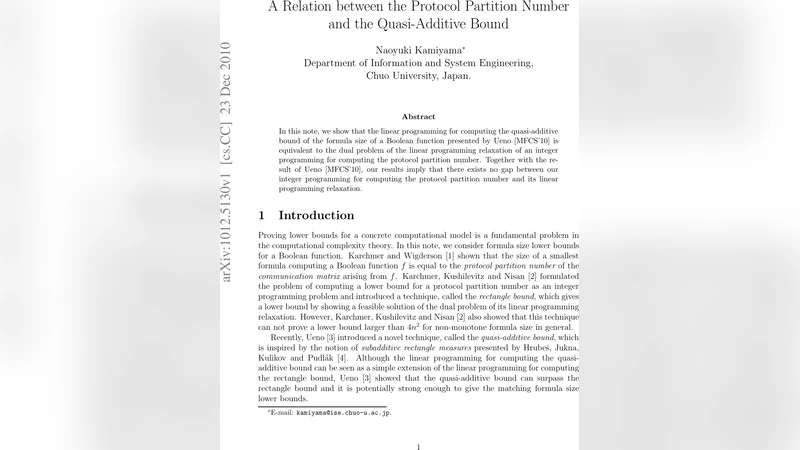
In this note, we show that the linear programming for computing the quasi-additive bound of the formula size of a Boolean function presented by Ueno [MFCS'10] is equivalent to the dual problem of the linear programming relaxation of an integer programming for computing the protocol partition number. Together with the result of Ueno [MFCS'10], our results imply that there exists no gap between our integer programming for computing the protocol partition number and its linear programming relaxation.
💡 Research Summary
The paper investigates the relationship between two approaches for lower‑bounding the formula size of Boolean functions: the protocol partition number (CP) introduced by Karchmer and Wigderson, and the quasi‑additive bound (QA) recently proposed by Ueno. The authors first recall that for any Boolean function f, the size L(f) of the smallest formula computing f equals the protocol partition number C_P(T_f) of the communication matrix M_{T_f} derived from the Karchmer‑Wigderson relation T_f. A protocol partition is a recursive decomposition of M_{T_f} into disjoint monochromatic rectangles; the minimal number of such rectangles gives C_P(T_f).
Ueno’s quasi‑additive bound is defined via a linear program (LP(T)). Variables φ_c are assigned to each cell c of M_T, and variables ψ_{c,R} are assigned to each cell‑rectangle pair. The objective maximizes the sum of φ_c subject to two families of constraints: (i) for every monochromatic rectangle R, the total weight inside R plus the total “penalty” outside R does not exceed 1; (ii) for every rectangle R and every possible partition {V,W} of R, the penalties of the two parts dominate the penalty of R. This LP extends the classic rectangle‑bound LP and was shown by Ueno to be strictly stronger.
The main technical contribution of the present note is an exact integer programming formulation, denoted PN(T), whose optimal value equals the protocol partition number. PN introduces binary variables x_R for each monochromatic rectangle R (indicating whether R belongs to the partition) and integer variables y_{V,P} for each non‑monochromatic rectangle V together with a specific partition P of V. The constraints are:
- For every cell c, the sum of x_R over all monochromatic rectangles containing c equals 1 (each cell is covered exactly once).
- For each non‑monochromatic rectangle V and each of its possible partitions P, the sum of y_{V,P} plus x_V (if V is monochromatic) must be at least the sum of y_{R,P} over all rectangles R that appear as parts in P. This enforces a consistent recursive decomposition.
Lemma 4 shows that any given recursive partition M′ can be turned into a feasible integer solution (x,y) of PN by setting x_R=1 for rectangles in M′ and y_{V,P}=1 for the partition that corresponds to each internal node of the decomposition tree. Lemma 5 proves the converse: any feasible integer solution x yields a set M_x of monochromatic rectangles that indeed forms a recursive partition of M_T. The proof proceeds by induction on the number of selected rectangles, using the y‑variables to locate a minimal rectangle with a positive y‑value, extracting its partition, and reducing the instance.
Consequently, the optimal value of PN(T) is exactly C_P(T). Ueno’s earlier work established that the dual of the linear‑programming relaxation of PN(T) coincides with the quasi‑additive LP(LP(T)). Therefore, the optimal value of the quasi‑additive bound equals the protocol partition number: QA(T)=C_P(T)=L(f) for the associated Boolean function. This equivalence explains why the quasi‑additive bound can surpass the traditional rectangle bound: it is not merely a relaxation but captures the exact integer optimum.
The paper also notes that, to the best of the authors’ knowledge, no exact integer programming model for the protocol partition number had been previously described, making PN(T) a novel contribution. Corollary 8 formalizes the duality relationship, and Corollary 9 asserts that there is no integrality gap between PN(T) and its LP relaxation. Hence, linear‑programming based lower‑bound techniques for formula size are provably tight when expressed through the quasi‑additive framework.
Overall, the note bridges two previously separate strands of complexity theory—communication‑based protocol partitions and LP‑based quasi‑additive bounds—by showing they are two sides of the same linear‑programming duality. This insight not only clarifies the power of the quasi‑additive bound but also provides a solid foundation for future research aiming to develop stronger lower‑bounds for Boolean formula size using integer‑programming and LP duality techniques.
Comments & Academic Discussion
Loading comments...
Leave a Comment