Rational version of Archimedes symplectomorphysm and birational Darboux coordinates on coadjoint orbit of $GL(N,C)$
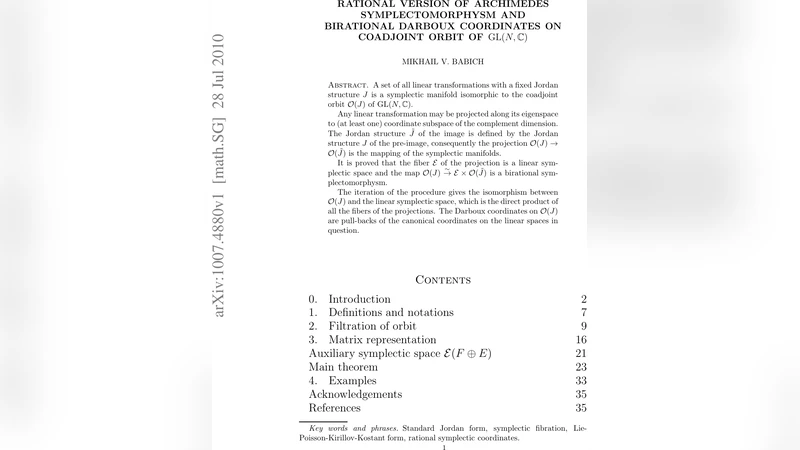
A set of all linear transformations with a fixed Jordan structure $J$ is a symplectic manifold isomorphic to the coadjoint orbit $\mathcal O (J)$ of $GL(N,C)$. Any linear transformation may be projected along its eigenspace to (at least one) coordinate subspace of the complement dimension. The Jordan structure $\tilde J$ of the image is defined by the Jordan structure $J$ of the pre-image, consequently the projection $\mathcal O (J)\to \mathcal O (\tilde J)$ is the mapping of the symplectic manifolds. It is proved that the fiber $\mathcal E$ of the projection is a linear symplectic space and the map $\mathcal O(J) \to \mathcal E \times \mathcal O (\tilde J)$ is a birational symplectomorphysm. The iteration of the procedure gives the isomorphism between $\mathcal O (J)$ and the linear symplectic space, which is the direct product of all the fibers of the projections. The Darboux coordinates on $\mathcal O(J)$ are pull-backs of the canonical coordinates on the linear spaces in question.
💡 Research Summary
The paper investigates the symplectic geometry of coadjoint orbits of the complex general linear group GL(N, C) by focusing on the set of linear operators that share a fixed Jordan canonical form J. This set is naturally a symplectic manifold, canonically isomorphic to the coadjoint orbit 𝒪(J). The authors introduce a projection procedure: for a chosen eigenvalue, one selects an eigen‑subspace and projects any operator A∈𝒪(J) onto a complementary coordinate subspace. The projected operator inherits a new Jordan structure ˜J, which is uniquely determined by the original structure J. Consequently there is a natural map
π : 𝒪(J) → 𝒪(˜J)
between two symplectic manifolds.
A central result is that the fibre ℰ of π is itself a linear symplectic space. By constructing explicit coordinates on ℰ (essentially the degrees of freedom that live inside the chosen eigen‑subspace) the authors prove that the map
Φ : 𝒪(J) → ℰ × 𝒪(˜J), Φ(A) = (π_E(A), π_˜J(A))
is a birational symplectomorphism. “Birational” means that on dense Zariski‑open subsets the map and its inverse are given by rational functions; “symplectomorphism” means that the pull‑back of the product symplectic form on ℰ × 𝒪(˜J) coincides with the canonical Kirillov–Kostant–Souriau form on 𝒪(J).
The construction can be iterated: after each projection the dimension of the Jordan block under consideration decreases by one. Repeating the process until all blocks are of size one yields a chain of projections
𝒪(J) → 𝒪(J₁) → … → 𝒪(J_k) = point,
with associated fibres ℰ₁, ℰ₂, …, ℰ_k. The composition of the birational symplectomorphisms gives an explicit birational identification
𝒪(J) ≈ ℰ₁ × ℰ₂ × … × ℰ_k,
where each ℰ_i is a standard linear symplectic space (ℝ^{2m_i} with the form ∑dx_i∧dy_i). The coordinates (x_i, y_i) on each ℰ_i are pulled back to 𝒪(J) and together form a global Darboux coordinate system on the orbit.
From a practical standpoint, this result provides an explicit, constructive set of Darboux coordinates for any coadjoint orbit of GL(N, C) determined by a Jordan type. Traditional approaches rely on implicit constructions using matrix invariants or on solving differential equations for the Kirillov form; the present method replaces those with elementary linear algebra and rational maps. Consequently, Hamiltonian systems whose phase space is a coadjoint orbit can be written in canonical form, facilitating both analytical integration (e.g., via action‑angle variables) and numerical simulation (since the symplectic structure is constant in the chosen coordinates).
Moreover, the birational nature of the symplectomorphism has algebraic‑geometric implications. It shows that the orbit 𝒪(J) and the product of linear spaces share the same function field, which is relevant for quantization, representation theory, and the study of Poisson varieties. In particular, the construction aligns with the “rational version of the Archimedes symplectomorphism” mentioned in the title: the classical volume‑preserving map of the sphere to a cylinder (Archimedes’ theorem) is replaced here by a rational, symplectic map between high‑dimensional orbits and flat symplectic spaces.
In summary, the paper establishes a systematic, iterative projection technique that decomposes any GL(N, C) coadjoint orbit into a product of linear symplectic fibres, proves that the resulting map is a birational symplectomorphism, and extracts from it a global Darboux coordinate system. This advances the explicit symplectic description of coadjoint orbits, opens new avenues for concrete calculations in classical and quantum integrable systems, and connects symplectic geometry with birational algebraic geometry in a concrete, computationally tractable framework.
Comments & Academic Discussion
Loading comments...
Leave a Comment