A Consistent Dark Matter Interpretation For CoGeNT and DAMA/LIBRA
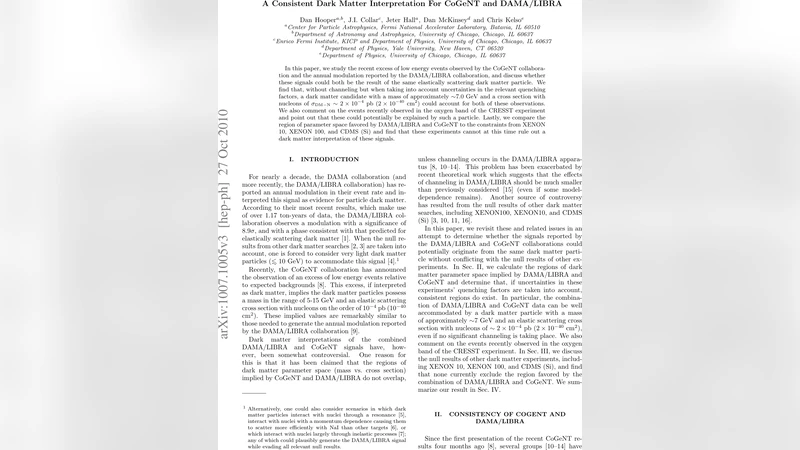
In this paper, we study the recent excess of low energy events observed by the CoGeNT collaboration and the annual modulation reported by the DAMA/LIBRA collaboration, and discuss whether these signals could both be the result of the same elastically scattering dark matter particle. We find that, without channeling but when taking into account uncertainties in the relevant quenching factors, a dark matter candidate with a mass of approximately ~7.0 GeV and a cross section with nucleons of sigma_{DM-N} ~2x10^-4 pb (2x10^-40 cm^2) could account for both of these observations. We also comment on the events recently observed in the oxygen band of the CRESST experiment and point out that these could potentially be explained by such a particle. Lastly, we compare the region of parameter space favored by DAMA/LIBRA and CoGeNT to the constraints from XENON 10, XENON 100, and CDMS (Si) and find that these experiments cannot at this time rule out a dark matter interpretation of these signals.
💡 Research Summary
The paper addresses the intriguing low‑energy excess reported by the CoGeNT collaboration and the annual modulation observed by DAMA/LIBRA, asking whether a single elastically‑scattering dark‑matter (DM) particle could be responsible for both phenomena. The authors adopt a conservative approach: they ignore the possible channeling effect in NaI crystals, but they explicitly incorporate the sizable uncertainties in the quenching factors for Na, I, and Ge, which translate nuclear recoil energies into the measured electron‑equivalent energies. By scanning over the allowed quark‑level DM–nucleon cross‑section and DM mass, they find that a particle with a mass of roughly 7 GeV and a spin‑independent cross‑section of about 2 × 10⁻⁴ pb (2 × 10⁻⁴⁰ cm²) can simultaneously reproduce the CoGeNT recoil spectrum and the DAMA/LIBRA modulation amplitude.
The analysis assumes the standard isotropic Maxwell‑Boltzmann halo with a local density of 0.3 GeV cm⁻³, a circular speed of 220 km s⁻¹, and a Earth‑halo relative speed of 232 km s⁻¹. Under these astrophysical conditions, the high‑velocity tail of the DM velocity distribution dominates the low‑energy recoil rate, making the results relatively robust against modest variations in the halo model. The authors also discuss how alternative halo features (streams, anisotropies) could shift the preferred region but do not qualitatively change the conclusion.
A critical part of the work is the comparison with the most stringent contemporary limits. XENON10’s S2‑only analysis, XENON100’s low‑energy threshold data, and CDMS‑Si results are examined. Because xenon‑based detectors have reduced sensitivity to such light WIMPs due to higher nuclear mass and uncertainties in the scintillation efficiency at sub‑keV energies, the current XENON limits do not exclude the 7 GeV, 2 × 10⁻⁴ pb region. CDMS‑Si, using silicon targets, imposes a tighter bound that grazes the preferred parameter space, indicating a mild tension but not a definitive exclusion. The authors further note that the oxygen‑band events reported by CRESST could be accommodated by the same DM candidate, providing an additional, albeit tentative, cross‑check.
In the discussion, the paper emphasizes that the compatibility hinges on the adopted quenching factor ranges; modest shifts within experimental uncertainties can move the DAMA/LIBRA allowed region enough to overlap with CoGeNT’s best‑fit contour. The lack of a channeling contribution is a conservative choice; if channeling were significant, the required cross‑section would be lower, potentially easing the tension with CDMS‑Si.
The authors conclude that, given present experimental uncertainties, a light (~7 GeV) elastically‑scattering dark‑matter particle remains a viable explanation for both CoGeNT and DAMA/LIBRA signals. They advocate for future low‑threshold experiments, precise measurements of quenching factors for Na, I, and Ge, and refined astrophysical modeling to either confirm this interpretation or rule it out definitively. The paper thus provides a coherent framework that integrates disparate low‑mass signals while respecting existing exclusion limits.
Comments & Academic Discussion
Loading comments...
Leave a Comment