Statistical studies of Spinning Black-Hole Binaries
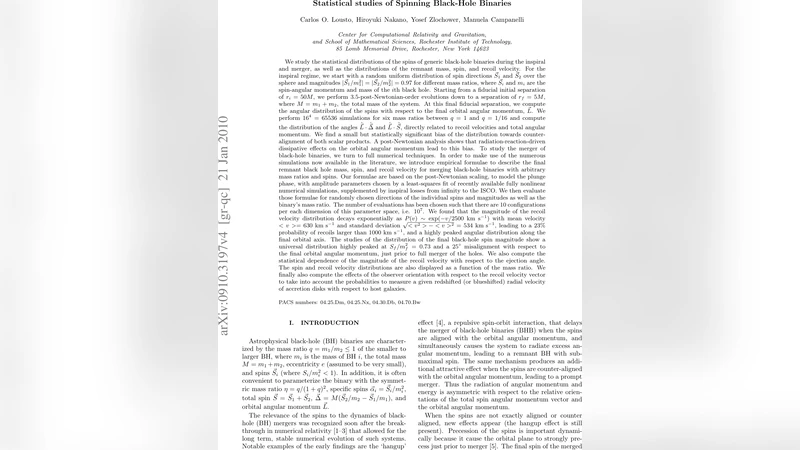
We study the statistical distributions of the spins of generic black-hole binaries during the inspiral and merger, as well as the distributions of the remnant mass, spin, and recoil velocity. For the inspiral regime, we start with a random uniform distribution of spin directions S1 and S2 and magnitudes S1=S2=0.97 for different mass ratios. Starting from a fiducial initial separation of ri=50m, we perform 3.5PN evolutions down to rf=5m. At this final fiducial separation, we compute the angular distribution of the spins with respect to the final orbital angular momentum, L. We perform 16^4 simulations for six mass ratios between q=1 and q=1/16 and compute the distribution of the angles between L and Delta and L and S, directly related to recoil velocities and total angular momentum. We find a small but statistically significant bias of the distribution towards counter-alignment of both scalar products. To study the merger of black-hole binaries, we turn to full numerical techniques. We introduce empirical formulae to describe the final remnant black hole mass, spin, and recoil velocity for merging black-hole binaries with arbitrary mass ratios and spins. We then evaluate those formulae for randomly chosen directions of the individual spins and magnitudes as well as the binary’s mass ratio. We found that the magnitude of the recoil velocity distribution decays as P(v) \exp(-v/2500km/s),
💡 Research Summary
This paper presents a comprehensive statistical investigation of spin dynamics in generic black‑hole binaries, covering both the inspiral phase (using post‑Newtonian (PN) methods) and the final merger (using full numerical relativity). The authors begin by fixing the spin magnitudes of the two black holes to a high value (|S₁| = |S₂| = 0.97 in geometrized units) and sampling the spin directions uniformly at random. Six mass‑ratio values are considered, ranging from equal‑mass (q = 1) down to q = 1/16. Starting from an initial separation of rᵢ = 50 M, each binary is evolved with a 3.5PN approximation down to a fiducial final separation of r_f = 5 M. For each of the 16⁴ = 65,536 simulations per mass ratio, the authors compute the angles between the final orbital angular momentum L and two key vectors: the spin difference Δ = S₁ – S₂ and the total spin S = S₁ + S₂. These angles are directly linked to the recoil (kick) velocity and to the conservation of total angular momentum. The statistical analysis reveals a modest but significant bias toward counter‑alignment of both L·Δ and L·S, an effect that becomes more pronounced as the mass ratio decreases (i.e., when one black hole dominates the mass budget). This bias confirms that spin‑orbit coupling during the inspiral tends to drive the spins away from perfect alignment with the orbital plane.
To address the merger phase, the authors turn to full numerical relativity simulations. They derive empirical formulae that predict the final remnant mass (m_f), spin (S_f), and recoil velocity (v) for arbitrary mass ratios and spin configurations. These formulae extend earlier “super‑kick” and “hang‑up” models by incorporating both the in‑plane and out‑of‑plane components of the individual spins, the mass‑ratio asymmetry, and the full three‑dimensional angular geometry. By sampling millions of random spin orientations and magnitudes together with the mass ratio, they evaluate the statistical properties of the remnant. The recoil‑velocity distribution follows an exponential law P(v) ∝ exp(–v/2500 km s⁻¹), yielding an average kick
The final spin magnitude of the remnant black hole exhibits a remarkably universal distribution, strongly peaked at S_f / m_f² ≈ 0.73 with a narrow spread (≈ ± 0.02). The spin direction is typically misaligned by about 25° with respect to the final orbital angular momentum, reflecting a partial but not complete alignment induced by the merger dynamics. This misalignment persists across the entire range of mass ratios examined, although the most extreme mass‑ratio cases (q = 1/16) show a slight reduction in the peak spin value.
The paper’s contributions are threefold. First, it provides the first large‑scale PN‑based statistical confirmation that spin‑orbit interactions generate a measurable counter‑alignment bias during inspiral. Second, it offers a set of empirically calibrated, yet analytically simple, formulae for predicting remnant properties across the full parameter space of generic binaries, enabling rapid population‑synthesis studies without the need for costly full‑numerical simulations. Third, it quantifies the probability of high‑velocity recoils and the universal spin distribution, supplying concrete numbers (e.g., exponential decay constant 2500 km s⁻¹, mean spin 0.73) that can be directly incorporated into models of galaxy evolution, black‑hole demographics, and gravitational‑wave data analysis.
The authors discuss several astrophysical implications. The 23 % chance of kicks > 1000 km s⁻¹ suggests that a non‑negligible fraction of merger remnants could be displaced from, or even ejected from, their host galaxies, potentially explaining observed off‑center active galactic nuclei or the paucity of super‑massive black holes in some dwarf galaxies. The near‑universal final spin value has ramifications for the efficiency of subsequent accretion and jet production, as spin directly influences the Blandford‑Znajek mechanism. Moreover, the modest 25° typical misalignment implies that gravitational‑waveforms from the ringdown phase will retain a predictable polarization pattern, aiding parameter estimation in current and future detectors.
Future work should extend the analysis to include environmental effects such as gas torques, stellar scattering, and the influence of surrounding dark‑matter halos, which could modify both the inspiral spin evolution and the recoil dynamics. Additionally, incorporating higher‑order PN terms and exploring eccentric orbits would refine the empirical models and broaden their applicability to the diverse population of binary black holes expected to be observed by LIGO, Virgo, KAGRA, and upcoming space‑based detectors like LISA.
Comments & Academic Discussion
Loading comments...
Leave a Comment