Dual topologies on non-abelian groups
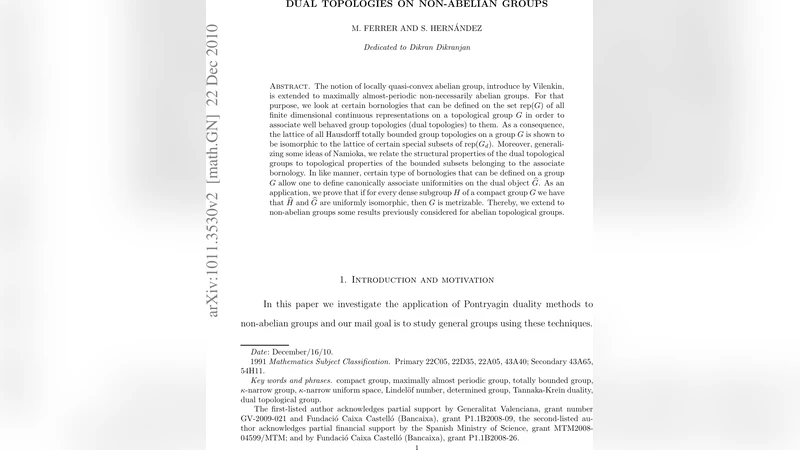
The notion of locally quasi-convex abelian group, introduce by Vilenkin, is extended to maximally almost-periodic non-necessarily abelian groups. For that purpose, we look at certain bornologies that can be defined on the set $\hbox{rep}(G)$ of all finite dimensional continuous representations on a topological group $G$ in order to associate well behaved group topologies (dual topologies) to them. As a consequence, the lattice of all Hausdorff totally bounded group topologies on a group $G$ is shown to be isomorphic to the lattice of certain special subsets of $\hbox{rep}(G_d)$. Moreover, generalizing some ideas of Namioka, we relate the structural properties of the dual topological groups to topological properties of the bounded subsets belonging to the associate bornology. In like manner, certain type of bornologies that can be defined on a group $G$ allow one to define canonically associate uniformities on the dual object $\hat G$. As an application, we prove that if for every dense subgroup $H$ of a compact group $G$ we have that $\hat H$ and $\hat G$ are uniformly isomorphic, then $G$ is metrizable. Thereby, we extend to non-abelian groups some results previously considered for abelian topological groups.
💡 Research Summary
The paper develops a systematic theory of “dual topologies” for arbitrary (not necessarily abelian) topological groups, extending the classical notion of locally quasi‑convex groups that was originally defined only for abelian groups by Vilenkin. The authors start by replacing characters with the full set rep(G) of all finite‑dimensional continuous representations of a group G. On rep(G) they introduce special bornologies—families of subsets that capture a notion of boundedness for representations. Each bornology 𝔅 determines a family of “dual neighborhoods” in G: for every representation π in 𝔅‑bounded rep(G) the map g↦π(g) produces a set of matrix values that separates points of G. The collection of all such neighborhoods generates a Hausdorff, totally bounded group topology τ_𝔅, called the dual topology associated with 𝔅.
A central result is that the assignment 𝔅↦τ_𝔅 establishes a bijection between the lattice of Hausdorff totally bounded group topologies on G and a lattice of distinguished subsets of rep(G_d) (the representation set of G equipped with the discrete topology). In other words, every such topology on G is uniquely encoded by a suitable bornology on the discrete representation space, and conversely each admissible bornology yields exactly one dual topology. This mirrors the Pontryagin‑dual correspondence for abelian groups, but now works for non‑abelian groups without invoking characters.
The authors then generalize ideas of Namioka concerning the interplay between boundedness and continuity. They show that structural properties of the dual topological group (completeness, metrizability, local compactness, etc.) are precisely reflected by topological properties of the bounded subsets that belong to the underlying bornology. For instance, if the bornology is countably generated, the resulting dual topology is metrizable; if it is σ‑compact, the dual group is locally compact; and if the bornology is complete in the sense of containing all limits of Cauchy nets of representations, then τ_𝔅 is a complete uniform space.
A further line of investigation concerns the dual object Ĝ, i.e., the set of equivalence classes of continuous finite‑dimensional representations equipped with a natural uniform structure induced by a chosen bornology on G. By selecting appropriate bornologies on G, one can canonically endow Ĝ with a uniformity that makes the evaluation map G×Ĝ→U(n) uniformly continuous for each representation. The main application of this construction is the following metrizability criterion: if for every dense subgroup H of a compact group G the duals Ĥ and Ĝ are uniformly isomorphic (i.e., there exists a uniform homeomorphism preserving the representation structure), then G must be metrizable. This extends a classical result known for abelian compact groups to the non‑abelian setting, showing that the uniform structure of the dual detects the metrizability of the original compact group.
Overall, the paper provides a robust framework that replaces characters by finite‑dimensional representations, uses bornologies to control boundedness, and translates representation‑theoretic data into concrete topological information about the group. It unifies several strands—locally quasi‑convexity, bornological analysis, uniform structures on dual objects—and demonstrates that many familiar theorems from abelian duality have natural non‑abelian analogues. The results open new avenues for studying non‑abelian topological groups via their representation theory, particularly in contexts where duality, uniformities, and boundedness play a crucial role.
Comments & Academic Discussion
Loading comments...
Leave a Comment