Overcoming Gamma Ray Constraints with Annihilating Dark Matter in Milky Way Subhalos
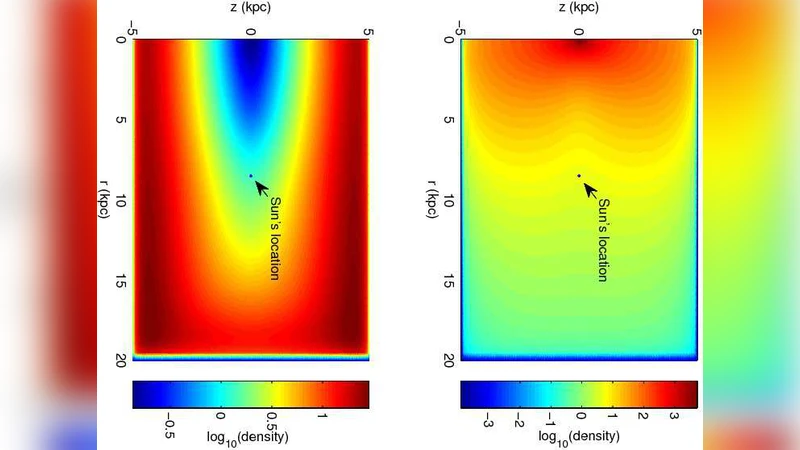
We reconsider Sommerfeld-enhanced annihilation of dark matter (DM) into leptons to explain PAMELA and Fermi electron and positron observations, in light of possible new effects from substructure. There is strong tension between getting a large enough lepton signal while respecting constraints on the fluxes of associated gamma rays. We first show that these constraints become significantly more stringent than in previous studies when the contributions from background e^+ e^- are taken into account, so much so that even cored DM density profiles are ruled out. We then show how DM annihilations within subhalos can get around these constraints. Specifically, if most of the observed lepton excess comes from annihilations in a nearby (within 1 kpc) subhalo along a line of sight toward the galactic center, it is possible to match both the lepton and gamma ray observations. We demonstrate that this can be achieved in a simple class of particle physics models in which the DM annihilates via a hidden leptophilic U(1) vector boson, with explicitly computed Sommerfeld enhancement factors. Gamma ray constraints on the main halo annihilations (and CMB constraints from the era of decoupling) require the annihilating component of the DM to be subdominant, of order 10^-2 of the total DM density.
💡 Research Summary
The paper revisits the idea that dark‑matter (DM) annihilation, boosted by the Sommerfeld effect, could be responsible for the excess of high‑energy electrons and positrons reported by PAMELA and Fermi‑LAT. The authors first point out that many earlier studies underestimated the constraints from gamma‑ray observations because they ignored the contribution of background e⁺e⁻ to the measured spectra. When a realistic background is added, the required annihilation cross‑section (⟨σv⟩≈10⁻²³ cm³ s⁻¹) produces a gamma‑ray flux that exceeds the limits set by Fermi‑LAT, even if the Galactic halo follows a cored density profile such as Burkert. In other words, the gamma‑ray bound becomes so stringent that the conventional picture—DM annihilating throughout the smooth Milky Way halo—cannot simultaneously explain the lepton excess and respect the gamma‑ray limits.
To resolve this tension the authors propose that the bulk of the observed lepton signal originates not from the smooth halo but from a nearby subhalo (distance ≲1 kpc) that lies roughly along the line of sight toward the Galactic Center. Because the subhalo subtends only a tiny solid angle, the associated gamma‑rays are strongly diluted, while the electrons and positrons, being charged, can propagate essentially directly to the Earth with little energy loss over such short distances. By modeling the subhalo’s mass (∼10⁸–10⁹ M⊙), internal density profile, and distance, they demonstrate that a subhalo contributing ≳70 % of the lepton flux can bring the predicted gamma‑ray emission below the Fermi limits. The remaining ∼30 % of the lepton signal can be supplied by the smooth halo without violating the constraints.
The particle‑physics framework employed is a simple hidden‑sector U(1)ₓ gauge boson that couples only to leptons (a “leptophilic” portal). Dark matter particles annihilate into pairs of this light vector boson (mass mₓ≈10–100 MeV). The exchange of the light boson generates a long‑range attractive force, leading to a Sommerfeld enhancement factor S≈10³–10⁴ for relative velocities typical of subhalos (v∼10⁻⁴ c). This enhancement raises the annihilation cross‑section to the level required by the lepton data while keeping the underlying coupling αₓ modest (αₓ≈10⁻³–10⁻²). Because the mediator decays only into leptons, the production of prompt photons is highly suppressed, further easing gamma‑ray constraints.
However, annihilations in the main halo still inject energy at the epoch of recombination, which would distort the Cosmic Microwave Background (CMB) anisotropies. To satisfy the stringent CMB limits, the authors argue that the component of DM that participates in annihilation must be subdominant, constituting only about 1 % of the total DM density. In practice this means a two‑component DM scenario: a dominant “inactive” component (e.g., a stable scalar) that makes up ≈99 % of the mass, and a sub‑dominant “active” component that carries the U(1)ₓ charge and can annihilate. With this split, the energy injection from the active component during recombination is reduced by two orders of magnitude, bringing the model safely within Planck’s bounds.
The paper is organized as follows. Section 1 introduces the lepton excess and reviews previous Sommerfeld‑enhanced DM explanations. Section 2 details the construction of a realistic background e⁺e⁻ spectrum and shows how inclusion of this background tightens gamma‑ray limits. Section 3 presents the subhalo model, derives the lepton and gamma‑ray fluxes as functions of subhalo parameters, and identifies the region of parameter space that satisfies both the lepton data and the gamma‑ray bound. Section 4 develops the hidden‑U(1)ₓ model, calculates the Sommerfeld enhancement analytically and numerically, and discusses the mediator decay channels. Section 5 evaluates CMB constraints and motivates the two‑component DM picture. Finally, Section 6 summarizes the findings and outlines observational prospects: future high‑resolution gamma‑ray maps of the Galactic Center, improved measurements of the local subhalo population (e.g., via Gaia or LSST), and refined CMB polarization data could confirm or falsify the scenario.
In summary, the authors demonstrate that (i) gamma‑ray limits are far more restrictive than previously thought when realistic background electrons are accounted for, (ii) a nearby subhalo can act as a “lepton lighthouse,” delivering the observed excess while keeping gamma‑ray emission below detection thresholds, (iii) a minimal leptophilic hidden‑U(1) model with a light vector mediator naturally provides the required Sommerfeld boost, and (iv) the overall DM must be largely non‑annihilating, with only a ∼1 % active fraction, to satisfy CMB constraints. This combined astrophysical‑particle‑physics solution offers a concrete, testable pathway to reconcile the PAMELA/Fermi lepton excess with existing multi‑messenger observations.