Properties of Bare Strange Stars Associated with Surface Electric Fields
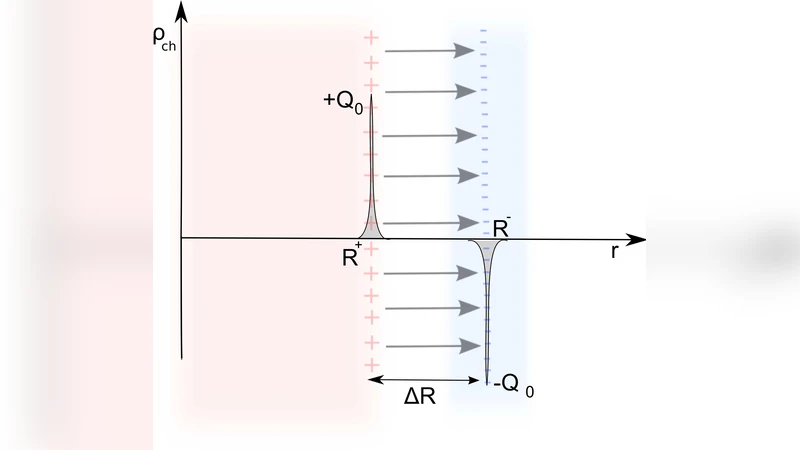
In this paper we investigate the electrodynamic surface properties of bare strange quark stars. The surfaces of such objects are characterized by the formation of ultra-high electric surface fields which might be as high as $\sim 10^{19}$ V/cm. These fields result from the formation of electric dipole layers at the stellar surfaces. We calculate the increase in gravitational mass associated with the energy stored in the electric dipole field, which turns out to be only significant if the star possesses a sufficiently strong {\em net} electric charge distribution. In part two of the paper, we explore the intriguing possibility of what happens when the electron layer (sphere) rotates with respect to the stellar strange matter body. We find that in this event magnetic fields can be generated which, for moderate effective rotational frequencies between the electron layer and the stellar body, agree with the magnetic fields inferred for several Central Compact Objects (CCOs). These objects could thus be comfortably interpreted as strange stars whose electron atmospheres rotate at frequencies that are moderately different ($\sim 10$ Hz) from the rotational frequencies of the strange star itself.
💡 Research Summary
The paper investigates two distinct electrodynamic aspects of bare strange quark stars—objects composed entirely of deconfined up, down, and strange quarks with no conventional crust. In the first part the authors model the formation of an electric dipole layer at the stellar surface. Because electrons are slightly less bound than the positively charged quark matter, they form a thin sheath just outside the star, while the quark bulk remains positively charged. This separation creates an electric field that can reach values of order 10¹⁹ V cm⁻¹. By solving Poisson’s equation for a realistic charge density profile, the authors compute the total electrostatic energy stored in the dipole layer. Converting this energy to an equivalent mass (ΔM = U/c²) shows that the contribution to the star’s gravitational mass is at most 10⁻⁶ of the total mass, unless the star carries an unusually large net charge (Q ≳ 10²⁰ C). Consequently, for the typical charge‑neutral configuration the electric field does not appreciably alter the star’s structure or its external spacetime.
The second part of the work explores the dynamical consequences when the electron sheath rotates at a slightly different angular velocity than the quark core. Treating the electron layer as a thin spherical shell of radius R ≈ 10 km, thickness d ≈ 10⁻⁵ km and surface charge density σ ≈ 10¹⁹ C m⁻², the authors derive the azimuthal current density J = σ ΔΩ r, where ΔΩ = Ωₑ − Ωₛ is the differential rotation rate. Using Ampère’s law and the Biot–Savart law for a rotating charged shell, they obtain an estimate for the generated magnetic field at the stellar surface:
B ≈ (μ₀/3) σ ΔΩ d ≈ 10¹⁰–10¹¹ G for ΔΩ ≈ 10 Hz.
These field strengths are comparable to those inferred for several Central Compact Objects (CCOs), a class of X‑ray sources with relatively low spin‑down inferred magnetic fields (10¹⁰–10¹¹ G) and no detectable radio pulsations. The authors therefore propose that CCOs could be interpreted as bare strange stars whose electron atmospheres rotate modestly faster or slower than the underlying quark core, producing the observed magnetic fields without invoking a conventional dipolar magnetosphere.
The paper also addresses the stability of the rotating electron layer. Potential damping mechanisms include frictional coupling between electrons and the quark matter, electromagnetic radiation reaction, and charge loss through electron emission or quantum tunnelling. The authors argue that the star’s strong gravitational binding keeps the electron sheath tightly confined, making charge loss rates negligible on astrophysical timescales. Nonetheless, they acknowledge that detailed microphysical modeling of the electron–quark interface is required to confirm long‑term stability.
Finally, the authors discuss the interplay between the static electric dipole field and the dynamical magnetic field generated by the rotating sheath. The coexistence of a strong electric field and a modest magnetic field could lead to complex magnetospheric structures, potentially imprinting subtle signatures on the X‑ray pulse profiles, spectral lines, or polarization properties of the emitted radiation. They suggest that high‑resolution timing, spectroscopy, and polarimetry with next‑generation X‑ray observatories could test these predictions.
In summary, the study demonstrates that while the ultra‑high surface electric field of a bare strange star contributes negligibly to its gravitational mass, a modest differential rotation between the electron layer and the quark core can generate magnetic fields of the magnitude observed in CCOs. This provides a novel, physically motivated explanation for the magnetic properties of these enigmatic objects and opens new avenues for probing the existence of strange quark matter through electromagnetic observations. Future work should focus on detailed modeling of the electron‑quark coupling, charge‑loss processes, and the observable electromagnetic signatures of the combined electric‑magnetic surface structure.
Comments & Academic Discussion
Loading comments...
Leave a Comment