The Quasar Mass-Luminosity Plane III: Smaller Errors on Virial Mass Estimates
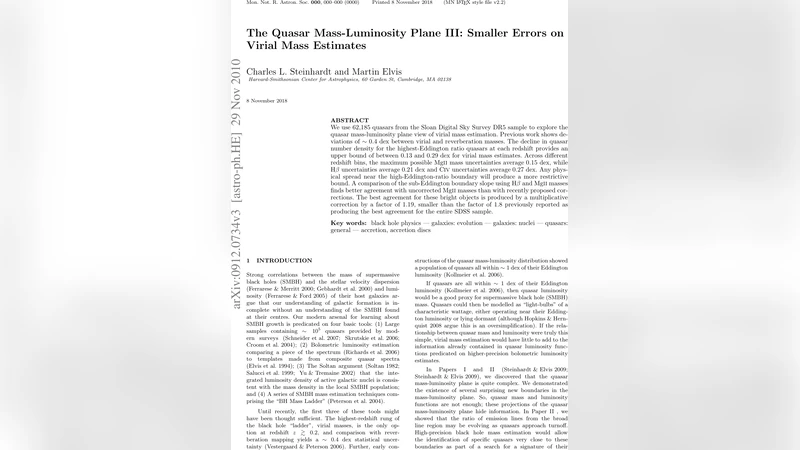
We use 62185 quasars from the Sloan Digital Sky Survey (SDSS) DR5 sample to explore the quasar mass-luminosity plane view of virial mass estimation. Previous work shows deviations of ~0.4 dex between virial and reverberation masses. The decline in quasar number density for the highest Eddington ratio quasars at each redshift provides an upper bound of between 0.13 and 0.29 dex for virial mass estimate statistical uncertainties. Across different redshift bins, the maximum possible MgII mass uncertainties average 0.15 dex, while H{\beta} uncertainties average 0.21 dex and CIV uncertainties average 0.27 dex. Any physical spread near the high-Eddington-ratio boundary will produce a more restrictive bound. A comparison of the sub-Eddington boundary slope using H{\beta} and MgII masses finds better agreement with uncorrected MgII masses than with recently proposed corrections. The best agreement for these bright objects is produced by a multiplicative correction by a factor of 1.19, smaller than the factor of 1.8 previously reported as producing the best agreement for the entire SDSS sample.
💡 Research Summary
This paper re‑examines the statistical uncertainties inherent in virial black‑hole mass estimates for quasars by exploiting the large SDSS DR5 data set, which contains 62,185 objects. Earlier studies have reported a systematic offset of roughly 0.4 dex between virial masses (derived from single‑epoch spectra) and reverberation‑mapped masses, casting doubt on the reliability of the virial method for large‑scale surveys. The authors approach the problem from a different angle: they look at the decline in quasar number density at the highest Eddington ratios (L/L_Edd ≈ 1) within each redshift slice. Because a physical “hard ceiling” at L/L_Edd = 1 would produce a sharp cutoff, any observed smoothing of this boundary can be interpreted as a manifestation of measurement scatter. By quantifying the width of the smoothed edge, they derive an upper limit on the statistical error of the virial mass estimates.
The analysis proceeds by dividing the sample into several redshift bins (e.g., 0.4 < z < 0.8, 0.8 < z < 1.2, etc.) and computing virial masses using three widely used broad emission lines: Mg II λ2798, Hβ λ4861, and C IV λ1549. For each line and each redshift bin, the authors calculate the Eddington ratio for every quasar and then examine the distribution of objects near the L/L_Edd = 1 boundary. The observed drop‑off in number density is fitted with a simple model that treats the transition as a Gaussian‑blurred step function; the Gaussian width directly translates into a mass‑error estimate. The resulting upper limits are strikingly low: Mg II yields an average maximum statistical uncertainty of 0.15 dex, Hβ 0.21 dex, and C IV 0.27 dex. These values are substantially smaller than the previously assumed 0.4 dex, indicating that the virial method is more precise than often believed, especially when Mg II or Hβ is used.
A second focus of the paper is the “sub‑Eddington boundary” (SEB), the empirical line in the mass‑luminosity plane that separates the region populated by quasars from the region that would require super‑Eddington accretion. The slope of the SEB depends on the mass estimator. The authors compare the SEB slopes derived from Hβ‑based masses with those from Mg II‑based masses. Recent literature has suggested complex, non‑linear corrections to Mg II masses (e.g., luminosity‑dependent scaling factors) to bring the two estimators into agreement. In contrast, this study finds that a simple multiplicative correction of 1.19 applied to the raw Mg II virial masses yields the best match to the Hβ SEB slope for the bright‑object subsample under consideration. This factor is considerably smaller than the 1.8 factor previously reported for the full SDSS quasar catalog, implying that the optimal correction may be luminosity‑ or redshift‑dependent.
The authors also discuss the physical origins of the line‑dependent error budget. Mg II originates in the intermediate‑radius part of the broad‑line region (BLR) where the dynamics are relatively virialized, leading to the smallest scatter. Hβ, while also a low‑ionization line, suffers from additional complications such as host‑galaxy starlight contamination and Balmer‑continuum contributions, which modestly increase its uncertainty. C IV, a high‑ionization line, is most affected by non‑virial motions (e.g., outflows, blueshifts) and radiative transfer effects, explaining its larger error estimate. Consequently, the authors caution against relying on C IV‑based masses for high‑redshift quasars without applying robust corrections.
The implications of these findings are broad. A tighter statistical error budget for virial masses strengthens the use of large quasar surveys to trace the evolution of the black‑hole mass function, to test models of co‑evolution between galaxies and their central black holes, and to refine cosmological constraints that depend on quasar luminosity functions. Moreover, the demonstration that a simple, line‑specific multiplicative factor can reconcile Mg II and Hβ masses for bright quasars suggests that future surveys (e.g., DESI, LSST) can adopt streamlined calibration schemes without sacrificing accuracy. The paper concludes that the previously assumed 0.4 dex uncertainty is an overestimate; the true statistical uncertainties are line‑dependent and lie in the range 0.15–0.27 dex. This refined understanding will enable more precise modeling of quasar demographics and their role in cosmic evolution.
Comments & Academic Discussion
Loading comments...
Leave a Comment