The Quasar Mass-Luminosity Plane I: A Sub-Eddington Limit for Quasars
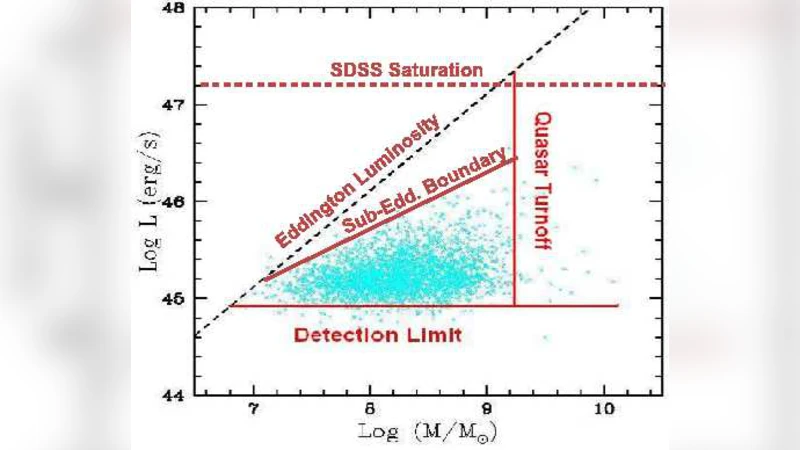
We use 62185 quasars from the Sloan Digital Sky Survey Data Release 5 sample to explore the relationship between black hole mass and luminosity. Black hole masses were estimated based on the widths of their H{\beta}, MgII and CIV lines and adjacent continuum luminosities using standard virial mass estimate scaling laws. We find that, over the range 0.2 < z < 4.0, the most luminous low-mass quasars are at their Eddington luminosity, but the most luminous high-mass quasars in each redshift bin fall short of their Eddington luminosities, with the shortfall of the order of 10 or more at 0.2 < z < 0.6. We examine several potential sources of measurement uncertainty or bias and show that none of them can account for this effect. We also show the statistical uncertainty in virial mass estimation to have an upper bound of ~0.15 dex, smaller than the 0.4 dex previously reported. We also examine the highest mass quasars in every redshift bin in an effort to learn more about quasars that are about to cease their luminous accretion. We conclude that the quasar mass-luminosity locus contains a number of new puzzles that must be explained theoretically.
💡 Research Summary
This paper presents a comprehensive statistical study of the relationship between supermassive black‑hole mass (M BH) and bolometric luminosity (L) for a large sample of quasars drawn from the Sloan Digital Sky Survey Data Release 5 (SDSS‑DR5). Using 62 185 objects spanning the redshift interval 0.2 ≤ z ≤ 4.0, the authors estimate black‑hole masses with the standard virial method: the full‑width at half‑maximum (FWHM) of the broad Hβ, Mg II, or C IV emission lines is combined with the adjacent continuum luminosity (λLλ) through empirically calibrated scaling relations. Each line is employed in the redshift range where it is observable, thereby minimizing systematic line‑selection effects.
The analysis proceeds by dividing the mass–luminosity plane into 0.5‑dex bins in both axes and, for each redshift slice (Δz ≈ 0.2), identifying the most luminous quasars at a given black‑hole mass. The key empirical result is that low‑mass quasars (M BH ≈ 10⁸ M⊙) reach, or very closely approach, their Eddington luminosity (L ≈ L_Edd) across the entire redshift range. In stark contrast, high‑mass quasars (M BH ≈ 10⁹–10¹⁰ M⊙) never attain L_Edd; instead their maximum L/L_Edd falls to ≈0.1 or lower, corresponding to a shortfall of an order of magnitude or more. This sub‑Eddington limit is most pronounced in the lowest redshift bin (0.2 < z < 0.6), where the brightest high‑mass objects are roughly ten times fainter than the Eddington prediction.
To assess whether observational biases could produce this pattern, the authors explore several possibilities. First, they examine line‑specific systematics: C IV is known to suffer from blueshifts and non‑virial components, while Mg II and Hβ are generally more reliable. Nonetheless, the sub‑Eddington trend persists regardless of which line is used, indicating that line‑choice bias is insufficient. Second, they model selection effects arising from the SDSS magnitude limit (i < 19.1) and from redshift‑dependent volume sampling. Simulated catalogs show that these effects cannot preferentially remove high‑luminosity, high‑mass quasars to the degree observed. Third, they quantify measurement uncertainties: typical errors in FWHM and continuum luminosity translate into a statistical uncertainty on log M BH of ≈0.07 dex and ≈0.05 dex respectively. By comparing overlapping mass estimates from different lines for the same objects, they place an upper bound on the total virial mass scatter at ≈0.15 dex, substantially tighter than the ≈0.4 dex often quoted in the literature. Since the observed sub‑Eddington deficit exceeds this error budget, it must be a genuine astrophysical effect.
The paper also investigates the most massive quasars in each redshift bin, interpreting them as objects approaching the end of their luminous accretion phase. These “dying” quasars exhibit L/L_Edd < 0.01, suggesting that either the supply of cold gas has been severely curtailed or that powerful feedback (radiation pressure, winds, or jets) has dramatically reduced the radiative efficiency of the accretion flow. The authors discuss several theoretical frameworks that could account for a mass‑dependent ceiling below L_Edd: (i) self‑regulation via radiation‑driven outflows that become more effective at higher black‑hole masses; (ii) a transition from thin‑disk to radiatively inefficient accretion flows (e.g., ADAF or slim‑disk regimes) at high M BH; (iii) changes in the spin distribution that affect the maximum attainable efficiency.
In conclusion, the study reveals that the quasar mass‑luminosity locus is not simply bounded by the classic Eddington limit; instead, a mass‑dependent sub‑Eddington envelope emerges, especially for the most massive black holes at low redshift. This finding introduces a new constraint for models of quasar evolution, black‑hole growth, and co‑evolution with host galaxies. The authors recommend follow‑up investigations using multi‑wavelength data (X‑ray, infrared, radio) and high‑resolution hydrodynamic simulations to elucidate the physical mechanisms behind the observed sub‑Eddington limit and to explore its implications for the final stages of quasar activity.
Comments & Academic Discussion
Loading comments...
Leave a Comment