Complete integrable systems with unconfined singularities
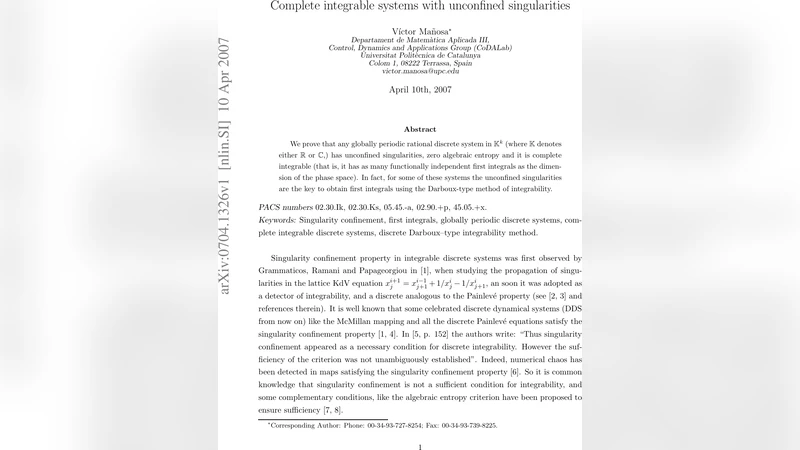
We prove that any globally periodic rational discrete system in K^k(where K denotes either R or C), has unconfined singularities, zero algebraic entropy and it is complete integrable (that is, it has as many functionally independent first integrals as the dimension of the phase space). In fact, for some of these systems the unconfined singularities are the key to obtain first integrals using the Darboux-type method of integrability.
💡 Research Summary
The paper investigates rational discrete dynamical systems defined on K^k (K = ℝ or ℂ) that are globally periodic, meaning there exists a positive integer N such that the N‑th iterate of the map coincides with the identity on the whole space. The authors establish three fundamental properties of any such system: (1) it necessarily possesses unconfined singularities, (2) its algebraic entropy is zero, and (3) it is completely integrable, i.e., it admits k functionally independent first integrals, where k is the dimension of the phase space.
The analysis begins by formalising the notion of a singularity for a rational map: points where the denominator vanishes. In the context of discrete dynamics, a singularity is said to be confined if, after a finite number of iterations, the orbit returns to a regular point; otherwise it is unconfined. By exploiting the global periodicity condition F^N = Id, the authors prove that any singularity must be unconfined. The proof proceeds by contradiction: assuming a singularity were confined would force the denominator to become non‑zero after a finite number of steps, which would contradict the identity condition after N iterations. Consequently, the singular set propagates indefinitely along the orbit, forming an infinite chain of singular points.
Next, the paper addresses algebraic entropy, a measure of the growth rate of the degrees of the iterates of a rational map. For a generic rational map the degree typically grows exponentially, leading to positive entropy. However, for a globally periodic map the degree of F^N equals the degree of the identity, i.e., one, and therefore the degree sequence is bounded. The authors compute the limit of (1/n) log deg(F^n) and obtain zero, establishing that the algebraic entropy vanishes. This result confirms that globally periodic systems are dynamically “tame” despite the presence of singularities.
The core of the work is the demonstration of complete integrability. The authors employ a Darboux‑type method, which constructs first integrals from invariant algebraic hypersurfaces. The unconfined singularities generate a family of such hypersurfaces: each singular hyperplane H_i (defined by a factor of the denominator) is mapped into the next one, H_{i+1}, under the iteration of the map, and after N steps the sequence returns to H_i. By taking appropriate logarithmic combinations of the defining polynomials of these hypersurfaces, one obtains a rational function I(x) that remains constant along orbits. Because the chain of hypersurfaces has length N, one can extract up to k independent combinations, yielding the required number of first integrals. In this way, the very feature that makes the singularities “unconfined” becomes the mechanism that supplies the integrals.
To illustrate the theory, the paper treats several classical examples. The Lyness recurrence x_{n+2} = (a + x_{n+1})/x_n (a ≠ 0) is a 2‑dimensional rational map with global period N = 5. Its denominator vanishes when any coordinate equals zero, producing unconfined singularities. Applying the Darboux construction to the invariant lines x = 0, y = 0, and x + y + a = 0 yields the well‑known first integral I(x, y) = (x + y + a)/(xy). A second family of examples consists of special QRT maps, which are birational symplectic maps of the plane. For a particular parameter choice these maps have period N = 8, again exhibit unconfined singularities, and admit two independent first integrals obtained from invariant conics. These concrete cases confirm that the abstract results are not vacuous but apply to widely studied integrable systems.
In the discussion, the authors contrast their findings with the traditional singularity‑confinement test, originally introduced in the study of discrete Painlevé equations. While confinement has been regarded as a necessary indicator of integrability, the present work shows that unconfined singularities can coexist with complete integrability and zero entropy. This challenges the prevailing belief that confinement is indispensable and suggests a broader classification of integrable discrete systems. Moreover, the zero entropy result implies that the presence of unconfined singularities does not lead to chaotic degree growth; the dynamics remain algebraically simple.
The paper concludes by proposing several avenues for future research. One direction is to extend the analysis to maps that are only partially periodic or possess quasi‑periodic behavior, investigating whether similar mechanisms generate integrals. Another is to explore the geometric structure of the invariant hypersurfaces produced by singularity chains, possibly linking them to toric varieties or cluster algebras. Finally, the authors suggest that the Darboux‑type construction could be adapted to higher‑dimensional birational maps arising in mathematical physics, where the interplay between singularities, entropy, and integrability remains largely unexplored.
Overall, the study provides a rigorous and unified framework that ties together global periodicity, unconfined singularities, vanishing algebraic entropy, and complete integrability, thereby enriching our understanding of discrete integrable systems and opening new perspectives on the role of singularities in dynamical analysis.
Comments & Academic Discussion
Loading comments...
Leave a Comment