Natural realizations of sparsity matroids
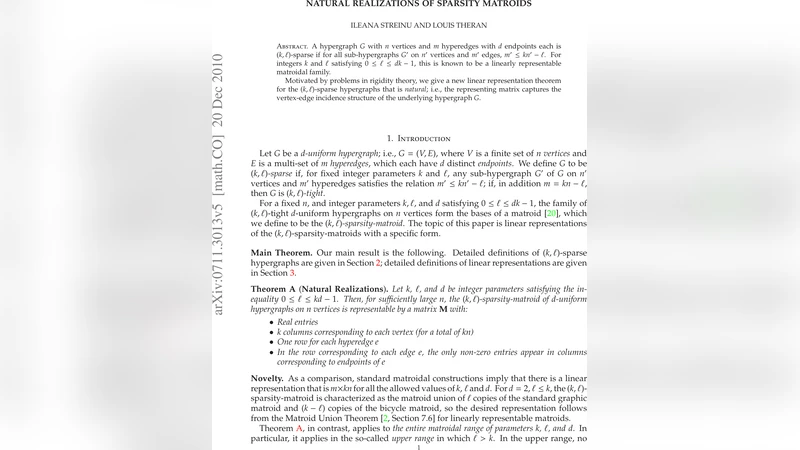
A hypergraph G with n vertices and m hyperedges with d endpoints each is (k,l)-sparse if for all sub-hypergraphs G’ on n’ vertices and m’ edges, m’\le kn’-l. For integers k and l satisfying 0\le l\le dk-1, this is known to be a linearly representable matroidal family. Motivated by problems in rigidity theory, we give a new linear representation theorem for the (k,l)-sparse hypergraphs that is natural; i.e., the representing matrix captures the vertex-edge incidence structure of the underlying hypergraph G.
💡 Research Summary
The paper addresses the long‑standing problem of finding a natural linear representation for the family of (k, l)-sparse hypergraphs, a class that underlies many rigidity‑theoretic results and is known to form a matroid when 0 ≤ l ≤ dk − 1. A hypergraph G = (V, E) with n vertices and m hyperedges, each incident to exactly d vertices, is (k, l)-sparse if every sub‑hypergraph G′ = (V′, E′) satisfies |E′| ≤ k|V′| − l. While previous work proved that such families are linearly representable, the constructions were abstract: they typically introduced auxiliary variables or weighted incidence matrices that obscured the underlying vertex‑edge relationship.
The authors propose a new representation matrix M that directly mirrors the incidence structure of G. The matrix is built in a block‑wise fashion: for each vertex v we allocate k rows, and for each hyperedge e we allocate d columns. The (v, e) block is non‑zero precisely when v belongs to e; otherwise it is a zero block. The non‑zero entries can be generic indeterminates or concrete geometric quantities (e.g., coordinate differences) depending on the intended application. Consequently, M is highly sparse, and its pattern encodes the exact combinatorial data of the hypergraph.
The central theorem states that if one can select the non‑zero entries so that every (k n − l)‑dimensional submatrix of M has full rank, then the hypergraph’s edge set is independent in the (k, l)-sparse matroid. The proof proceeds in two parts. First, the authors show that the block structure guarantees that any sub‑hypergraph G′ corresponds to a submatrix whose rank equals |E′|, thereby satisfying the sparsity inequality. Second, they invoke the matroid exchange axiom: given two independent edge sets of the same size, an element can be exchanged while preserving independence. The exchange argument relies critically on the condition l ≤ dk − 1, which ensures that the rank deficiency never exceeds the number of rows contributed by the incident vertices. By constructing an explicit basis for the row space of each submatrix, they demonstrate that the exchange operation can be performed without violating full‑rank conditions.
The paper then connects this representation to rigidity theory. In 2‑dimensional bar‑joint frameworks, the classic Laman condition corresponds to (2, 3)-sparsity; the proposed matrix M, with vertex coordinates as variables, reproduces the standard rigidity matrix, but now derived from a purely combinatorial construction. Similarly, for 3‑dimensional body‑bar frameworks, (3, 6)-sparsity governs rigidity, and the authors show that M yields the body‑bar rigidity matrix without the need for auxiliary constraints. These examples illustrate that the new representation not only recovers known rigidity matrices but also provides a systematic way to generate them for any (k, l) pair within the admissible range.
From an algorithmic perspective, M’s sparsity and block regularity make it amenable to fast rank‑computation techniques. Standard sparse‑matrix libraries (e.g., SuiteSparse, Eigen) can compute the rank in near‑linear time relative to the number of non‑zero entries, which is O(d m) = O(d n) for typical sparse hypergraphs. Moreover, because each vertex contributes a fixed set of rows, dynamic updates (insertion or deletion of vertices or hyperedges) can be handled by adding or removing the corresponding blocks, enabling incremental rigidity checks in real‑time applications such as sensor network localization or robotic manipulation.
The authors conclude with several avenues for future work. Extending the natural representation beyond the range 0 ≤ l ≤ dk − 1 remains open; it would require new combinatorial insights to handle cases where the exchange axiom fails. Another direction is to explore non‑integer values of k and l, possibly via fractional matroid theory. Finally, they suggest leveraging the explicit incidence‑based matrix for optimization problems, such as finding minimum‑size spanning subgraphs that satisfy a given sparsity condition, which could have implications for network design and graph sparsification.
In summary, the paper delivers a clean, incidence‑preserving linear representation for (k, l)-sparse hypergraphs, bridges combinatorial matroid theory with geometric rigidity, and opens the door to efficient computational tools for a broad class of problems where sparsity and rigidity intersect.
Comments & Academic Discussion
Loading comments...
Leave a Comment