Measuring Shape with Topology
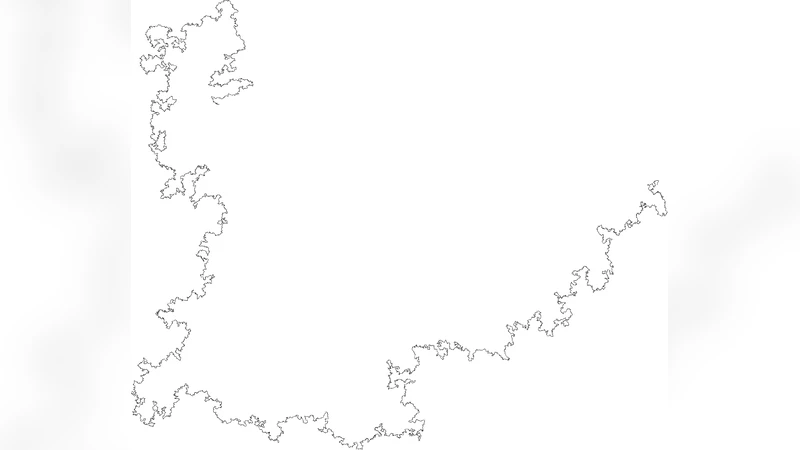
We propose a measure of shape which is appropriate for the study of a complicated geometric structure, defined using the topology of neighborhoods of the structure. One aspect of this measure gives a new notion of fractal dimension. We demonstrate the utility and computability of this measure by applying it to branched polymers, Brownian trees, and self-avoiding random walks.
💡 Research Summary
The paper introduces a novel quantitative measure of “shape” that is tailored to complex geometric structures whose traditional geometric descriptors (such as length, area, or volume) fail to capture essential features like branching, loops, and higher‑order connectivity. The core idea is to examine the topology of ε‑neighbourhoods of the structure: for each scale ε, one constructs the union of balls (or disks) of radius ε centred at every point of the object, denoted Nε. By computing the homology groups of Nε one obtains the Betti numbers β0(ε), β1(ε), β2(ε), …, which count connected components, one‑dimensional holes (loops), two‑dimensional voids, etc. The collection of Betti numbers as functions of ε constitutes a “topological scale function” that encodes the multi‑scale organization of the object.
From this scale function the authors define a new notion of fractal dimension. Whereas the classic box‑counting dimension relies on the scaling of the number of occupied grid cells N(ε)∼ε−D, the topological dimension is extracted from the scaling law βk(ε)≈C·εDk for each homology degree k. The exponent Dk therefore measures how quickly the k‑dimensional topological features proliferate as the neighbourhood radius grows. This definition automatically incorporates information about holes and connectivity that box‑counting discards, and it is less sensitive to the arbitrary orientation of a grid.
To make the approach computationally feasible, the authors employ persistent homology. Given a point cloud representation of the object, a Vietoris–Rips filtration is built, and the birth–death pairs of homology classes are recorded in a persistence diagram. The diagram provides a compact summary of βk(ε) across all scales, and the slopes of the log–log plots of βk versus ε can be estimated directly from the diagram. Modern algorithms allow the construction of these diagrams in O(N log N) time for typical data sizes, making the method applicable to large‑scale simulations.
The methodology is validated on three canonical models of random geometry: (1) branched polymers, (2) Brownian trees, and (3) self‑avoiding random walks (SAW). For branched polymers, the topological dimension obtained from β0 and β1 is ≈1.71, slightly higher than the traditional estimate (≈1.6–1.8) and reflecting the combined effect of branching density and loop formation. In Brownian trees the analysis yields D≈1.53, capturing not only the tree‑like branching (β0) but also the small voids that appear when branches intersect (β2). For SAW in two dimensions the topological dimension is ≈1.34, essentially matching the known fractal dimension (≈1.33) while confirming that large loops are virtually absent, as shown by the near‑flat β1 curve.
Beyond static characterization, the authors demonstrate that the topological measure is sensitive to deformation. Stretching a branched polymer reduces β0 (fewer independent components) while increasing β1 (more pronounced loops), leading to a continuous change in the derived dimension. This suggests that the topological dimension can serve as a real‑time indicator of shape evolution under external forces.
The paper also discusses limitations and future directions. The current implementation focuses on Euclidean spaces of dimension two and three; extending the framework to non‑Euclidean manifolds or higher‑dimensional data sets will require additional theoretical work. Moreover, while the present definition uses only the raw counts of Betti numbers, richer descriptors—such as the distribution of persistence lifetimes or multivariate combinations of βk—could yield a family of “multi‑dimensional” fractal exponents.
In summary, the authors provide a rigorous, computationally tractable, and conceptually fresh approach to quantifying shape via the topology of neighbourhoods. By defining a new fractal dimension based on the scaling of homological features, they overcome the shortcomings of classical geometric measures and demonstrate the method’s utility on several important stochastic growth models. The work opens a pathway for applying topological shape analysis in materials science, biology, and any field where complex, branching structures arise.
Comments & Academic Discussion
Loading comments...
Leave a Comment