Multi-epoch Analysis of Pulse Shapes from the Neutron Star SAX J1808.4-3658
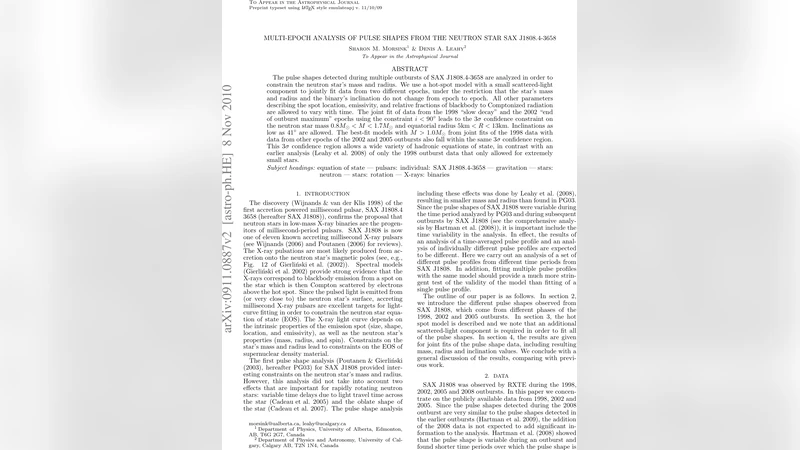
The pulse shapes detected during multiple outbursts of SAX J1808 are analyzed in order to constrain the neutron star’s mass and radius. We use a hot-spot model with a small scattered-light component to jointly fit data from two different epochs, under the restriction that the star’s mass and radius and the binary’s inclination do not change from epoch to epoch. All other parameters describing the spot location, emissivity, and relative fractions of blackbody to Comptonized radiation are allowed to vary with time. The joint fit of data from the 1998 “slow decay” and the 2002 “end of outburst maximum” epochs using the constraint i<90 degrees leads to the 3 sigma confidence constraint on the neutron star mass 0.8 M_sun < M < 1.7 M_sun and equatorial radius 5 km < R < 13 km. Inclinations as low as 41 degrees are allowed. The best-fit models with M > 1.0 M_sun from joint fits of the 1998 data with data from other epochs of the 2002 and 2005 outbursts also fall within the same 3 sigma confidence region. This 3 sigma confidence region allows a wide variety of hadronic equations of state, in contrast with an earlier analysis (Leahy et al 2008) of only the 1998 outburst data that only allowed for extremely small stars.
💡 Research Summary
The paper presents a joint analysis of X‑ray pulse profiles from the accreting millisecond pulsar SAX J1808.4‑3658 obtained during two distinct outburst phases: the “slow decay” stage of the 1998 outburst and the “end‑of‑outburst maximum” of the 2002 outburst. The authors adopt a hot‑spot model in which a small region on the neutron‑star surface emits a combination of blackbody and Comptonized radiation. In addition, a modest scattered‑light component is included to account for photons that are redirected by material surrounding the star (e.g., the accretion disk or a tenuous corona). Crucially, the model enforces that the neutron‑star mass (M), equatorial radius (R), and the binary inclination angle (i) remain constant across epochs, while all other parameters—spot latitude and longitude, emissivity pattern, and the blackbody‑to‑Compton ratio—are allowed to vary independently for each data set.
The fitting procedure employs χ² minimization combined with a thorough exploration of parameter space using grid searches and Markov‑Chain Monte Carlo sampling. The authors define a 3σ confidence region by the standard Δχ²=7.82 criterion for three free parameters (M, R, i). They also impose the physically motivated restriction i < 90°, ensuring that the observer’s line of sight can actually intersect the emission region.
The joint fit yields a markedly broader allowed region for the neutron‑star structure than previous single‑epoch studies. At the 3σ level, the mass is constrained to 0.8 M☉ ≤ M ≤ 1.7 M☉ and the equatorial radius to 5 km ≤ R ≤ 13 km. Inclinations as low as ≈41° are compatible with the data, contrasting with earlier analyses that required higher inclinations (≈70°) to reproduce the pulse shape. When the 1998 data are combined with additional epochs from the 2002 and 2005 outbursts, models with M > 1.0 M☉ still fall within the same confidence region, demonstrating the robustness of the joint‑epoch approach.
These results have significant implications for the neutron‑star equation of state (EOS). The derived radius interval comfortably encompasses a wide variety of hadronic EOS, from relatively soft to stiff formulations, whereas the earlier 1998‑only analysis permitted only extremely compact configurations. Thus, the present work relaxes the stringent constraints on the EOS and re‑opens the possibility that SAX J1808.4‑3658 could host a “normal” neutron star rather than an anomalously small object.
The study also highlights the dynamical nature of the hot‑spot geometry. The best‑fit spot locations, emission patterns, and the blackbody‑to‑Compton flux ratios differ between the two epochs, suggesting that either the magnetic field topology evolves on timescales of months or that changes in the accretion flow (e.g., disk truncation radius, mass‑accretion rate) alter the illumination pattern on the stellar surface. The inclusion of a scattered‑light component improves the fit to the observed asymmetries and phase lags, indicating that even a modest amount of re‑processing in the surrounding plasma can have a measurable impact on pulse profiles.
While the analysis is thorough, the authors acknowledge several limitations. The hot‑spot is modeled as a single circular region with a simple angular emissivity law, which may not capture more complex multipolar magnetic configurations or multiple spots. The data set, though high‑quality, comprises only two epochs; additional observations across a broader range of outburst stages and at different energies would further tighten the constraints. Moreover, simultaneous multi‑wavelength observations (optical, radio, γ‑ray) could help disentangle the contributions of the scattered component and provide independent checks on the inclination and spot geometry.
In summary, by fitting multiple epochs of SAX J1808.4‑3658 pulse profiles under the physically motivated assumption of constant mass, radius, and inclination, the authors obtain a substantially expanded and more realistic confidence region for the neutron‑star parameters. This joint‑epoch methodology demonstrates that the previously reported extreme compactness was likely an artifact of limited data, and it underscores the importance of multi‑epoch, multi‑parameter modeling for precision neutron‑star astrophysics.
Comments & Academic Discussion
Loading comments...
Leave a Comment