A Family of Exactly Solvable Radial Quantum Systems on Space of Non-Constant Curvature with Accidental Degeneracy in the Spectrum
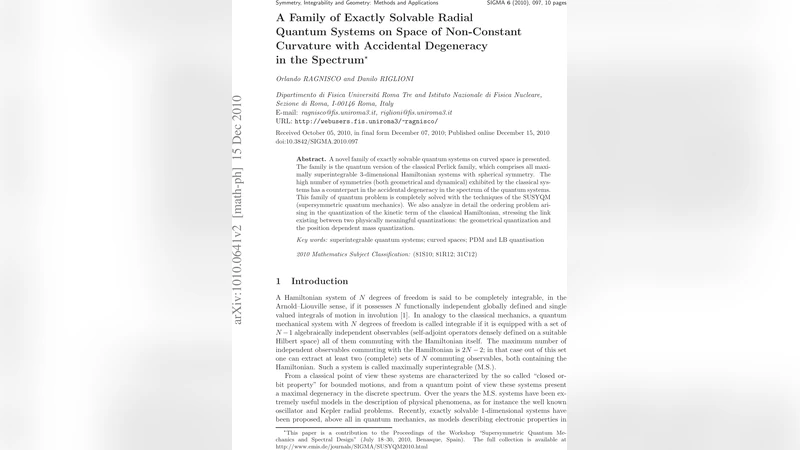
A novel family of exactly solvable quantum systems on curved space is presented. The family is the quantum version of the classical Perlick family, which comprises all maximally superintegrable 3-dimensional Hamiltonian systems with spherical symmetry. The high number of symmetries (both geometrical and dynamical) exhibited by the classical systems has a counterpart in the accidental degeneracy in the spectrum of the quantum systems. This family of quantum problem is completely solved with the techniques of the SUSYQM (supersymmetric quantum mechanics). We also analyze in detail the ordering problem arising in the quantization of the kinetic term of the classical Hamiltonian, stressing the link existing between two physically meaningful quantizations: the geometrical quantization and the position dependent mass quantization.
💡 Research Summary
The paper presents a comprehensive study of a new family of exactly solvable quantum systems defined on three‑dimensional spaces of non‑constant curvature that possess spherical symmetry. These systems are the quantum counterparts of the classical Perlick family, which was shown in the 1970s to contain all maximally superintegrable Hamiltonians with spherical symmetry in three dimensions. The authors begin by recalling the concept of maximal superintegrability: a classical system with five independent integrals of motion (energy, the square of the angular momentum, the components of a generalized Laplace‑Runge‑Lenz vector, etc.) exhibits a high degree of symmetry that, upon quantization, typically manifests as accidental degeneracy in the energy spectrum.
The central technical challenge addressed is the operator‑ordering problem that arises when one quantizes the kinetic term on a curved manifold whose scalar curvature is not constant. Two physically motivated quantization schemes are examined. The first, “geometric quantization,” constructs the kinetic operator directly from the Laplace‑Beltrami operator associated with the metric (g_{ij}) of the curved space, thereby incorporating the appropriate volume element. The second, “position‑dependent mass (PDM) quantization,” rewrites the kinetic term in a form that suggests an effective mass function (m(r)=\bigl(1+\kappa r^{2}\bigr)^{-1}), where (\kappa) is the curvature parameter. Although the two approaches lead to Hamiltonians that differ by ordering‑dependent terms, the authors demonstrate that a similarity transformation together with a constant shift renders them unitarily equivalent. This result bridges two widely used quantization philosophies and guarantees that physical predictions are independent of the chosen ordering prescription.
Having settled the quantization ambiguity, the authors turn to the exact solution of the radial Schrödinger equation. By separating variables in spherical coordinates, the problem reduces to an effective one‑dimensional equation for the radial coordinate (r). The authors then apply the machinery of supersymmetric quantum mechanics (SUSYQM). They construct a superpotential (W(r)) that depends on the curvature (\kappa) and on the parameters characterizing the Perlick potential (often denoted (\alpha) and (\beta) in the literature). The partner potentials (V_{\pm}(r)=W^{2}(r)\pm W’(r)) turn out to be shape‑invariant, a property that guarantees an algebraic determination of the entire bound‑state spectrum.
The shape‑invariance condition leads to a recursive energy relation that can be summed explicitly. The final energy eigenvalues take the compact form
\
Comments & Academic Discussion
Loading comments...
Leave a Comment