Vlasov-Maxwell, self-consistent electromagnetic wave emission simulations in the solar corona
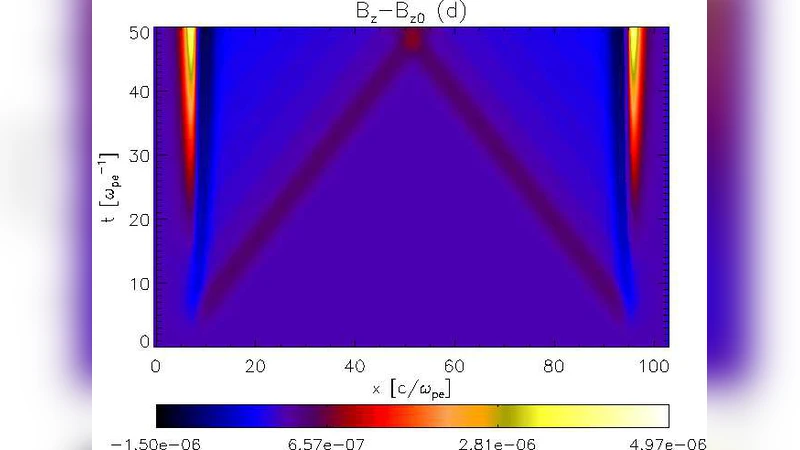
1.5D Vlasov-Maxwell simulations are employed to model electromagnetic emission generation in a fully self-consistent plasma kinetic model for the first time in the solar physics context. The simulations mimic the plasma emission mechanism and Larmor drift instability in a plasma thread that connects the Sun to Earth with the spatial scales compressed appropriately. The effects of spatial density gradients on the generation of electromagnetic radiation are investigated. It is shown that 1.5D inhomogeneous plasma with a uniform background magnetic field directed transverse to the density gradient is aperiodically unstable to Larmor-drift instability. The latter results in a novel effect of generation of electromagnetic emission at plasma frequency. When density gradient is removed (i.e. when plasma becomes stable to Larmor-drift instability) and a $low$ density, super-thermal, hot beam is injected along the domain, in the direction perpendicular to the magnetic field, plasma emission mechanism generates non-escaping Langmuir type oscillations which in turn generate escaping electromagnetic radiation. It is found that in the spatial location where the beam is injected, the standing waves, oscillating at the plasma frequency, are excited. These can be used to interpret the horizontal strips observed in some dynamical spectra. Quasilinear theory predictions: (i) the electron free streaming and (ii) the beam long relaxation time, in accord with the analytic expressions, are corroborated via direct, fully-kinetic simulation. Finally, the interplay of Larmor-drift instability and plasma emission mechanism is studied by considering $dense$ electron beam in the Larmor-drift unstable (inhomogeneous) plasma. http://www.maths.qmul.ac.uk/~tsiklauri/movie1.mpg * http://www.maths.qmul.ac.uk/~tsiklauri/movie2.mpg * http://www.maths.qmul.ac.uk/~tsiklauri/movie3.mpg
💡 Research Summary
This paper presents the first fully self‑consistent kinetic study of electromagnetic (EM) wave generation in a solar‑coronal plasma using 1.5‑dimensional Vlasov‑Maxwell simulations. The authors construct a numerical experiment that mimics a magnetic flux tube connecting the Sun and the Earth, compressing the realistic spatial scales so that both the plasma emission mechanism and the Larmor‑drift instability can be captured within a single model. Three distinct simulation sets are explored.
In the first set the background magnetic field is uniform and oriented perpendicular to a prescribed density gradient. Theory predicts that such a configuration is aperiodically unstable to the Larmor‑drift instability: the combined effect of particle gyromotion and the spatial variation of the plasma frequency drives a non‑oscillatory growth of EM fields at the local plasma frequency (ω_pe). The simulation confirms this prediction: transverse electric and magnetic components grow exponentially, the electron density exhibits standing oscillations locked to ω_pe, and the generated EM radiation propagates away from the source region without the need for a Langmuir wave intermediate. This demonstrates that a simple density gradient can act as a direct source of plasma‑frequency radiation in the corona.
The second set removes the density gradient, thereby stabilising the Larmor‑drift mode, and injects a low‑density, super‑thermal electron beam across the magnetic field (i.e., perpendicular to B). The beam parameters are chosen to be typical of type‑III burst drivers: n_b/n_e ≈ 10⁻⁵ and beam speed v_b ≈ 5 v_th. The beam excites Langmuir‑like electrostatic oscillations that remain largely non‑escaping (standing waves) at the injection site. Through the standard three‑wave coupling (Langmuir + ion‑acoustic → EM) these electrostatic oscillations generate escaping EM radiation near ω_pe. The simulation reproduces the characteristic “horizontal strips” seen in dynamic spectra: narrowband, nearly stationary features at the plasma frequency that correspond to the standing Langmuir field. Moreover, the free‑streaming of beam electrons and the long relaxation time τ_relax ≈ (n_b/n_e)⁻¹ ω_pe⁻¹ match quasilinear theory quantitatively, providing a stringent validation of the kinetic model.
The third set combines the two effects by embedding a dense electron beam (n_b/n_e ≈ 10⁻³) into the inhomogeneous plasma that is already Larmor‑drift unstable. In this regime the beam‑driven Langmuir activity and the gradient‑driven EM emission coexist and interact. The resulting EM spectrum shows a superposition of narrowband plasma‑frequency peaks (from the beam) and broader, drift‑induced components (from the Larmor‑drift). Interference between the two processes leads to modulation of the emitted power and to complex spectral structures that resemble the fine‑scale features observed in solar radio bursts.
Overall, the study delivers several key insights: (1) a transverse density gradient in a magnetised plasma can directly generate plasma‑frequency EM waves via the Larmor‑drift instability; (2) when this instability is suppressed, the classic plasma emission scenario operates, producing Langmuir standing waves and subsequent escaping radiation; (3) the beam density, temperature, and injection geometry critically control the efficiency and spectral signature of the emission; (4) the simultaneous presence of both mechanisms yields a rich, composite radio signature, offering a natural explanation for the diversity of structures seen in solar dynamic spectra. By demonstrating that a Vlasov‑Maxwell framework can capture both linear instabilities and nonlinear wave–particle interactions without resorting to ad‑hoc prescriptions, the paper establishes a powerful tool for future investigations of solar radio bursts, type‑III and type‑II emissions, and more generally for kinetic plasma processes in space and astrophysical environments.
Comments & Academic Discussion
Loading comments...
Leave a Comment