The club of simplicial sets
A club structure is defined on the category of simplicial sets. This club generalizes the operad of associative rings by adding 'amalgamated' products.
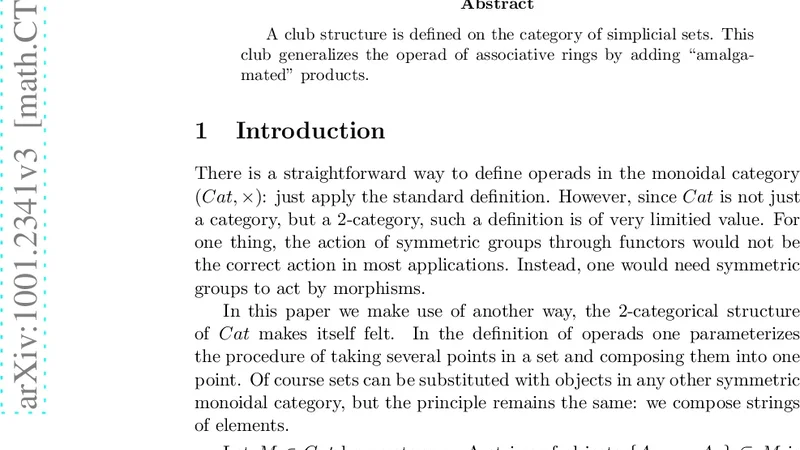
A club structure is defined on the category of simplicial sets. This club generalizes the operad of associative rings by adding “amalgamated” products.
💡 Research Summary
The paper introduces a club structure on the category of simplicial sets (sSet), extending the classical operadic framework by incorporating an “amalgamated product” that allows multiple objects to be combined along a common subobject. The authors begin by recalling Kelly’s notion of a club, which generalizes operads by permitting more flexible multi‑ary composition laws and by encoding coherence data at the level of the underlying category rather than merely at the level of sets. They argue that while operads such as the associative operad (Ass) capture the algebraic essence of monoids, they are insufficient for modeling constructions in homotopy theory where spaces (or simplicial sets) are often glued together along shared subspaces.
To address this, the authors define a binary operation on simplicial sets called the amalgamated product. Given simplicial sets X, Y and a common sub‑simplicial set A equipped with inclusions A → X and A → Y, the amalgamated product X ⨿_A Y is defined as the pushout of the diagram A → X, A → Y in sSet. This operation reduces to the disjoint union when A is empty and to the ordinary union when A is the whole of one factor, but in general it retains the homotopical information of the gluing locus. Crucially, the pushout in sSet is a homotopy‑pushout when the model structure is taken into account, so the amalgamated product respects weak equivalences and preserves cofibrancy under mild hypotheses.
Building on this binary operation, the authors construct a club C whose n‑ary operations C(n) are obtained by iteratively applying the amalgamated product to a sequence of n simplicial sets, choosing a specific pattern of common subobjects at each step. The symmetric group Σ_n acts by permuting the input slots, and the unit object I is taken to be the 0‑simplex Δ⁰. The key structural map γ : C(k) × C(n₁) × … × C(n_k) → C(n₁+…+n_k) is defined by a nested sequence of pushouts, effectively “plugging” the outputs of the inner operations into the inputs of the outer one. The authors verify the three coherence conditions required of a club: associativity (the two ways of forming a large pushout are related by a canonical weak equivalence), unit (plugging the unit Δ⁰ leaves an operation unchanged up to isomorphism), and symmetry (permuting inputs commutes with γ). These coherence maps are constructed explicitly using the universal property of pushouts and the fact that pushouts in a model category are homotopy‑invariant up to a unique homotopy class.
A substantial portion of the paper is devoted to comparing C with the classical associative operad Ass. The authors show that Ass embeds as a sub‑club of C by restricting to the case where all common subobjects are empty. Consequently, any Ass‑algebra (i.e., a strict monoid in sSet) automatically acquires a C‑algebra structure, but the converse is false: C‑algebras can encode non‑trivial gluing data, allowing for “amalgamated monoids” where multiplication is defined only after identifying a shared sub‑structure. This generalization opens the door to modeling homotopy‑coherent monoids, E_∞‑algebras, and other higher‑algebraic structures that naturally involve gluing along subspaces.
The paper concludes with several illustrative examples of C‑algebras. One example is a simplicial set built from a collection of simplices glued along common faces, yielding a combinatorial model of a CW‑complex with prescribed attaching maps. Another example demonstrates how a C‑algebra structure on a simplicial set can be interpreted as a homotopy‑coherent monoid in the sense of Boardman–Vogt, providing a bridge between classical operadic homotopy theory and the club framework. The authors also discuss potential applications to ∞‑category theory, suggesting that the club C could serve as a template for defining “amalgamated operads” in the setting of quasi‑categories, where higher‑dimensional horn‑filling conditions would replace the ordinary pushout diagrams.
Overall, the paper delivers a thorough categorical construction, proves the necessary coherence theorems, and situates the new club within the broader landscape of algebraic topology and higher algebra. By allowing amalgamated products as primitive operations, the club C enriches the algebraic toolbox available for handling glued simplicial structures, and it promises fruitful interactions with homotopy‑coherent algebra, ∞‑operads, and modern approaches to higher categorical algebra.
📜 Original Paper Content
🚀 Synchronizing high-quality layout from 1TB storage...