Higher dimensional operads
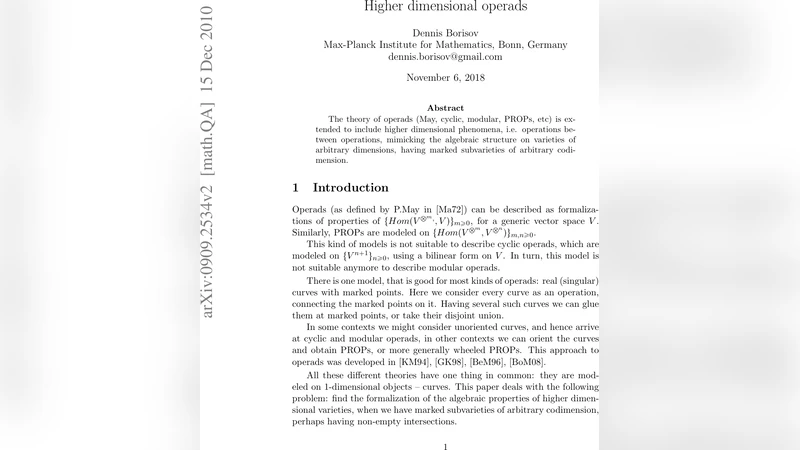
The theory of operads (May, cyclic, modular, PROPs, etc) is extended to include higher dimensional phenomena, i.e. operations between operations, mimicking the algebraic structure on varieties of arbitrary dimensions, having marked subvarieties of arbitrary codimension.
💡 Research Summary
The paper “Higher Dimensional Operads” proposes a systematic extension of classical operad theory—encompassing May operads, cyclic operads, modular operads, and PROPs—into a genuinely higher‑dimensional setting. The authors observe that traditional operads model operations with a set of 0‑dimensional inputs and a single output, which is sufficient for algebraic structures on points or 1‑dimensional objects but inadequate for describing algebraic phenomena on manifolds of arbitrary dimension that contain marked sub‑manifolds of various codimensions. To address this gap, they introduce the notion of a higher‑dimensional operad (HD‑operad), whose basic objects are pairs ((X,{Y_i})) where (X) is a (d)-dimensional manifold and each (Y_i\subset X) is a marked sub‑manifold of codimension (k_i). These marks play the role of “ports” but themselves carry operadic structure, allowing operations to act on operations recursively.
The central construction is a higher‑dimensional composition law. Given two HD‑operads ((X,{Y_i})) and ((X’,{Y’j})) that share a common marked sub‑manifold (Z), a gluing map (\phi:Z\to Z’) identifies the matching ports, and the composite is defined as the push‑out (X\cup{\phi}X’) together with the union of the remaining marks. Crucially, this gluing is not merely set‑theoretic; it is performed in the category of opetopic cell complexes (or more generally, in a suitable model of weak (n)-categories). This ensures that the resulting composite respects higher homotopical data and satisfies coherence conditions analogous to the Stasheff associahedra, but now in arbitrary dimension (e.g., higher‑dimensional pentagons, hexagons, etc.).
To make the theory robust, the authors formulate coherence axioms using the language of weak (n)-categories. They require that any two ways of composing a finite diagram of HD‑operads are related by a unique higher homotopy class, thereby generalizing the usual associativity and equivariance axioms. This yields a hierarchy of coherence cells that encode “operations between operations” at every level.
With the basic HD‑operad in place, the paper proceeds to construct higher‑dimensional cyclic operads, higher‑dimensional modular operads, and higher‑dimensional PROPs. In the cyclic case, the usual cyclic symmetry is lifted to an action of the orthogonal group on the marked spheres (S^{k}) that serve as ports, allowing for rotation invariance in any codimension. The modular extension replaces the underlying graph combinatorics by cellular complexes that can accommodate handles and higher‑genus features, thus modeling operations on surfaces with arbitrary genus and marked boundaries. The PROP generalization permits multiple inputs and outputs, each of which may be a manifold of its own dimension, and the composition is governed by a multicomposition operation on the corresponding cell complexes.
The authors illustrate the theory with several concrete examples. A 2‑dimensional surface with marked 1‑dimensional boundary components yields a HD‑operad that captures the algebraic structure of boundary conformal field theories. A 3‑manifold with embedded surfaces as marks models the handle‑addition operations familiar from 3‑dimensional topological quantum field theory (TQFT). Moreover, a higher‑dimensional PROP can encode multi‑particle interactions in quantum field theory, where each particle’s world‑line is a marked 1‑dimensional sub‑manifold and the interaction vertices are higher‑dimensional gluings.
Beyond examples, the paper explores connections to moduli spaces. The marked sub‑manifolds can be interpreted as points in a higher‑dimensional analog of the Deligne–Mumford space; the HD‑operad composition then corresponds to the natural gluing maps on these moduli spaces. This perspective opens a pathway to apply operadic techniques to the study of deformation theory, derived algebraic geometry, and enumerative invariants in higher dimensions.
In the concluding section, the authors outline several avenues for future work: (1) establishing an explicit equivalence between HD‑operads and existing models of (\infty)-operads, (2) developing computational tools (e.g., software for manipulating opetopic complexes) to facilitate concrete calculations, and (3) applying the framework to concrete physical theories such as higher‑dimensional conformal field theories, factorization algebras, and extended TQFTs. Overall, the paper delivers a comprehensive, mathematically rigorous, and conceptually rich extension of operad theory that promises to unify a wide range of algebraic structures appearing in geometry, topology, and physics.
Comments & Academic Discussion
Loading comments...
Leave a Comment