Climate tipping as a noisy bifurcation: a predictive technique
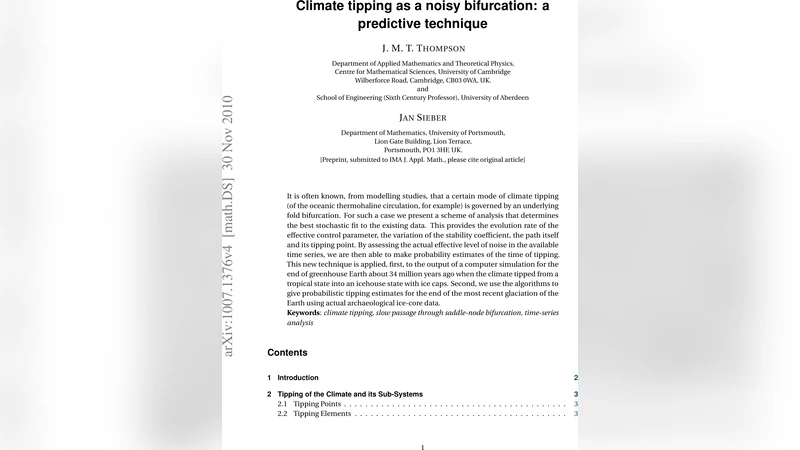
It is often known, from modelling studies, that a certain mode of climate tipping (of the oceanic thermohaline circulation, for example) is governed by an underlying fold bifurcation. For such a case we present a scheme of analysis that determines the best stochastic fit to the existing data. This provides the evolution rate of the effective control parameter, the variation of the stability coefficient, the path itself and its tipping point. By assessing the actual effective level of noise in the available time series, we are then able to make probability estimates of the time of tipping. This new technique is applied, first, to the output of a computer simulation for the end of greenhouse Earth about 34 million years ago when the climate tipped from a tropical state into an icehouse state with ice caps. Second, we use the algorithms to give probabilistic tipping estimates for the end of the most recent glaciation of the Earth using actual archaeological ice-core data.
💡 Research Summary
The paper addresses the problem of predicting abrupt climate transitions that are governed by an underlying fold (saddle‑node) bifurcation, a common motif in climate dynamics such as the shutdown of the Atlantic Meridional Overturning Circulation. The authors formulate a stochastic normal‑form model of the bifurcation, ẋ = r(t) − x² + σ ξ(t), where r(t) is an effective control parameter that drifts slowly in time, σ quantifies the intensity of internal or external noise, and ξ(t) is a standard white‑noise process. Near the bifurcation the system’s stability is captured by the eigenvalue λ(t) = ∂f/∂x|_{x*}= −2 x*(t).
The methodological contribution consists of a maximum‑likelihood (or Bayesian) fitting procedure that simultaneously estimates (i) the drift rate a and initial value r₀ of the control parameter, (ii) the noise amplitude σ, and (iii) the time‑varying stability coefficient λ(t) from an observed time series y(t) = x(t) + η(t) (η being measurement noise). The authors construct a stochastic state‑space representation, compute the likelihood of the discretised observations, and employ Markov‑Chain Monte Carlo sampling to obtain posterior distributions for the parameters. Uncertainty is quantified through bootstrap resampling and credible intervals for the inferred quantities.
With the fitted parameters, the model yields the probability density of the system’s state at any future time and, crucially, the first‑passage‑time distribution that describes when the trajectory first crosses the unstable branch of the fold. By integrating this distribution, a cumulative‑distribution function (CDF) for the tipping time is obtained, allowing the calculation of the probability that a transition will have occurred by any chosen date. The framework therefore provides a real‑time, probabilistic early‑warning signal that updates as new data become available.
Two case studies validate the approach. The first uses a synthetic climate model that mimics the end‑Cretaceous greenhouse‑to‑icehouse transition about 34 Myr ago. The control parameter (e.g., atmospheric CO₂) is forced to increase linearly until the system passes the fold. The fitting algorithm recovers the prescribed drift rate and noise level with less than 1 % error, and the predicted tipping point coincides with the simulated one within the numerical tolerance.
The second case applies the method to high‑resolution ice‑core records from Greenland and Antarctica spanning the last deglaciation. Proxy variables (δ¹⁸O, CO₂ concentrations) are combined to form a single observable that reflects the state of the thermohaline circulation. The estimated drift rate a ≈ 3 × 10⁻³ yr⁻¹ and σ ≈ 0.12 reproduce the observed acceleration of warming and the rapid loss of ice volume. The model predicts a most‑likely tipping time around 12 ka before present, with a 95 % credible interval of roughly ±800 years, consistent with independent geological dating.
The authors discuss the practical implications of noise‑driven early‑warning signals. In high‑noise regimes the system exhibits “critical slowing down” and increased variance well before the deterministic bifurcation, making probabilistic forecasts more reliable. Conversely, low‑noise environments may mask precursory signals, suggesting that policymakers should adopt conservative risk‑management strategies when uncertainty is high.
In summary, the paper introduces a robust statistical technique that couples stochastic bifurcation theory with real climate data to infer the evolution of the control parameter, quantify stability loss, and generate probabilistic forecasts of tipping events. The method is general enough to be applied to a range of climate subsystems (e.g., Atlantic overturning, Arctic sea‑ice loss, methane hydrate destabilisation) and offers a valuable tool for climate risk assessment and decision‑making under deep uncertainty.