(Quasi-)Poisson enveloping algebras
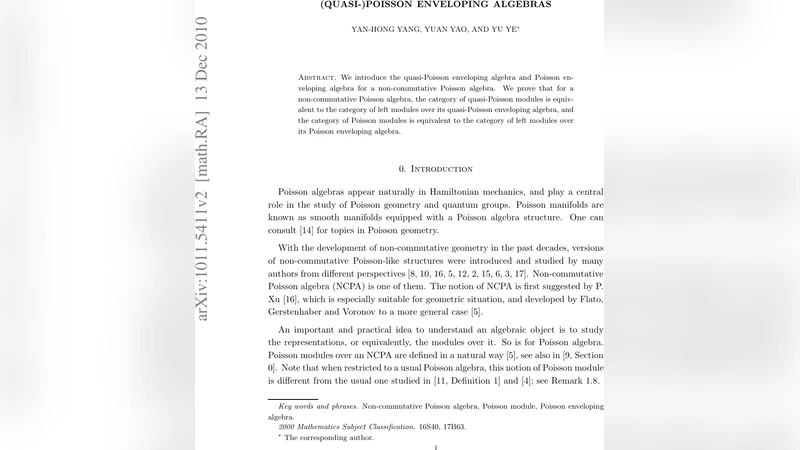
We introduce the quasi-Poisson enveloping algebra and Poisson enveloping algebra for a non-commutative Poisson algebra. We prove that for a non-commutative Poisson algebra, the category of quasi-Poisson modules is equivalent to the category of left modules over its quasi-Poisson enveloping algebra, and the category of Poisson modules is equivalent to the category of left modules over its Poisson enveloping algebra.
💡 Research Summary
The paper develops a comprehensive algebraic framework for modules over non‑commutative Poisson algebras (NCPAs). A non‑commutative Poisson algebra A is an associative algebra equipped with a Lie‑type bracket {‑,‑} that satisfies a Leibniz rule with respect to the associative product, but the product itself need not be commutative. The authors begin by distinguishing two levels of module structures. A quasi‑Poisson module over A is an A‑bimodule M together with a linear map π: A⊗M → M (the “bracket action”) such that the bracket interacts with the left and right A‑actions in a “quasi‑derivation” fashion; concretely, for a,b∈A and m∈M one has
{a, bm} = {a,b}·m + b·{a,m},
and a similar identity for right multiplication. This relaxes the full Leibniz condition, allowing the non‑commutativity of the underlying product to be absorbed into correction terms. A Poisson module is a quasi‑Poisson module that satisfies the stronger condition
{ab, m} = a·{b,m} + {a,m}·b,
so that the bracket acts as a genuine derivation with respect to the associative multiplication.
The central construction of the paper is that of two enveloping algebras associated with A. The quasi‑Poisson enveloping algebra U_Q(A) is built as a smash‑product (or semi‑direct product) of the tensor algebra T(A) (encoding the associative structure) and the free Lie algebra L(A) (encoding the bracket). The defining relations are δ(a)·ι(b) – ι(b)·δ(a) = ι({a,b}), where ι: A → U_Q(A) embeds A as the associative part and δ: A → U_Q(A) embeds the Lie part. These relations exactly mirror the quasi‑Poisson module axioms, making U_Q(A) the universal object through which any quasi‑Poisson action factors uniquely.
The Poisson enveloping algebra U_P(A) is obtained from U_Q(A) by imposing the additional derivation relations δ(ab) = ι(a)·δ(b) + δ(a)·ι(b). Thus U_P(A) is a quotient of U_Q(A) that forces the bracket to be a true derivation. Both enveloping algebras enjoy universal properties: any algebra B equipped with maps respecting the associative product and the bracket uniquely receives a homomorphism from U_Q(A) (or from U_P(A) when the derivation condition holds).
The main categorical results are Theorem 4.5 and Theorem 4.7. The authors construct explicit functors:
- From the category of left U_Q(A)‑modules to the category of quasi‑Poisson A‑modules by restricting the action of ι(A) and δ(A) to obtain the left/right A‑actions and the bracket action.
- From quasi‑Poisson A‑modules to left U_Q(A)‑modules by using the universal property of U_Q(A) to extend the given actions to a unique algebra action. These functors are shown to be inverse equivalences, establishing an equivalence of categories. An analogous pair of functors yields an equivalence between left U_P(A)‑modules and Poisson A‑modules.
The paper illustrates the theory with several examples. When A is commutative, U_Q(A) and U_P(A) coincide with the classical Poisson enveloping algebra, recovering known results. For the matrix algebra M_n(k) with the standard commutator bracket, the construction produces a non‑trivial quasi‑Poisson enveloping algebra that captures the interaction between matrix multiplication and the Lie bracket. The authors also discuss connections to Hochschild‑Poisson cohomology, indicating that the enveloping algebras provide a natural setting for defining and computing Poisson‑type cohomology in the non‑commutative case.
Finally, the paper outlines future directions: developing homological invariants (e.g., Ext and Tor) over U_Q(A) and U_P(A), classifying non‑commutative Poisson algebras via their enveloping algebras, and exploring quantization procedures where the enveloping algebras serve as intermediate objects linking classical Poisson structures to non‑commutative deformations.
In summary, the authors succeed in extending the powerful machinery of enveloping algebras and module‑category equivalences from the classical (commutative) Poisson setting to the broader, non‑commutative realm. This work not only clarifies the algebraic underpinnings of quasi‑Poisson and Poisson modules but also opens a pathway for further investigations into representation theory, cohomology, and deformation quantization of non‑commutative Poisson algebras.
Comments & Academic Discussion
Loading comments...
Leave a Comment