Three-Dimensional Lattice Boltzmann Model for High-Speed Compressible Flows
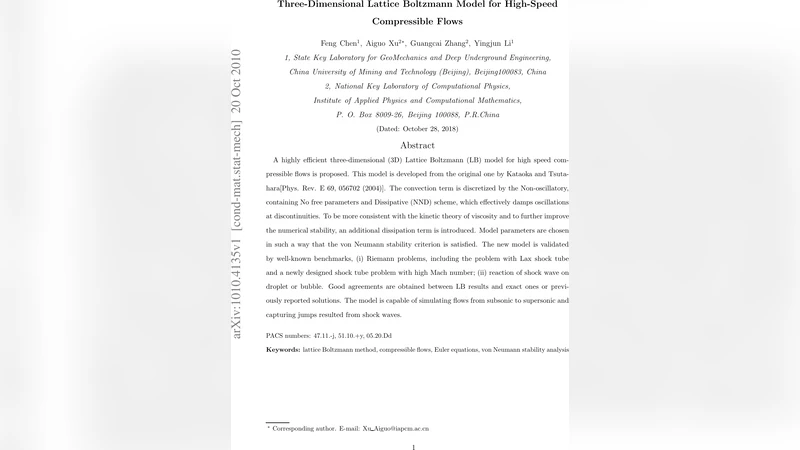
A highly efficient three-dimensional (3D) Lattice Boltzmann (LB) model for high speed compressible flows is proposed. This model is developed from the original one by Kataoka and Tsutahara[Phys. Rev. E 69, 056702 (2004)]. The convection term is discretized by the Non-oscillatory, containing No free parameters and Dissipative (NND) scheme, which effectively damps oscillations at discontinuities. To be more consistent with the kinetic theory of viscosity and to further improve the numerical stability, an additional dissipation term is introduced. Model parameters are chosen in such a way that the von Neumann stability criterion is satisfied. The new model is validated by well-known benchmarks, (i) Riemann problems, including the problem with Lax shock tube and a newly designed shock tube problem with high Mach number; (ii) reaction of shock wave on droplet or bubble. Good agreements are obtained between LB results and exact ones or previously reported solutions. The model is capable of simulating flows from subsonic to supersonic and capturing jumps resulted from shock waves.
💡 Research Summary
The paper presents a three‑dimensional lattice Boltzmann (LB) model specifically designed for high‑speed compressible flows. Building on the original Kataoka‑Tsutahara formulation (Phys. Rev. E 69, 056702, 2004), the authors introduce two major numerical enhancements to overcome the limitations of earlier LB schemes when dealing with strong shocks and supersonic regimes. First, the convection term is discretized using a Non‑Oscillatory, No‑Free‑Parameter Dissipative (NND) scheme. Unlike conventional upwind or MUSCL approaches, NND provides high‑order accuracy while guaranteeing the absence of spurious oscillations near discontinuities, a crucial property for capturing shock fronts without Gibbs phenomena. Second, an additional artificial dissipation term is incorporated into the collision operator. This term is not meant to model physical viscosity directly; rather, it acts as a stabilizer that damps high‑frequency numerical noise that typically arises at high Mach numbers. The artificial viscosity coefficient is scaled with the grid spacing and time step, ensuring that it diminishes automatically as the mesh is refined.
To guarantee numerical stability, the authors perform a von Neumann linear stability analysis on the fully discretized LB equation, which now includes both the NND convection and the artificial dissipation. By examining the amplification factor G(k) for Fourier modes, they derive admissible ranges for the relaxation time τ, the Courant–Friedrichs–Lewy (CFL) number, and the artificial viscosity coefficient. The analysis shows that choosing τ in the interval
Comments & Academic Discussion
Loading comments...
Leave a Comment