Public Infrastructure for Monte Carlo Simulation: publicMC@BATAN
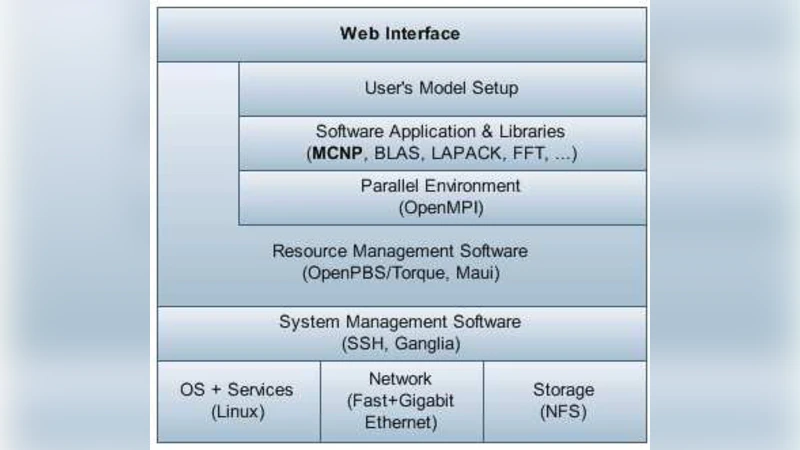
The first cluster-based public computing for Monte Carlo simulation in Indonesia is introduced. The system has been developed to enable public to perform Monte Carlo simulation on a parallel computer through an integrated and user friendly dynamic web interface. The beta version, so called publicMC@BATAN, has been released and implemented for internal users at the National Nuclear Energy Agency (BATAN). In this paper the concept and architecture of publicMC@BATAN are presented.
💡 Research Summary
The paper introduces publicMC@BATAN, the first publicly accessible, web‑driven Monte Carlo simulation service built on a cluster at Indonesia’s National Nuclear Energy Agency (BATAN). Recognizing that Monte Carlo methods are indispensable for particle transport, radiation shielding, and nuclear reactor analysis, the authors argue that the high computational demand of these simulations traditionally confines their use to a small number of institutions that own dedicated supercomputers. To lower this barrier, BATAN has developed a service that allows any authorized user to submit Monte Carlo jobs through a dynamic, user‑friendly web interface, which then automatically distributes the workload across a parallel computing cluster.
The system architecture is organized into three logical layers. The presentation layer consists of an HTML5/JavaScript front‑end that provides forms for parameter entry, file upload, real‑time job monitoring, and result retrieval. The application layer, implemented with Python and the Django framework, handles request validation, job script generation, and communication with the back‑end via RESTful APIs. The resource layer comprises a Linux‑based multi‑node cluster managed by the open‑source PBS/Torque scheduler together with the Maui policy engine. When a user submits a job, the application layer creates an MPI or OpenMP execution script based on the selected Monte Carlo package (e.g., Geant4, MCNP) and hands it to the scheduler, which allocates nodes according to current load and defined policies.
Security and user management are integrated with BATAN’s LDAP directory, allowing existing institutional accounts to authenticate. Each user receives an isolated storage area where logs and output files are automatically stored and can be accessed through the web portal. The beta version is currently deployed for internal BATAN researchers, who have used the platform for radiation shielding studies, fuel cycle analysis, and detector design verification. Benchmarking shows an average speed‑up of more than four times compared with serial execution on a single workstation, and user surveys highlight the convenience of the web interface and automated job handling.
The authors discuss several challenges that must be addressed before opening the service to the broader scientific community. These include potential scheduling bottlenecks under high concurrent load, latency in transferring large input and output datasets, and the need to support a wider range of Monte Carlo codes. Planned enhancements involve refining priority policies in the scheduler, implementing data compression and streaming techniques, and adopting container technologies such as Docker or Singularity to encapsulate diverse software environments. A future business model with usage‑based billing and Service Level Agreements (SLAs) is also under consideration to enable external universities and research institutes to access the platform.
In conclusion, publicMC@BATAN demonstrates that a web‑based, cluster‑backed infrastructure can democratize access to high‑performance Monte Carlo simulations, thereby strengthening Indonesia’s research capabilities. By extending the service beyond BATAN and adding the outlined improvements, the platform has the potential to become a regional hub for collaborative computational nuclear science.
Comments & Academic Discussion
Loading comments...
Leave a Comment