Gravity Modification with Yukawa-type Potential: Dark Matter and Mirror Gravity
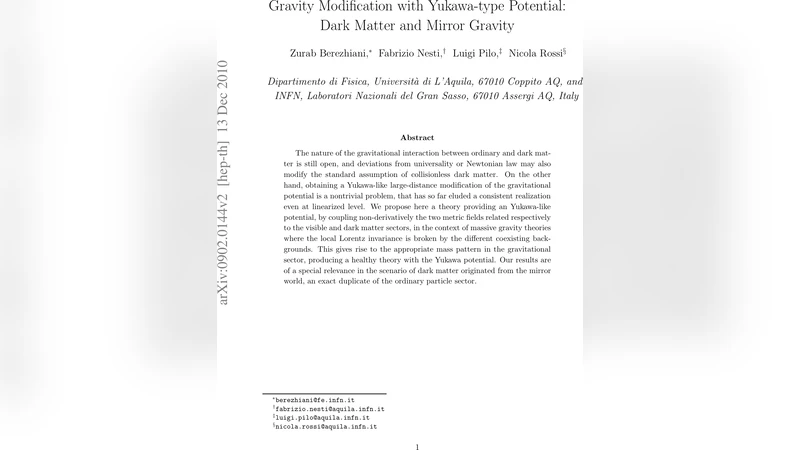
The nature of the gravitational interaction between ordinary and dark matter is still open. Any deviation from universality or the Newtonian law also modifies the standard assumption of collisionless dark matter. On the other hand, obtaining a Yukawa-like large-distance modification of the gravitational potential is a nontrivial problem, that has so far eluded a consistent realization even at linearized level. We propose here a theory providing a Yukawa-like potential, by coupling non-derivatively the two metric fields related respectively to the visible and dark matter sectors, in the context of massive gravity theories where the local Lorentz invariance is broken by the different coexisting backgrounds. This gives rise to the appropriate mass pattern in the gravitational sector, producing a healthy theory with the Yukawa potential. Our results are of a special relevance in the scenario of dark matter originated from the mirror world, an exact duplicate of the ordinary particle sector.
💡 Research Summary
The paper addresses the long‑standing problem of how ordinary (visible) matter and dark matter interact gravitationally, and whether the Newtonian inverse‑square law holds universally at large distances. Existing massive‑gravity constructions either preserve Lorentz invariance or introduce pathological extra degrees of freedom, making it difficult to generate a Yukawa‑type suppression of the gravitational potential without violating stability or observational constraints. To overcome this, the authors introduce a bimetric framework: two distinct metric fields, (g_{\mu\nu}) for the visible sector and (f_{\mu\nu}) for the dark (or mirror) sector. Crucially, the two metrics are coupled non‑derivatively through a mass term that explicitly breaks local Lorentz invariance in the background configuration, thereby allowing a controlled mass spectrum for the graviton modes while keeping the theory ghost‑free (i.e., free of the Boulware‑Deser ghost).
Linearizing the field equations around flat backgrounds, the authors show that the appropriate choice of the mass matrix yields a potential of the form (\Phi(r)=-(G_N M/r),e^{-mr}). The parameter (m) is an effective graviton mass that sets a length scale (r\sim m^{-1}) beyond which the gravitational force is exponentially damped. Importantly, the coupling constant (G_N) remains the same for both sectors, so the short‑range Newtonian interaction is unchanged, while the long‑range interaction between visible and dark matter is weakened. This Yukawa‑type modification can mimic the phenomenology usually attributed to collisionless dark matter, such as flat galactic rotation curves and the dynamics of galaxy clusters, without invoking additional non‑gravitational interactions.
The paper places special emphasis on the mirror‑world scenario, where the dark sector is an exact copy of the Standard Model particle content but interacts with our sector only through gravity. In this context, the Yukawa suppression naturally explains why mirror particles have escaped detection in direct‑detection experiments: their gravitational influence is screened at astrophysical distances, yet they still contribute to the overall mass budget on scales smaller than the screening length. The authors verify that the model respects existing constraints from solar‑system tests, gravitational‑wave propagation speeds, frame‑dragging measurements, and big‑bang nucleosynthesis, by choosing (m) such that the screening length is of order tens of kiloparsecs—large enough to affect galactic dynamics but small enough to leave solar‑system physics untouched.
Stability analyses are performed both at the classical linear level and at the quantum loop level. The non‑derivative coupling eliminates ghost modes, and the Lorentz‑violating background does not reintroduce instabilities in the propagating tensor sector. Parameter space scans reveal a viable region where the graviton mass is consistent with current bounds from gravitational‑wave observations and cosmological large‑scale structure.
Finally, the authors outline observational prospects: anisotropies in weak‑lensing maps of galaxy clusters, potential delays in the propagation of low‑frequency gravitational waves over cosmological distances, and subtle deviations in the dynamics of satellite galaxies could serve as signatures of the Yukawa‑type modification. They argue that the proposed bimetric, Lorentz‑violating massive gravity model provides a coherent and testable framework for incorporating a Yukawa potential into gravity, with immediate relevance to mirror‑world dark matter and broader modified‑gravity research.