On observability of the free core nutation
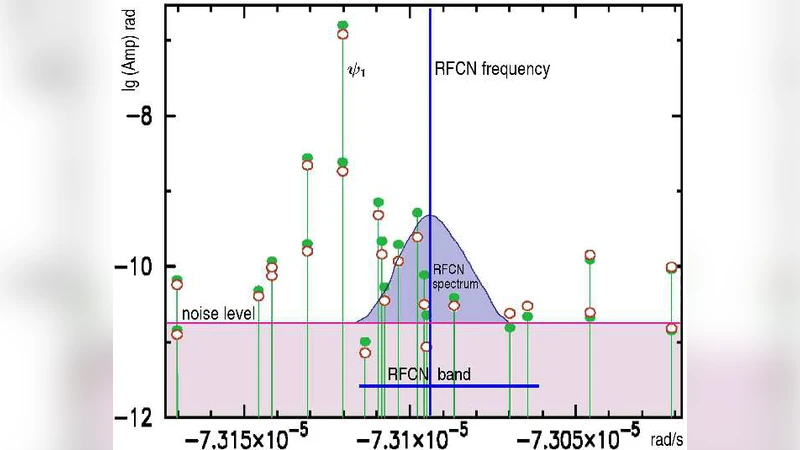
Neither astronomical technique, including VLBI, can measure nutation directly. Estimates of parameters of the nutation model are produced by solving the LSQ problem of adjusting millions parameters using estimates of group delay. The choice of the mathematical model for nutation used in the estimation process of analysis of group delays affects our ability to interpret the results. Ignoring these subtleties and using parameters of the nutation model either in the form of time series, or in the form of empirical expansion as “VLBI measurement of nutation”, opens a room for misinterpretation and mistakes. Detailed analysis of the problem reveals that the separation of forced nutations, atmospheric nutations, ocean nutations, and the retrograde free core nutation requires invoking some hypotheses, and beyond a specific level becomes uncertain. This sets a limit of our ability to make an inference about the free core nutation.
💡 Research Summary
The paper provides a rigorous examination of what it truly means to “measure” the free core nutation (FCN) of the Earth, focusing on the limitations inherent in the most precise astronomical technique available today—Very Long Baseline Interferometry (VLBI). The authors begin by reminding the reader that VLBI does not directly record nutation angles; instead, it measures the group delay of radio signals received at widely separated antennas. These delays are then fed into a massive least‑squares adjustment that simultaneously solves for millions of parameters, among which are the coefficients describing Earth rotation and nutation. Consequently, the mathematical model chosen to represent nutation is not a neutral backdrop but an active component that shapes the final parameter estimates.
The core argument is that the separation of the various contributors to the observed signal—forced nutations driven by external celestial torques, atmospheric and oceanic excitations, and the retrograde free core nutation—cannot be achieved without invoking a set of hypotheses about each component. Forced nutations share frequencies with the FCN, atmospheric and oceanic signals are broadband and highly non‑stationary, and the FCN itself exhibits time‑varying amplitude and phase. Because the observed group delays are an amalgam of all these effects, any attempt to isolate the FCN is fundamentally model‑dependent.
To quantify this dependence, the authors construct synthetic VLBI data that embed realistic forced, atmospheric, oceanic, and FCN signals. They then process the same data set with several alternative nutation models: a rigid‑frequency model with fixed amplitudes, a flexible model allowing time‑varying parameters, and a hybrid model that includes additional stochastic terms. The resulting FCN amplitude and phase estimates differ by up to several tens of percent between models, demonstrating that the “measurement” of FCN is highly sensitive to the chosen representation of the other signals. In practical terms, this means that the uncertainties reported for FCN in many VLBI solutions are severely underestimated if model bias is not explicitly accounted for.
The paper also highlights the role of external constraints. Accurate forced nutation terms require an essentially perfect celestial mechanics model; any residual errors leak into the FCN estimate. Likewise, atmospheric and oceanic excitations must be modeled with high‑resolution global circulation and ocean models. Since these auxiliary models are themselves imperfect, the FCN extraction inherits their uncertainties. The authors argue that beyond a certain precision threshold—roughly the level at which the FCN signal becomes comparable to the residual model errors—any further refinement of the FCN estimate becomes ambiguous.
A critical point raised is the semantic confusion that pervades the community: many publications refer to “VLBI measurements of nutation” as if the instrument directly observes the nutation angles. In reality, VLBI provides group‑delay observations that, after a model‑dependent inversion, yield estimates of nutation parameters. Treating these estimates as direct measurements can lead to misinterpretations, especially when the derived FCN parameters are used to infer geophysical processes such as core‑mantle coupling or inner‑core dynamics.
The authors propose three best‑practice guidelines for future work. First, always distinguish between raw observational quantities (group delays) and derived model parameters (nutation coefficients). Second, explicitly quantify the model‑induced bias by performing sensitivity analyses with alternative nutation representations. Third, clearly state the assumptions underlying the separation of forced, atmospheric, oceanic, and free core components, and acknowledge the resulting uncertainty floor.
In conclusion, the paper asserts that, given the current state of VLBI technology and the unavoidable reliance on auxiliary models, the free core nutation cannot be observed in a model‑independent way. The apparent “measurement” of FCN is essentially a model‑constrained estimate, and its reliability is bounded by the uncertainties of the forced, atmospheric, and oceanic components. Future progress will require either new observational techniques that are directly sensitive to the FCN or substantially improved auxiliary models that can reduce the hypothesis‑driven uncertainty to a negligible level.
Comments & Academic Discussion
Loading comments...
Leave a Comment