Conditional coloring of some parameterized graphs
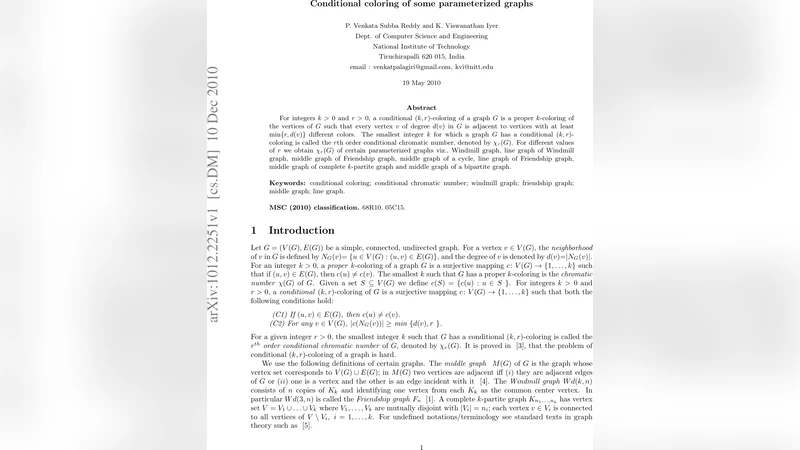
For integers k>0 and r>0, a conditional (k,r)-coloring of a graph G is a proper k-coloring of the vertices of G such that every vertex v of degree d(v) in G is adjacent to vertices with at least min{r,d(v)} different colors. The smallest integer k for which a graph G has a conditional (k,r)-coloring is called the rth order conditional chromatic number, denoted by $\chi_r(G)$. For different values of r we obtain $\chi_r(G)$ of certain parameterized graphs viz., Windmill graph, line graph of Windmill graph, middle graph of Friendship graph, middle graph of a cycle, line graph of Friendship graph, middle graph of complete k-partite graph and middle graph of a bipartite graph.
💡 Research Summary
**
The paper studies conditional (k, r)‑colorings, a variant of proper vertex colorings in which each vertex v of degree d(v) must see at least min{r, d(v)} different colors among its neighbors. The smallest integer k for which such a coloring exists is the r‑th order conditional chromatic number χ₍ᵣ₎(G). While the decision problem is known to be NP‑hard, the authors focus on a family of parameterized graphs and determine χ₍ᵣ₎(G) exactly for each.
Two auxiliary results are introduced. Lemma 1 shows that if a set S₍d≤r₎ of vertices of degree at most r satisfies a connectivity condition (any two vertices are either adjacent or share a common neighbor inside the set), then χ₍ᵣ₎(G) ≥ |S₍d≤r₎|. This provides a lower bound. Lemma 2 states that if a coloring c already satisfies condition (C2) (the neighbor‑color diversity requirement) and the graph satisfies an additional structural property (C3) – namely, for every edge uv there exists a vertex w of degree ≤ r that is adjacent to both u and v – then c automatically satisfies properness (C1) and thus is a conditional (k, r)‑coloring. This gives a constructive way to obtain an upper bound.
Using these lemmas, the paper proves seven propositions, each giving a closed‑form expression for χ₍ᵣ₎ of a specific graph class:
-
Windmill graph W₍d₎(k, n) – n copies of Kₖ sharing a common center. For 2 ≤ r ≤ k − 1, χ₍ᵣ₎ = k (the same as the ordinary chromatic number). For r ≥ k, χ₍ᵣ₎ = min{r, Δ}+1, where Δ = n(k − 1) is the maximum degree (the center vertex).
-
Line graph of the windmill L(W₍d₎(k, n)) – The authors compute the number of vertices, identify a large clique of size n(k − 1), and construct a V₍d≤r₎ set of size z = n(k − 1)+⌈k/2⌉. Lemma 1 yields χ₍Δ₎ ≥ z, while a carefully defined coloring (using modular arithmetic) satisfies (C2) and (C3), giving χ₍Δ₎ ≤ z. Hence χ₍Δ₎ = z.
-
Line graph of the friendship graph L(Fₙ) (where Fₙ = W₍d₎(3, n)). The maximum degree is Δ = 2n. If r < Δ, the conditional chromatic number equals the size of a maximum clique, 2n. If r = Δ, one extra color is needed, giving χ₍ᵣ₎ = 2n + 1.
-
Middle graph of a complete k‑partite graph M(K_{n₁,…,n_k}) – The middle graph contains both original vertices and edges. Let ℓ = ½∑_{i=1}^k n_i (n − n_i) be the number of edges. The authors show χ₍Δ₎ = k + ℓ by constructing a V₍d≤Δ₎ set consisting of all edge‑vertices together with one representative vertex from each part, then defining a coloring that separates edge‑vertices from part‑vertices.
-
Middle graph of a cycle M(Cₙ) – For r = 2 the conditional chromatic number is 3; for r = 3 it is 4. Explicit color assignments are given for even and odd n, demonstrating that the extra condition forces one or two additional colors beyond the ordinary chromatic number (which is 2 for cycles).
-
Middle graph of the friendship graph M(Fₙ) – Here Δ = 2n + 2. Three regimes are considered: (i) r ≤ 2n gives χ₍ᵣ₎ = 2n + 1 (the size of a maximum clique); (ii) r = 2n + 1 gives χ₍ᵣ₎ = 2n + 2; (iii) r = Δ gives χ₍ᵣ₎ = 2n + 4. The proofs combine Lemma 1 (using appropriate V₍d≤r₎ sets) with intricate colorings that allocate colors to the central vertex, edge‑vertices, and the two copies of K₃ per friendship triangle.
-
Middle graph of a complete bipartite graph M(K_{n₁,n₂}) (assume n₁ ≤ n₂). The conditional chromatic number is n₂ + 1 when r ≤ n₂, and n₂ + 2 when r = n₂ + 1. The authors again use the V₍d≤r₎ construction (all vertices of the larger part together with incident edge‑vertices) to obtain the lower bound, and a modular coloring scheme to achieve the upper bound.
Across all propositions, the methodology is uniform: identify a large V₍d≤r₎ set to obtain a lower bound via Lemma 1, then construct an explicit coloring that satisfies (C2) and the structural property (C3) of Lemma 2, thereby guaranteeing a proper conditional coloring and establishing the matching upper bound. The results illustrate how the additional “neighbor‑color diversity” requirement interacts with graph structure: high‑degree vertices (e.g., the windmill center) force extra colors once r reaches their degree, while in sparse graphs (cycles, bipartite graphs) only a small increase over the ordinary chromatic number is needed.
The paper contributes closed‑form formulas for χ₍ᵣ₎ on several well‑studied families, extending the understanding of conditional coloring beyond the few examples previously known. By systematically applying the two lemmas, the authors provide a template that can be adapted to other graph transformations (e.g., total graphs, subdivision graphs) and to more complex parameterizations. The work thus bridges a gap between the theoretical hardness of conditional coloring and concrete computable results for important graph classes.
Comments & Academic Discussion
Loading comments...
Leave a Comment