What the Cited and Citing Environments Reveal of "Advances in Atmospheric Sciences"?
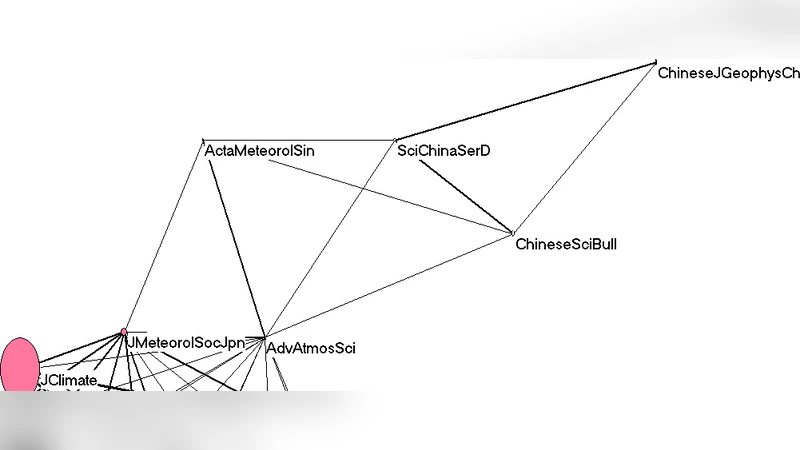
The networking ability of journals reflects their academic influence among peer journals. This paper analyzes the cited and citing environments of the journal–Advances in Atmospheric Sciences–using methods from social network analysis. The journal has been actively participating in the international journal environment, but one has a tendency to cite papers published in international journals. Advances in Atmospheric Sciences is intensely interrelated with international peer journals in terms of similar citing pattern. However, there is still room for an increase in its academic visibility given the comparatively smaller reception in terms of cited references.
💡 Research Summary
The paper applies social network analysis (SNA) to evaluate the scholarly positioning of the journal “Advances in Atmospheric Sciences” (Adv. Atmos. Sci.). Following Leydesdorff’s (2007) framework, the authors address four methodological challenges: selecting a seed journal, defining a similarity measure, setting a threshold, and choosing a clustering algorithm. Using Adv. Atmos. Sci. as the seed, they extract all journals that cite it (cited environment) and all journals it cites (citing environment) from the 2009 Journal Citation Reports. Similarity between journal pairs is quantified with the cosine of their citation vectors; values below 0.2 are suppressed to focus on strong relationships, and only journals contributing at least 1 % of the total citations are retained, reducing noise.
In the cited environment, the map reveals five dominant international journals—Journal of Geophysical Research, Geophysical Research Letters, Journal of Climate, Atmospheric Environment, and Monthly Weather Review—occupying the core. These journals have the highest total citation counts and C/N ratios, indicating that they are the primary sources of citations to Adv. Atmos. Sci. Chinese journals (Acta Meteorologica Sinica, Chinese Journal of Geophysics‑CH, Science China Series D, etc.) appear on the periphery with low impact, but Adv. Atmos. Sci. and Acta Meteorl. Sin. act as bridges linking the Chinese cluster to the international core. This suggests a nascent “Chinese aggregation” within geosciences, yet its international influence remains modest.
The citing environment shows a contrasting picture. Authors publishing in Adv. Atmos. Sci. heavily reference the same six international journals identified above, plus Journal of Atmospheric Sciences and Climate Dynamics, indicating strong reliance on leading global literature. A principal component analysis (PCA) of the citation matrix yields three distinct factor groups. Factor 1 clusters Climate Dynamics, Journal of Climate, International Journal of Climatology, Boundary‑Layer Meteorology, and Adv. Atmos. Sci., reflecting a shared focus on atmospheric and climate research. Factor 2 groups Quarterly Journal of the Royal Meteorological Society, Journal of Atmospheric Sciences, Monthly Weather Review, Journal of the Meteorological Society of Japan, and Applied Meteorology and Climatology, suggesting a secondary, more specialized citation pattern. Factor 3 comprises Journal of Geophysical Research, Geophysical Research Letters, Atmospheric Environment, and Science, indicating a broader geoscience orientation.
Overall, the analysis confirms that Adv. Atmos. Sci. is well integrated into the international citation network as a citing journal, but its visibility as a cited source lags behind. While it outperforms many domestic journals in total citations, the journal still receives relatively few citations from the international community. The authors conclude that to enhance its global standing, Adv. Atmos. Sci. should increase the proportion of high‑impact international papers it publishes, foster more international collaborations, and perhaps adopt editorial policies that attract citations from the broader geoscience community. This case also illustrates a common pattern among Chinese SCI journals: strong outward citation behavior but limited inbound citation reception, highlighting the need for strategic efforts to convert citation activity into reciprocal scholarly impact.
Comments & Academic Discussion
Loading comments...
Leave a Comment