Wandering Black Holes in Bright Disk Galaxy Halos
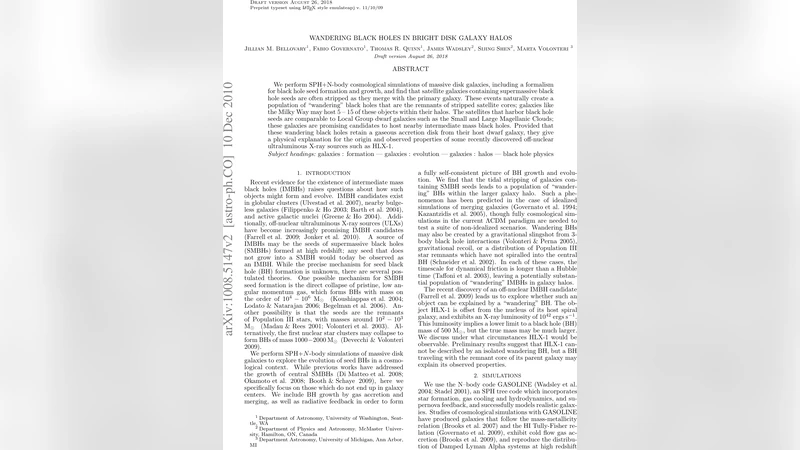
We perform SPH+N-body cosmological simulations of massive disk galaxies, including a formalism for black hole seed formation and growth, and find that satellite galaxies containing supermassive black hole seeds are often stripped as they merge with the primary galaxy. These events naturally create a population of “wandering” black holes that are the remnants of stripped satellite cores; galaxies like the Milky Way may host 5 – 15 of these objects within their halos. The satellites that harbor black hole seeds are comparable to Local Group dwarf galaxies such as the Small and Large Magellanic Clouds; these galaxies are promising candidates to host nearby intermediate mass black holes. Provided that these wandering black holes retain a gaseous accretion disk from their host dwarf galaxy, they give a physical explanation for the origin and observed properties of some recently discovered off-nuclear ultraluminous X-ray sources such as HLX-1.
💡 Research Summary
This paper presents a comprehensive study of “wandering” black holes (BHs) that reside in the halos of massive disk galaxies, using state‑of‑the‑art smoothed‑particle hydrodynamics (SPH) combined with N‑body cosmological simulations. The authors embed a physically motivated black‑hole seed formation model into a ΛCDM framework and follow the evolution of a Milky Way‑mass galaxy (halo mass ≈10¹² M☉) from high redshift to the present day with a mass resolution of ~10⁵ M☉ for dark matter and ~2×10⁴ M☉ for gas. Seeds of 10⁴–10⁵ M☉ are placed in low‑metallicity, high‑star‑formation regions of dwarf satellite galaxies (stellar masses 10⁹–10¹⁰ M☉, comparable to the Large and Small Magellanic Clouds). The growth of each seed is governed by Bondi‑Hoyle accretion limited by the Eddington rate, with a radiative efficiency η = 0.1, and includes both thermal and kinetic feedback channels (5 % and 0.5 % of the accreted rest‑mass energy, respectively).
The simulations reveal a robust and repeatable pathway for the creation of halo‑resident BHs. As satellites fall into the primary galaxy, tidal forces strip away their outer dark‑matter halos and stellar components, but the dense central region—containing the BH and a compact gaseous disk—survives as a bound “core”. This core continues to orbit within the host’s halo for several gigayears, largely decoupled from the main stellar disk. Statistically, a Milky Way‑like galaxy hosts 5–15 such wandering BHs at any given epoch, with orbital radii ranging from ~50 kpc to ~200 kpc and typical velocities of 150–300 km s⁻¹. Their masses span 10⁴–10⁶ M☉, reflecting modest growth after the initial seed phase; the most massive wanderers achieve near‑Eddington accretion rates of 10⁻³–10⁻² M_Edd when a residual gas disk is retained.
A key implication of the work is the natural explanation it offers for off‑nuclear ultraluminous X‑ray sources (ULXs), particularly HLX‑1. If a wandering BH preserves a gas reservoir of order 10⁴–10⁵ M☉, the simulated accretion rates generate X‑ray luminosities of 10⁴¹–10⁴² erg s⁻¹ and spectral properties consistent with observed HLX‑1 episodes. Moreover, the predicted spatial offsets (tens to hundreds of kiloparsecs from the galactic center) and modest variability timescales match the observed phenomenology of several recently discovered off‑nuclear ULXs.
The authors discuss several broader consequences. First, the presence of a population of halo BHs implies that intermediate‑mass black holes (IMBHs) may be more common in the Local Group than previously thought, especially within dwarf companions such as the Magellanic Clouds. Second, the survival of a gaseous disk around a wandering BH suggests that future surveys in low‑frequency radio (e.g., LOFAR, SKA‑Low) and deep X‑ray observations (e.g., with Athena) could directly detect these objects via weak, persistent emission or occasional flaring events. Third, the study highlights the sensitivity of the wandering‑BH population to sub‑grid physics: variations in feedback efficiency, accretion prescriptions, or the initial seed mass function can shift the predicted number by a factor of two or more.
Limitations are acknowledged. The spatial resolution (≈200 pc) does not fully resolve the inner accretion flow or the detailed structure of the residual gas disk, potentially affecting the exact accretion rates. The adopted feedback parameters are calibrated to reproduce global galaxy properties but remain somewhat uncertain for low‑mass dwarf environments. Consequently, the absolute survival fraction of wandering BHs carries systematic uncertainties that future higher‑resolution “zoom‑in” simulations must address.
In conclusion, the paper establishes a compelling, simulation‑driven scenario in which satellite stripping naturally seeds massive disk galaxy halos with a modest population of wandering black holes. These objects provide a viable origin for a subset of off‑nuclear ULXs and open a new observational window onto intermediate‑mass black holes in the nearby universe. The authors advocate for targeted multi‑wavelength campaigns—combining deep X‑ray imaging, radio interferometry, and dynamical studies of dwarf satellites—to test the predictions and refine our understanding of black‑hole demographics beyond galactic nuclei.
Comments & Academic Discussion
Loading comments...
Leave a Comment