Noise-enhanced trapping in chaotic scattering
We show that noise enhances the trapping of trajectories in scattering systems. In fully chaotic systems, the decay rate can decrease with increasing noise due to a generic mismatch between the noiseless escape rate and the value predicted by the Liouville measure of the exit set. In Hamiltonian systems with mixed phase space we show that noise leads to a slower algebraic decay due to trajectories performing a random walk inside Kolmogorov-Arnold-Moser islands. We argue that these noise-enhanced trapping mechanisms exist in most scattering systems and are likely to be dominant for small noise intensities, which is confirmed through a detailed investigation in the Henon map. Our results can be tested in fluid experiments, affect the fractal Weyl’s law of quantum systems, and modify the estimations of chemical reaction rates based on phase-space transition state theory.
💡 Research Summary
**
The paper investigates how weak stochastic perturbations (noise) can paradoxically increase the trapping time of trajectories in chaotic scattering systems. Two distinct mechanisms are identified, each operating in a different class of dynamical systems.
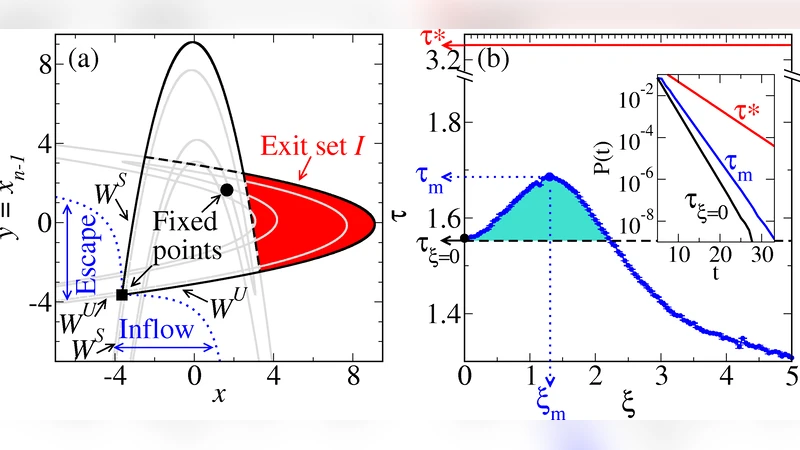
In fully chaotic (hyperbolic) systems the authors first consider a simple baker map with a vertical leak. In the deterministic limit (noise amplitude ξ = 0) the survival probability decays exponentially with a characteristic lifetime τ₀ that can be computed from periodic orbit theory (τ₀≈6.06 for the chosen leak). When additive uniform noise is added, trajectories are randomly displaced at each iteration. For very large noise the distribution of surviving points becomes uniform over phase space, and the escape rate is governed solely by the Liouville measure μ(I) of the leak, giving a lifetime τ*≈1/μ(I) (≈9.49 in the example). Because τ* > τ₀, the average lifetime first increases as ξ grows from zero, reaches a maximum τₘ at a finite ξₘ, and then decreases for still larger ξ (especially under open boundary conditions). The key condition for this “noise‑enhanced trapping” is τ* > τ₀, i.e. the noisy invariant density is more uniform than the deterministic one inside the leak, so noise tends to push trajectories out of the leak rather than into it. The effect persists for a wide range of leak positions and for both periodic and open boundary conditions, although the quantitative details differ.
The second mechanism concerns Hamiltonian systems with mixed phase space, where regular KAM islands coexist with a chaotic sea. In the deterministic case the survival probability exhibits an algebraic tail P(t) ∼ t⁻ᵅ with α > 1, reflecting stickiness of trajectories near the islands. Adding noise can allow trajectories to cross the invariant manifolds that normally shield the islands, thereby entering the island interior. Once inside, the motion is effectively a one‑dimensional random walk in the direction transverse to the island’s invariant circles. The authors model this by a symmetric random walk with a reflecting boundary at the island centre (r = 0) and an absorbing boundary at r = r* ∼ ℓ/ξ, where ℓ is the island width. In the idealized infinite‑island limit the survival probability decays as P(t) ∼ t⁻¹ᐟ² (α = 0.5), which is slower than any deterministic algebraic decay, thus enhancing trapping. For a finite island the walk eventually reaches the absorbing boundary, producing a crossover at a time tₑ ∼ ξ⁻² after an initial crossover at t_b ∼ ξ⁻ᵝ (β≈1). Between t_b and t_e the decay follows the slower t⁻¹ᐟ² law, so for sufficiently small ξ the interval of enhanced trapping can be arbitrarily long.
Both mechanisms are demonstrated numerically using the Hénon map x_{n+1}=k−x_n²−x_{n-1}+ξδ_n. For k = 6 the map is fully chaotic; the computed τ₀≈1.557 and τ*≈3.239 satisfy τ* > τ₀, and simulations show a non‑monotonic τ(ξ) with a clear maximum τₘ > τ₀ at ξ≈0.03, confirming the first mechanism. For k = 2 the map exhibits a large KAM island. Simulations with ξ ranging from 10⁻⁴ to 10⁻² reveal the predicted crossover times t_b∝ξ⁻⁰·⁹² and t_e∝ξ⁻², and the survival probability follows the t⁻⁰·⁵ algebraic decay between them, in excellent agreement with the random‑walk model.
The authors discuss several implications. In transition‑state theory (TST) for unimolecular reactions, the lifetime τ corresponds to the reactant lifetime distribution; noise‑enhanced trapping therefore implies a reduction of the reaction rate. In fluid‑dynamics experiments with passive tracers, varying tracer diffusivity (∝ ξ²) should modify the escape statistics in precisely the way predicted. In quantum chaos, the lifetime of resonances is linked to the fractal dimension of the classical repeller; an increase of τ suggests a change in the fractal Weyl law governing the density of quantum resonances.
Overall, the paper overturns the common intuition that noise always accelerates escape in chaotic systems. Instead, it shows that weak noise can systematically increase the average trapping time through two robust, generic mechanisms: (i) uniformization of the invariant density in fully chaotic maps, and (ii) noise‑induced infiltration of regular islands leading to a slow random‑walk‑type decay. These findings are expected to be relevant across a broad spectrum of physical, chemical, and quantum scattering problems where small stochastic perturbations are unavoidable.
Comments & Academic Discussion
Loading comments...
Leave a Comment