We study dynamics of two coupled periodically driven oscillators. Important example of such a system is a dynamic vibration absorber which consists of a small mass attached to the primary vibrating system of a large mass. Periodic solutions of the approximate effective equation are determined within the Krylov-Bogoliubov-Mitropolsky approach to get the amplitude profiles $AOmega) $. Dependence of the amplitude $A$ of nonlinear resonances on the frequency $ \Omega $ is much more complicated than in the case of one Duffing oscillator and hence new nonlinear phenomena are possible. In the present paper we study metamorphoses of the function $A(\Omega) $ induced by changes of the control parameters.
Deep Dive into Coupled nonlinear oscillators: metamorphoses of amplitude profiles. The case of the approximate effective equation.
We study dynamics of two coupled periodically driven oscillators. Important example of such a system is a dynamic vibration absorber which consists of a small mass attached to the primary vibrating system of a large mass. Periodic solutions of the approximate effective equation are determined within the Krylov-Bogoliubov-Mitropolsky approach to get the amplitude profiles $AOmega) $. Dependence of the amplitude $A$ of nonlinear resonances on the frequency $ \Omega $ is much more complicated than in the case of one Duffing oscillator and hence new nonlinear phenomena are possible. In the present paper we study metamorphoses of the function $A(\Omega) $ induced by changes of the control parameters.
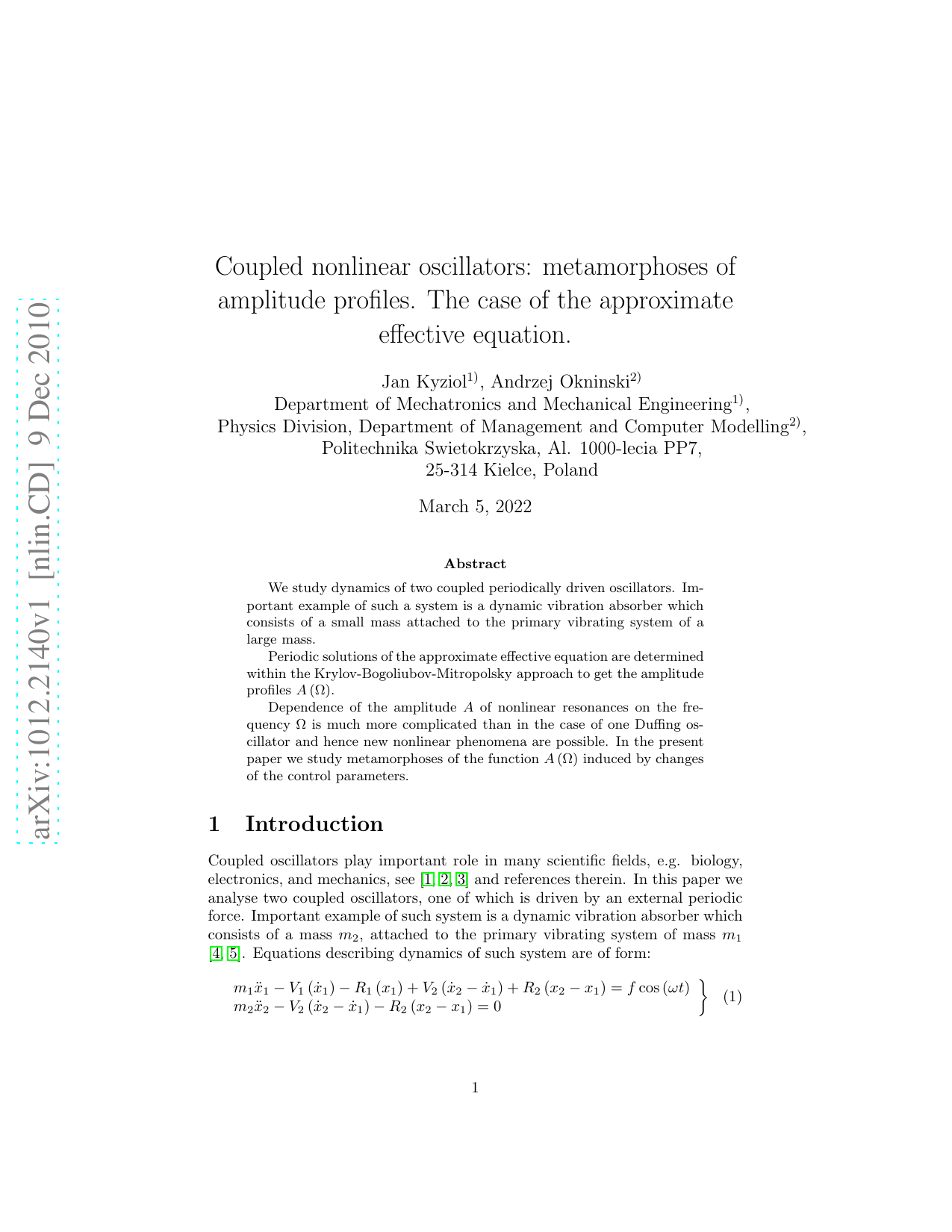
Coupled oscillators play important role in many scientific fields, e.g. biology, electronics, and mechanics, see [1,2,3] and references therein. In this paper we analyse two coupled oscillators, one of which is driven by an external periodic force. Important example of such system is a dynamic vibration absorber which consists of a mass m 2 , attached to the primary vibrating system of mass m 1 [4,5]. Equations describing dynamics of such system are of form:
where V 1 , R 1 and V 2 , R 2 represent (nonlinear) force of internal friction and (nonlinear) elastic restoring force for mass m 1 and mass m 2 , respectively. In the present paper we do not assume that the ratio m 2 /m 1 is small.
In the present paper we shall consider a simplified model:
Dynamics of coupled periodically driven oscillators is very complicated [1,2,3]. We simplified the set equations ( 1), (2) by reducing it to the problem of motion of two independent oscillators. More exactly, we derived the exact fourth-order nonlinear equation for internal motion as well as approximate second-order effective equation in [6]. Moreover, applying the Krylov-Bogoliubov-Mitropolsky method to these equations we have computed the corresponding nonlinear resonances (cf. [6] for the case of the effective equation). Dependence of the amplitude A of nonlinear resonances on the frequency ω is much more complicated than in the case of Duffing oscillator and hence new nonlinear phenomena are possible. In the present paper we study metamorphoses of the function A (ω) induced by changes of the control parameters.
The paper is organized as follows. In the next Section derivation of the exact 4th-order equation for the internal motion and approximate 2nd-order effective equations in non-dimensional form are presented. In Section 3 metamorphoses of amplitude profiles determined within the Krylov-Bogoliubov-Mitropolsky approach for the approximate 2nd-order effective equation are studied and the case of the standard Duffing equation is presented as well. More exactly, theory of algebraic curves is used to compute singular points on effective equation amplitude profiles -metamorphoses of amplitude profiles occur in neighbourhoods of such points. In Section 4 examples of analytical and numerical computations are presented for the effective equation. Our results are summarized and perspectives of further studies are described in the last Section.
In new variables, x ≡ x 1 , y ≡ x 2 -x 1 , equations ( 1), (2) can be written as:
where
Adding equations (3) we obtain important relation between variables x and y:
where M = m + m e .
We can eliminate variable x in (3) to obtain the following exact equation for relative motion:
where F = m e ω 2 f , µ = mm e /M and λ = m e /M is a nondimensional parameter. Equations ( 5), ( 4) are equivalent to the initial equations ( 1), (2) [6].
In the present work we assume:
R e (y) = α e yγ e y 3 , V e ( ẏ) = -ν e ẏ.
We thus get:
where:
we get the exact equation for motion of mass m e :
where nondimensional constants are given by:
We shall consider hierarchy of approximate equations arising from (10). For small κ, H, a we can reject the second term on the left in (10) to obtain the approximate equation:
which can be integrated partly to yield the effective equation:
where transient states has been omitted [6]. And finally, for H = 0, a = 0 we get the Duffing equation:
3 Metamorphoses of the amplitude profiles
We applied the Krylov-Bogoliubov-Mitropolsky (KBM) perturbation approach [7,8] to the effective equation ( 13) obtaining for the 1 : 1 resonance the following amplitude profile [6]:
Now, for H = 0, a = 0, we obtain the amplitude profile for the Duffing equation ( 14):
It is well known that dependence of the function A D , cf. ( 16), on control parameters γ, h is rather simple. On the other hand, dependence of the amplitude profile A ef f (Ω) on control parameters γ, h, a, H is more complicated and thus A ef f (Ω) can describe new nonlinear phenomena. In the next Section we shall study possible metamorphoses of A D , A ef f induced by changes of control parameters, the more complicated case of the 4th-order exact equation ( 10) will be treated elsewhere.
Equations ( 16), (15) define the corresponding amplitude profiles implicitly. Such amplitude profiles can be classified as planar algebraic curves. Firstly, we shall collect useful theorems on implicit functions which will be used below.
Let us write equations (15), (16) as L e (Y e , X) = 0 and L D (Y D , X) = 0, respectively, where X ≡ Ω 2 , Y ≡ A 2 :
It follows from general theory of implicit functions [11,12] that conditions for critical points of Y (X) read:
Moreover, critical points of the inverse function X (Y ) are given by:
It may happen that in some points (X 0 , Y 0 ) we have:
Such points are referred to as singular points of algebraic curve L (Y, X) = 0 because they are in some sense exceptional.
Singular points of the algebraic curve defined by
…(Full text truncated)…
This content is AI-processed based on ArXiv data.