semanticSBML 2.0 - A Collection of Online Services for SBML Models
📝 Original Info
- Title: semanticSBML 2.0 - A Collection of Online Services for SBML Models
- ArXiv ID: 1012.1664
- Date: 2010-12-09
- Authors: Researchers from original ArXiv paper
📝 Abstract
semanticSBML 2.0 is an online collection of services for the work with biochemical network models in SBML format.💡 Deep Analysis
Deep Dive into semanticSBML 2.0 - A Collection of Online Services for SBML Models.semanticSBML 2.0 is an online collection of services for the work with biochemical network models in SBML format.
📄 Full Content
semanticSBML 2.0 is an online collection of services for the work with biochemical network models in SBML format. After uploading one or more SBML models, the following features are available:
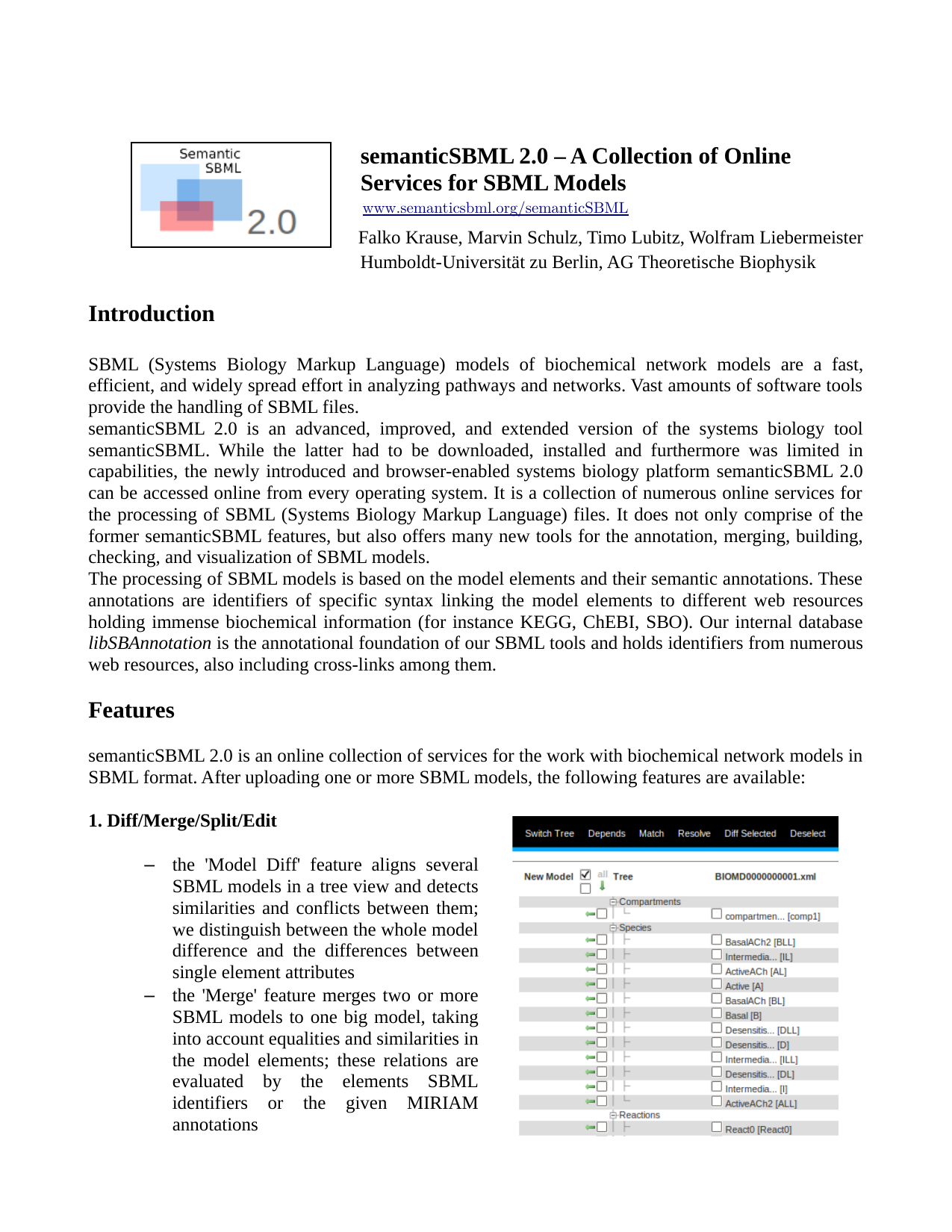
- Diff/Merge/Split/Edit the ‘Model Diff’ feature aligns several SBML models in a tree view and detects similarities and conflicts between them; we distinguish between the whole model difference and the differences between single element attributes the ‘Merge’ feature merges two or more SBML models to one big model, taking into account equalities and similarities in the model elements; these relations are evaluated by the elements SBML identifiers or the given MIRIAM annotations -‘Edit’ provides the ability to edit the annotations of SBML models the ‘Split’ feature is able to split SBML models into smaller submodels; it is crucial to keep the mutual dependencies of the model elements in mind to construct a valid submodel
Generates a graphical view on the network of SBML models using GraphViz. Furthermore, using the ‘SBML Wobble’ feature, a flexible network graphic is created. An alternative to this visualization technique is ‘SBML Browse’, a feature displaying the SBML model practically in the internet browser itself.
Using the feature ‘Shorthand SBML’, the user can create an own SBML model. The shorthand notation is much easier to read, write, and use than the actual SBML notation, and can be translated to an SBML model using a python based tool.
On our Web site we are providing an online editor for the use of shorthand SBML.
Many features of semanticSBML 2.0 can be accessed by a RESTful interface (Representational State Transfer), which allows the user to integrate its features in own software applications or Web sites.
The terms of the Systems Biology Ontology (SBO) can be automatically assigned to a models kinetic rate laws and the local parameters representing kinetic constants by just one click.
For populating an SBML model with modular rate laws, it is crucial to be provided with large sets of kinetic data to describe the rate laws. Usually, it is tedious to collect these data and often they are simply not available. ‘Parameter balancing’ is a tool complementing incomplete kinetic data sets by performing parameter estimates within a Bayesian framework. The produced kinetic data set is thermodynamically consistent by construction. After parameter balancing, the kinetic rate laws including the balanced kinetic data set can be inserted into the SBML model.
The uploaded models can be ranked and clustered by their annotation similarities and arranged in a graph view. The annotations of the SBML model elements can be removed, added, or altered by using our annotation tool ‘Annotate your Model’ (AYM).
The ’libSBAnnotation’ is an internal database of biological entities and relations on which the features of semanticSBML 2.0 are based. By browsing the libSBAnnotation ontology, the user is able to discover synonyms, cross-references, and chemical relations for the elements of the uploaded SBML models. The search results are visualized in form of an editable tree view, linking to the source databases.
📸 Image Gallery