IceCube expectations for two high-energy neutrino production models at active galactic nuclei
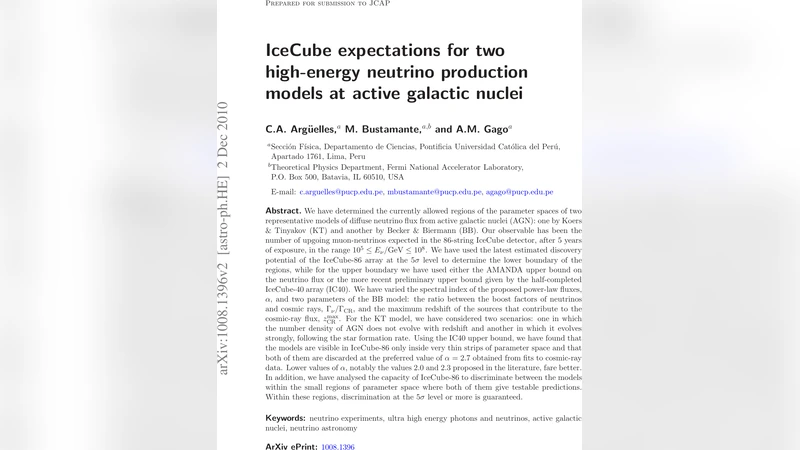
We have determined the currently allowed regions of the parameter spaces of two representative models of diffuse neutrino flux from active galactic nuclei (AGN): one by Koers & Tinyakov (KT) and another by Becker & Biermann (BB). Our observable has been the number of upgoing muon-neutrinos expected in the 86-string IceCube detector, after 5 years of exposure, in the range 10^5 < E/GeV < 10^8. We have used the latest estimated discovery potential of the IceCube-86 array at the 5-sigma level to determine the lower boundary of the regions, while for the upper boundary we have used either the AMANDA upper bound on the neutrino flux or the more recent preliminary upper bound given by the half-completed IceCube-40 array (IC40). We have varied the spectral index of the proposed power-law fluxes, alpha, and two parameters of the BB model: the ratio between the boost factors of neutrinos and cosmic rays, Gamma_nu/Gamma_{CR}, and the maximum redshift of the sources that contribute to the cosmic-ray flux, zCRmax. For the KT model, we have considered two scenarios: one in which the number density of AGN does not evolve with redshift and another in which it evolves strongly, following the star formation rate. Using the IC40 upper bound, we have found that the models are visible in IceCube-86 only inside very thin strips of parameter space and that both of them are discarded at the preferred value of alpha = 2.7 obtained from fits to cosmic-ray data. Lower values of alpha, notably the values 2.0 and 2.3 proposed in the literature, fare better. In addition, we have analysed the capacity of IceCube-86 to discriminate between the models within the small regions of parameter space where both of them give testable predictions. Within these regions, discrimination at the 5-sigma level or more is guaranteed.
💡 Research Summary
The paper conducts a systematic feasibility study of two benchmark diffuse high‑energy neutrino flux models from active galactic nuclei (AGN): the Koers & Tinyakov (KT) model and the Becker & Biermann (BB) model. The authors adopt the number of up‑going muon neutrinos that would be recorded by the completed 86‑string IceCube detector (IceCube‑86) after five years of exposure as the observable. The energy window considered is 10⁵ GeV < E < 10⁸ GeV, a range where IceCube’s effective area for up‑going muons is large and atmospheric backgrounds are strongly suppressed.
For the lower bound of the allowed parameter space the authors use IceCube‑86’s published 5‑σ discovery potential, i.e., the smallest flux that would yield a statistically significant detection. For the upper bound they consider two existing experimental limits: the historic AMANDA upper bound on the diffuse neutrino flux and the more recent preliminary upper limit derived from the half‑completed IceCube‑40 (IC40) configuration. By requiring that a model’s predicted event rate lies between these two limits, they delineate the region of model parameters that is both not already excluded and still potentially observable.
Both models assume a power‑law neutrino spectrum, ϕν(E) ∝ E⁻ᵅ, and the authors scan the spectral index α over a range motivated by cosmic‑ray observations (α = 2.0, 2.3, 2.7). In the BB model two additional free parameters are introduced: the ratio of the boost factors of neutrinos and cosmic rays, Γν/ΓCR, and the maximum redshift of sources that contribute to the observed cosmic‑ray flux, zCRmax. For the KT model two evolutionary scenarios are examined: (i) a non‑evolving AGN number density, and (ii) a strong evolution that follows the star‑formation rate (SFR).
The main findings are as follows. When the IC40 upper bound is imposed, the allowed regions in the multi‑dimensional parameter space shrink to very thin strips. At the preferred spectral index α ≈ 2.7, which best fits the observed ultra‑high‑energy cosmic‑ray spectrum, both the KT and BB models fall below IceCube‑86’s discovery potential and are therefore effectively ruled out. Flatter spectra (α = 2.0 or 2.3), which are often invoked in theoretical works to enhance the neutrino yield, produce larger event rates and can remain within the thin allowed strips. In the BB framework, only combinations with a relatively large boost‑factor ratio (Γν/ΓCR > 1) and moderate source redshifts (zCRmax ≈ 0.5–1.0) generate enough events to be detectable.
A further important result concerns model discrimination. Within the narrow overlapping region where both models predict an observable flux, the predicted numbers of up‑going muon events differ by an amount that exceeds the statistical fluctuations expected for a five‑year IceCube‑86 exposure. The authors quantify this by calculating the significance of the difference and find that a 5‑σ (or greater) discrimination is guaranteed throughout the overlapping region. Consequently, if IceCube‑86 observes a flux consistent with either model, the detector will be able to identify which of the two theoretical constructions more accurately describes the AGN neutrino production mechanism.
In summary, the paper demonstrates that current IceCube‑40 limits already place stringent constraints on diffuse AGN neutrino models, allowing only very specific combinations of spectral index, source evolution, and boost‑factor ratios to survive. The forthcoming full‑scale IceCube‑86 detector will not only test these surviving parameter sets but will also possess the statistical power to distinguish between the KT and BB scenarios at the 5‑σ level, provided the true flux lies within the narrow allowed region. These results sharpen the expectations for AGN‑origin neutrinos and guide future observational strategies aimed at uncovering the connection between high‑energy cosmic rays and their neutrino counterparts.