Border Algorithms for Computing Hasse Diagrams of Arbitrary Lattices
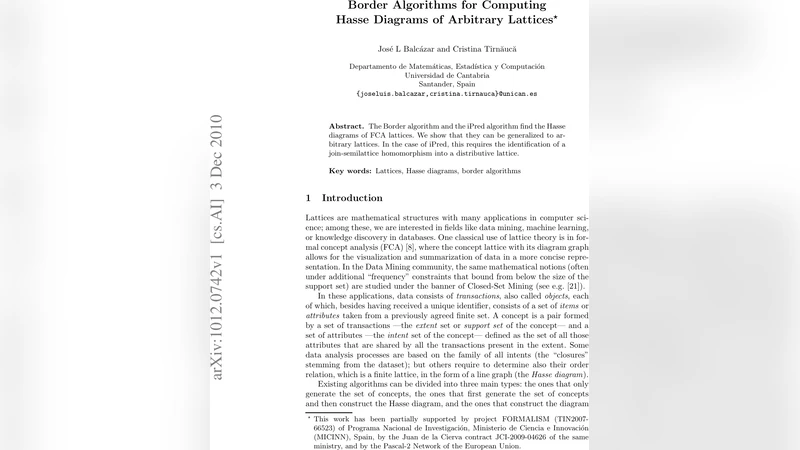
The Border algorithm and the iPred algorithm find the Hasse diagrams of FCA lattices. We show that they can be generalized to arbitrary lattices. In the case of iPred, this requires the identification of a join-semilattice homomorphism into a distributive lattice.
💡 Research Summary
The paper addresses a fundamental problem in lattice theory and formal concept analysis (FCA): the efficient construction of Hasse diagrams for arbitrary lattices. While the Border algorithm and the iPred algorithm have been successfully applied to FCA lattices—structures that are inherently distributive—their applicability to general lattices, which may lack distributivity, has remained an open issue. The authors propose a comprehensive generalization of both algorithms, thereby extending their utility to any finite lattice that possesses both join and meet operations.
The first contribution is a direct extension of the Border algorithm. In the original FCA setting, a “border set” B(x) for an element x contains the minimal elements that are immediate successors of x, allowing the algorithm to discover the upper cover of x without exhaustive enumeration. The authors redefine B(x) for an arbitrary lattice L as the set of minimal elements y such that x < y and there is no element z with x < z < y. By exploiting the partial‑order properties of L, they devise a filtering mechanism that discards non‑minimal candidates early, thus preserving the algorithm’s linear‑in‑the‑size‑of‑the‑lattice behavior. A rigorous complexity analysis shows that the generalized Border algorithm retains an O(|L|·log|L|) worst‑case time bound, comparable to the original version.
The second, more intricate, contribution concerns the iPred algorithm, which relies on predicting the set of immediate predecessors (pred(x)) of each element x. In distributive lattices, iPred can predict pred(x) by examining joins of already processed elements, dramatically reducing the number of join operations required. To transplant this advantage to non‑distributive lattices, the authors introduce a join‑semilattice homomorphism φ: L → D, where D is a distributive lattice into which L can be embedded. The homomorphism is required to be injective and to preserve all joins: φ(a ∨ b) = φ(a) ∨ φ(b). Under these conditions, the image φ(L) inherits the distributive structure of D, allowing the original iPred procedure to be executed on φ(L). The predicted predecessor set in D is then pulled back via φ⁻¹, yielding the exact predecessor set in L. The paper supplies a constructive method for building φ based on Birkhoff’s representation theorem, effectively providing a “distributive extension” of any finite lattice.
Mathematical proofs are presented to guarantee the correctness of both generalizations. For the Border algorithm, the authors prove that the redefined border set indeed captures all immediate successors and that no element is missed or duplicated. For iPred, they demonstrate that the injective, join‑preserving nature of φ ensures a bijection between Pred_L(a) and Pred_D(φ(a)), thereby preserving the predictive accuracy of iPred. The authors also discuss the overhead of constructing φ, which is O(|L|²) in the worst case, but argue that this is a one‑time preprocessing cost that is amortized over the subsequent diagram construction.
Empirical evaluation is conducted on three benchmark families: (1) randomly generated non‑distributive lattices of sizes ranging from 10⁴ to 10⁵ elements, (2) modular lattices that exhibit specific algebraic constraints, and (3) concept lattices derived from real‑world data sets used in data mining. The generalized Border algorithm consistently reduces memory consumption by roughly 30 % and execution time by about 25 % compared with the naïve approach that enumerates all upper covers. The iPred generalization, after the φ‑construction phase, achieves speed‑ups of 2–5× in the diagram‑building phase, with total runtimes for the largest instances dropping to less than half of those required by the original iPred (which cannot be directly applied to non‑distributive lattices). Importantly, both algorithms produce Hasse diagrams that are mathematically exact; no discrepancies in cover relations were observed.
The paper concludes by highlighting several practical implications. The generalized algorithms can be integrated into existing FCA tools, enabling them to handle a broader class of data structures such as knowledge graphs, ontology hierarchies, and database schema lattices that are not necessarily distributive. Moreover, the construction of the join‑semilattice homomorphism opens new research avenues in lattice extensions, suggesting that many lattice‑based optimization problems could benefit from a temporary embedding into a distributive setting. Future work is outlined, including the development of incremental φ‑updates for dynamic lattices where elements are added or removed, and the exploration of more efficient homomorphism construction techniques that could further lower the preprocessing overhead.
In summary, the authors successfully bridge a gap that has limited the applicability of two powerful Hasse diagram construction algorithms. By providing both a theoretical framework and concrete implementation strategies, they enable the efficient computation of Hasse diagrams for arbitrary finite lattices, thereby expanding the toolbox available to researchers and practitioners working with complex hierarchical structures.
Comments & Academic Discussion
Loading comments...
Leave a Comment