Process Behaviour: Formulae vs. Tests (Extended Abstract)
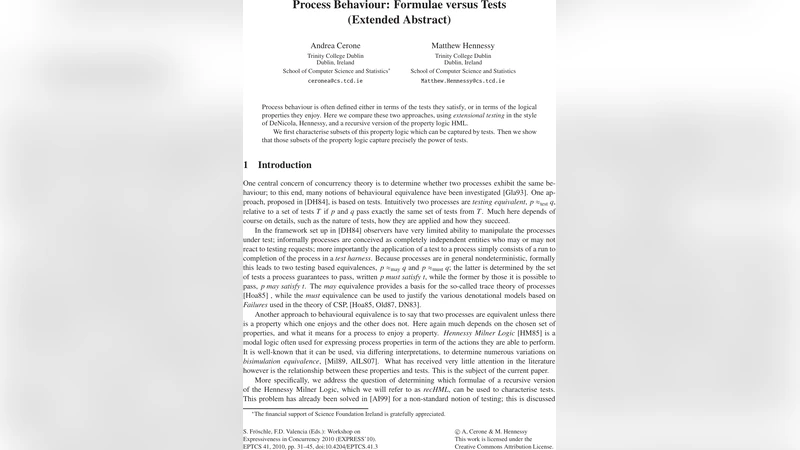
Process behaviour is often defined either in terms of the tests they satisfy, or in terms of the logical properties they enjoy. Here we compare these two approaches, using extensional testing in the style of DeNicola, Hennessy, and a recursive version of the property logic HML. We first characterise subsets of this property logic which can be captured by tests. Then we show that those subsets of the property logic capture precisely the power of tests.
💡 Research Summary
The paper “Process Behaviour: Formulae vs. Tests (Extended Abstract)” investigates the relationship between two foundational ways of characterizing the behaviour of concurrent processes: extensional testing, as pioneered by De Nicola and Hennessy, and logical specification using a recursive variant of Hennessy‑Milner Logic (HML). The authors first adopt the De Nicola–Hennessy testing framework, where a test is an external observer that interacts with a process by offering actions and records a binary outcome (success or failure). Tests can be composed using basic operators for choice, sequencing, and iteration, thereby expressing a wide range of behavioural expectations.
In parallel, the paper introduces a recursive extension of HML. Classical HML employs the modal operators ⟨a⟩φ (there exists an a‑transition leading to a state satisfying φ) and
Comments & Academic Discussion
Loading comments...
Leave a Comment