Robustness of Equations Under Operational Extensions
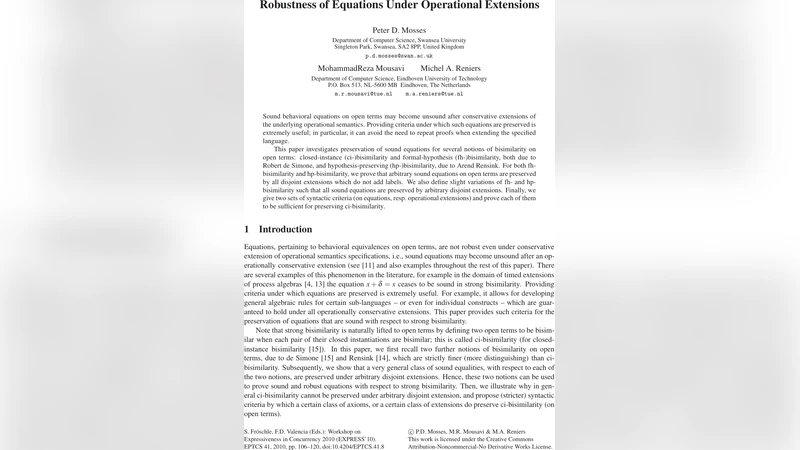
Sound behavioral equations on open terms may become unsound after conservative extensions of the underlying operational semantics. Providing criteria under which such equations are preserved is extremely useful; in particular, it can avoid the need to repeat proofs when extending the specified language. This paper investigates preservation of sound equations for several notions of bisimilarity on open terms: closed-instance (ci-)bisimilarity and formal-hypothesis (fh-)bisimilarity, both due to Robert de Simone, and hypothesis-preserving (hp-)bisimilarity, due to Arend Rensink. For both fh-bisimilarity and hp-bisimilarity, we prove that arbitrary sound equations on open terms are preserved by all disjoint extensions which do not add labels. We also define slight variations of fh- and hp-bisimilarity such that all sound equations are preserved by arbitrary disjoint extensions. Finally, we give two sets of syntactic criteria (on equations, resp. operational extensions) and prove each of them to be sufficient for preserving ci-bisimilarity.
💡 Research Summary
The paper investigates a fundamental problem in the theory of structural operational semantics (SOS): when a language is extended conservatively, do equations that are sound with respect to a given notion of bisimilarity on open terms remain sound? This question is crucial for language designers because re‑proving all behavioural equivalences after each extension is costly and error‑prone. The authors focus on three well‑known equivalence relations for open terms: closed‑instance bisimilarity (ci‑bisimilarity) introduced by Robert de Simone, formal‑hypothesis bisimilarity (fh‑bisimilarity) also due to de Simone, and hypothesis‑preserving bisimilarity (hp‑bisimilarity) defined by Arend Rensink.
First, the paper formalises what it means for an SOS specification to be extended conservatively. An extension is “disjoint” when it adds new operators and new transition rules but does not modify any existing rule, and it is “label‑preserving” when it does not introduce fresh action labels. Such extensions are the most common in practice: they model the addition of new constructs without altering the semantics of the existing ones.
The core technical contribution concerns preservation results for fh‑ and hp‑bisimilarity. The authors prove that any sound equation on open terms is preserved under all disjoint, label‑preserving extensions. The proof hinges on the fact that both fh‑ and hp‑bisimilarity are defined in terms of hypotheses about the behaviour of variables. Because the extension does not interfere with the set of hypotheses that can be formed from the original language, a bisimulation that witnesses the equation before the extension can be lifted unchanged to the extended language.
To strengthen the result further, the authors introduce slight variants of fh‑ and hp‑bisimilarity. In these variants the definition of a hypothesis is broadened so that it automatically tolerates the presence of new operators, even when those operators introduce fresh labels. With the modified definitions, any disjoint extension—whether or not it adds new labels—preserves all sound open‑term equations. This yields a robust notion of behavioural equivalence that is immune to the most common forms of language growth.
The situation for ci‑bisimilarity is more delicate. Since ci‑bisimilarity requires that all closed instantiations of an open term be bisimilar, the addition of new labels can change the transition structure of those closed instances, potentially invalidating previously sound equations. The authors therefore identify two syntactic criteria that guarantee preservation for ci‑bisimilarity.
-
Equation‑side criterion (label independence). An equation is label‑independent if none of the operators occurring in it can generate the new labels introduced by the extension. In other words, the equation’s terms only involve actions from the original label set.
-
Extension‑side criterion (non‑interfering, label‑preserving extensions). An extension satisfies this condition when every new rule either uses only fresh operators or adds transitions that involve only fresh labels, never augmenting the transition relation of existing operators with the original labels.
If either of these conditions holds, the authors prove that any ci‑bisimilarity‑sound equation remains sound after the extension. The proofs combine standard SOS congruence arguments with a careful analysis of how closed instances can be affected by the new rules.
The paper concludes with illustrative examples. It shows how the results apply to classic process algebras such as CCS and the π‑calculus, where new synchronization or name‑generation constructs are added. In each case the syntactic criteria are verified, confirming that previously established equations (e.g., associativity, commutativity, or more complex behavioural laws) survive the extension without re‑proof.
Overall, the work provides a clear taxonomy of when behavioural equations are robust under language growth. For fh‑ and hp‑bisimilarity the answer is simple: any disjoint, label‑preserving extension suffices, and with modest modifications of the equivalence definitions even arbitrary disjoint extensions are harmless. For ci‑bisimilarity, the authors give concrete syntactic checks that language designers can apply before extending a language, thereby avoiding costly re‑verification of behavioural properties. The results have practical relevance for the modular development of process calculi, programming language semantics, and verification tools that rely on open‑term reasoning.
Comments & Academic Discussion
Loading comments...
Leave a Comment