Classifying Clustering Schemes
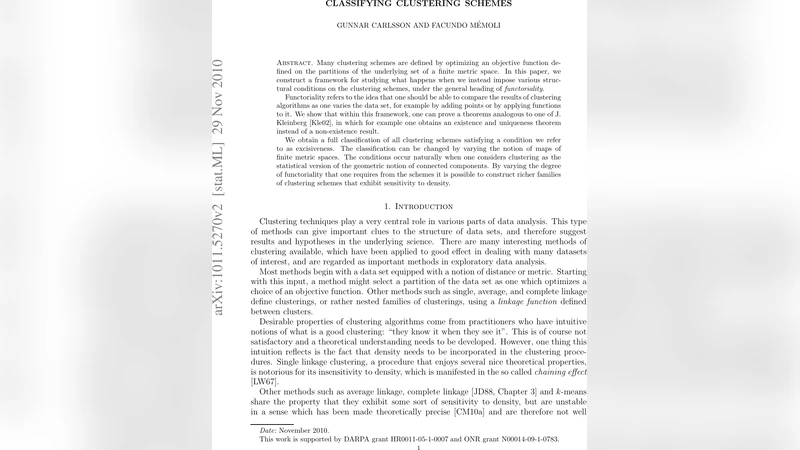
Many clustering schemes are defined by optimizing an objective function defined on the partitions of the underlying set of a finite metric space. In this paper, we construct a framework for studying what happens when we instead impose various structural conditions on the clustering schemes, under the general heading of functoriality. Functoriality refers to the idea that one should be able to compare the results of clustering algorithms as one varies the data set, for example by adding points or by applying functions to it. We show that within this framework, one can prove a theorems analogous to one of J. Kleinberg, in which for example one obtains an existence and uniqueness theorem instead of a non-existence result. We obtain a full classification of all clustering schemes satisfying a condition we refer to as excisiveness. The classification can be changed by varying the notion of maps of finite metric spaces. The conditions occur naturally when one considers clustering as the statistical version of the geometric notion of connected components. By varying the degree of functoriality that one requires from the schemes it is possible to construct richer families of clustering schemes that exhibit sensitivity to density.
💡 Research Summary
The paper re‑examines clustering from a categorical perspective, replacing the traditional objective‑function paradigm with a structural one based on functoriality. In this setting, finite metric spaces are objects and maps between them (such as non‑expansive maps or inclusions) are morphisms. A clustering scheme is required to be a functor: whenever a map f : X → Y is given, the partition of X produced by the algorithm must be compatible with the partition of Y after applying f, and vice‑versa for inclusions. This captures the intuitive demand that clustering results should vary in a coherent way when the data set is enlarged, reduced, or transformed.
Beyond functoriality the authors introduce excisiveness, a condition inspired by the topological notion of connected components. Excisiveness demands that if a clustering partitions a space into disjoint blocks, then restricting the algorithm to any block yields exactly the same block as before. In other words, the algorithm’s output must be stable under “cut‑and‑paste” of its own clusters. This property forces any functorial clustering to behave like a decomposition into connected components of a graph built from the data.
The central contribution is a complete classification theorem for all clustering schemes that are both functorial (with respect to a chosen class of maps) and excisive. The classification depends on the chosen morphism class: for the most permissive class (all non‑expansive maps and inclusions) there is a single family of admissible schemes, each uniquely determined by a monotone “threshold function” τ : ℝ₊ → ℝ₊. Given a metric space (X,d) and a scale r, one forms the r‑ball graph (connect two points if their distance ≤ r) and then takes the connected components of this graph after applying τ(r). The resulting partition is exactly the output of any functorial‑excisive clustering. Thus, existence and uniqueness replace Kleinberg’s impossibility result: while Kleinberg showed that no algorithm can satisfy Scale‑invariance, Richness, and Consistency simultaneously, this paper shows that by swapping those three axioms for functoriality plus excisiveness, a well‑defined, unique family of algorithms emerges.
The authors also explore how varying the degree of functoriality yields richer families that are sensitive to point density. By restricting morphisms to those that preserve local density (e.g., maps that do not collapse high‑density regions), the resulting τ‑functions can be tuned to produce clusters that split dense areas while merging sparse ones. This demonstrates that the categorical framework is flexible enough to encode desirable practical properties such as density‑aware clustering, which standard distance‑threshold methods lack.
In addition to the theoretical results, the paper discusses practical implications. Functorial clustering guarantees stability under common data‑preprocessing operations: adding or removing points, subsampling, and applying non‑expansive transformations will not cause arbitrary changes in the output. Moreover, the threshold function τ can be learned from data or set by domain knowledge, giving users direct control over the granularity of the hierarchy and the sensitivity to density. The authors suggest several avenues for future work, including extensions to continuous metric spaces, probabilistic morphisms, and integration with semi‑supervised learning frameworks. Overall, the work provides a rigorous categorical foundation for clustering, offers a clear classification of admissible schemes, and opens the door to designing algorithms that are both mathematically principled and practically robust.
Comments & Academic Discussion
Loading comments...
Leave a Comment