A dynamical systems approach to actin-based motility in Listeria monocytogenes
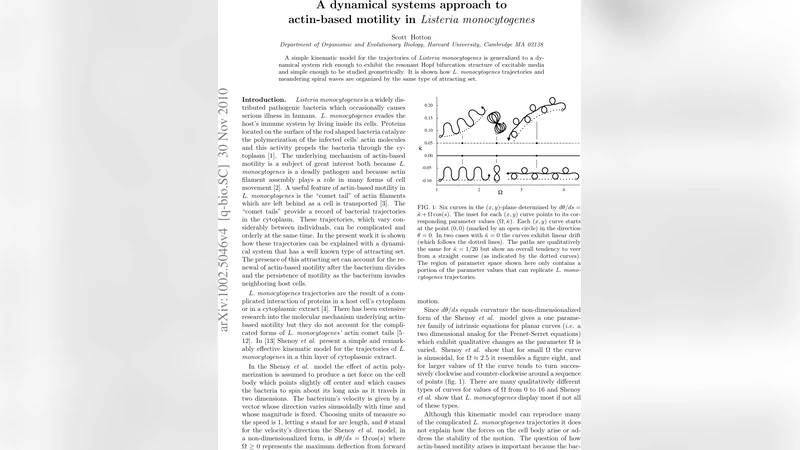
A simple kinematic model for the trajectories of Listeria monocytogenes is generalized to a dynamical system rich enough to exhibit the resonant Hopf bifurcation structure of excitable media and simple enough to be studied geometrically. It is shown how L. monocytogenes trajectories and meandering spiral waves are organized by the same type of attracting set.
💡 Research Summary
The paper addresses the long‑standing problem of how the intracellular pathogen Listeria monocytogenes propels itself by polymerizing actin filaments into a comet‑tail structure. Earlier work described the bacterium’s path with a simple kinematic model that treated the cell as a point moving with a constant speed and a fixed turning rate. While such a model captures the basic forward motion, it fails to reproduce the rich variety of curved, looping, and periodically modulated trajectories that are routinely observed in microscopy experiments.
To overcome this limitation, the authors construct a low‑dimensional dynamical system that retains geometric simplicity yet is capable of generating the complex behavior seen in real cells. The state variables are the planar coordinates ((x,y)) of the bacterium and its heading angle (\theta). The governing equations are
\
Comments & Academic Discussion
Loading comments...
Leave a Comment