The angular momentum of two collided rarefied preplanetesimals and the formation of binaries
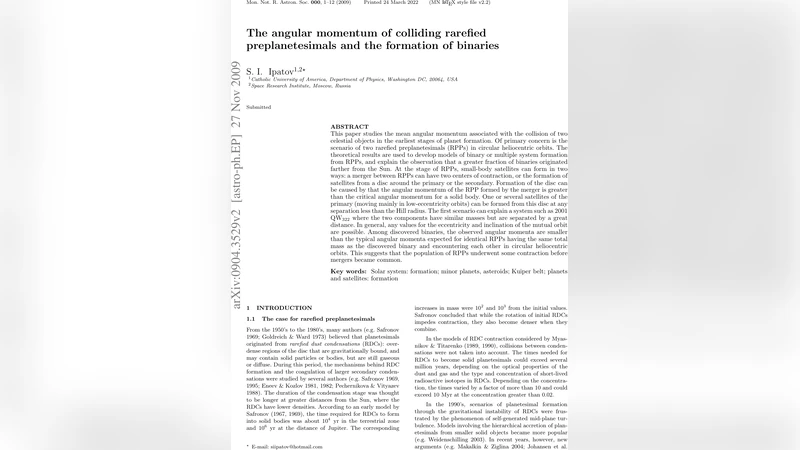
This paper studies the mean angular momentum associated with the collision of two celestial objects in the earliest stages of planet formation. Of primary concern is the scenario of two rarefied preplanetesimals (RPPs) in circular heliocentric orbits. The theoretical results are used to develop models of binary or multiple system formation from RPPs, and explain the observation that a greater fraction of binaries originated farther from the Sun. At the stage of RPPs, small-body satellites can form in two ways: a merger between RPPs can have two centers of contraction, or the formation of satellites from a disc around the primary or the secondary. Formation of the disc can be caused by that the angular momentum of the RPP formed by the merger is greater than the critical angular momentum for a solid body. One or several satellites of the primary (moving mainly in low-eccentricity orbits) can be formed from this disc at any separation less than the Hill radius. The first scenario can explain a system such as 2001 QW322 where the two components have similar masses but are separated by a great distance. In general, any values for the eccentricity and inclination of the mutual orbit are possible. Among discovered binaries, the observed angular momenta are smaller than the typical angular momenta expected for identical RPPs having the same total mass as the discovered binary and encountering each other in circular heliocentric orbits. This suggests that the population of RPPs underwent some contraction before mergers became common.
💡 Research Summary
The paper investigates the angular momentum budget associated with collisions between two rarefied pre‑planetesimals (RPPs) during the earliest phase of planet formation, when solid bodies have not yet condensed and the material exists as a low‑density mixture of gas and dust. The authors focus on the case where the two RPPs occupy circular heliocentric orbits and approach each other on nearly coplanar trajectories. By treating each RPP as a homogeneous sphere of mass M and radius r, they derive an expression for the pre‑collision angular momentum L₀ in terms of the heliocentric orbital speed vₖ = √(GM⊙/a) and the orbital radius a. For circular orbits the average angular momentum transferred to the merged object is L̄ ≈ (M₁+M₂) vₖ a, assuming the impact angle is close to 90°.
After the collision, the combined body has mass M_tot = M₁+M₂ and a characteristic radius r′ that depends on its mean density ρ. The authors introduce a critical angular momentum L_c = k G M_tot^{5/3} ρ^{-1/3} (with k ≈ 0.4–0.5) which represents the maximum spin a solid, self‑gravitating body can sustain without breaking apart. If L̄ exceeds L_c, the merged RPP cannot remain a single spheroid; instead, excess angular momentum must be redistributed into a circum‑RPP disk that extends out to the Hill radius R_H ≈ a
Comments & Academic Discussion
Loading comments...
Leave a Comment