A Magnetized Jet from a Massive Protostar
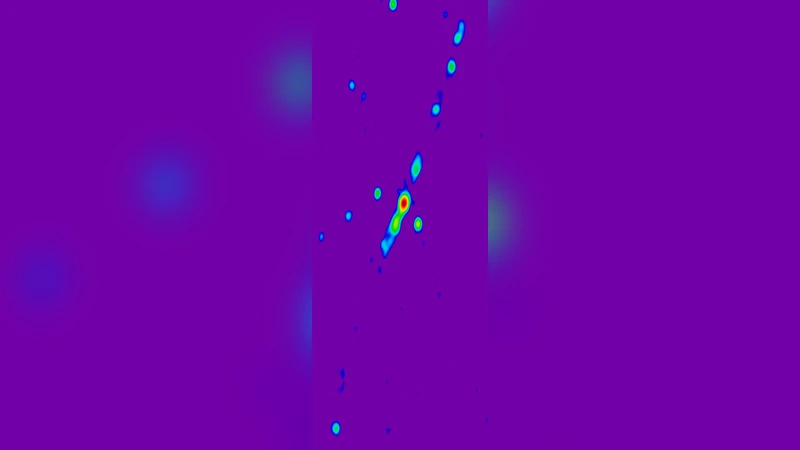
Synchrotron emission is commonly found in relativistic jets from active galactic nuclei (AGNs) and microquasars, but so far its presence in jets from young stellar objects (YSOs) has not been proved. Here, we present evidence of polarized synchrotron emission arising from the jet of a YSO. The apparent magnetic field, with strength of ~0.2 milligauss, is parallel to the jet axis, and the polarization degree increases towards the jet edges, as expected for a confining helical magnetic field configuration. These characteristics are similar to those found in AGN jets, hinting at a common origin of all astrophysical jets.
💡 Research Summary
The paper presents the first robust detection of linearly polarized synchrotron emission from the jet of a massive young stellar object (YSO), specifically the protostar IRAS 16547‑4247 located at a distance of roughly 2.9 kpc. Using high‑resolution (∼0.3″) radio observations obtained with the Karl G. Jansky Very Large Array (VLA) in A‑configuration and the Australia Telescope Compact Array (ATCA) at 5 GHz and 8 GHz, the authors constructed Stokes I, Q, and U maps of the jet. The total intensity spectrum follows a power law with a spectral index α≈‑0.6 (Sν∝ν^α), a clear signature of non‑thermal synchrotron radiation rather than thermal free‑free emission. This indicates the presence of relativistic electrons within the jet, implying an in‑situ acceleration mechanism.
The polarization vectors are strikingly aligned with the jet axis (north‑south direction). The mean fractional polarization across the jet is about 5 %, but it rises dramatically toward the jet edges, reaching 10–12 % in the northern lobe. Such an edge‑brightening of polarization is exactly what is expected for a jet threaded by a helical magnetic field: the central spine, dominated by a longitudinal field component, shows lower net polarization because of line‑of‑sight averaging, whereas the shear layer at the boundary, where the toroidal component is amplified by velocity shear, yields a higher ordered component and thus higher polarization.
Assuming equipartition between the energy densities of relativistic particles and magnetic fields, the authors estimate a magnetic field strength of roughly 0.2 mG on average, with values up to ∼0.3 mG near the edges. This is 1–2 orders of magnitude stronger than the ambient magnetic field in the surrounding molecular cloud (∼10–30 µG), suggesting that the jet either amplifies the field via compression and dynamo action or preferentially drags in and aligns pre‑existing interstellar magnetic flux.
To interpret the observations, the paper compares the data with magnetohydrodynamic (MHD) simulations of jets that include a velocity shear layer. In those models, differential motion between the fast jet core and the slower ambient medium twists the magnetic field lines, generating a toroidal component that wraps around the jet axis. The simulated polarization profiles—low polarization in the core, rising toward the edges—match the observed profiles quantitatively, providing strong evidence that the same physical mechanism operates in YSO jets as in much larger, relativistic jets from active galactic nuclei (AGN) and microquasars.
The authors emphasize the broader implication: despite the enormous disparity in size (parsec‑scale AGN jets versus sub‑parsec YSO jets) and bulk speed (relativistic versus a few hundred km s⁻¹), the magnetic field geometry and particle acceleration processes appear to be universal. This supports the hypothesis that all astrophysical jets are fundamentally magnetically launched and collimated, with a helical field configuration playing a central role in both confinement and the generation of synchrotron emission.
Finally, the paper outlines future directions. Higher‑frequency observations (≥30 GHz) and very long baseline interferometry (VLBI) could resolve the jet transverse structure down to ≲10 AU, directly imaging the toroidal field component and the shear layer. Multi‑wavelength campaigns—including infrared and X‑ray diagnostics—would help to trace the interaction between the jet and its natal envelope, quantify feedback on star formation, and refine models of magnetic field amplification in protostellar environments. The work thus opens a new observational window onto the magnetic nature of YSO jets and bridges the gap between low‑mass star formation and the physics of powerful extragalactic jets.
Comments & Academic Discussion
Loading comments...
Leave a Comment