Theory of spike timing based neural classifiers
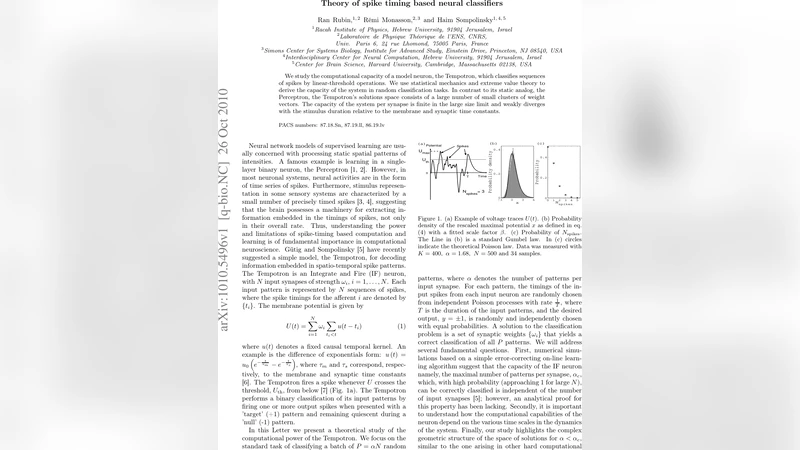
We study the computational capacity of a model neuron, the Tempotron, which classifies sequences of spikes by linear-threshold operations. We use statistical mechanics and extreme value theory to derive the capacity of the system in random classification tasks. In contrast to its static analog, the Perceptron, the Tempotron’s solutions space consists of a large number of small clusters of weight vectors. The capacity of the system per synapse is finite in the large size limit and weakly diverges with the stimulus duration relative to the membrane and synaptic time constants.
💡 Research Summary
The paper investigates the computational capacity of the Tempotron, a spiking neuron model that classifies temporal spike patterns by means of a linear‑threshold operation on the membrane potential. Unlike the classic perceptron, which treats inputs as static vectors, the Tempotron integrates incoming spikes with a bi‑exponential kernel that reflects the membrane ((\tau_m)) and synaptic ((\tau_s)) time constants. The membrane potential at any time (t) is given by (V(t)=\sum_i J_i\sum_{t_i^{(k)}<t}K(t-t_i^{(k)})), where (J_i) are synaptic weights and (K(t)) is the kernel. A spike is emitted when the maximum of (V(t)) over the stimulus interval exceeds a fixed threshold (\theta).
The authors address two fundamental questions: (1) how many random input patterns can be correctly classified simultaneously, i.e., the storage capacity, and (2) what is the geometric structure of the solution space in weight space. To answer these, they combine tools from statistical mechanics (the Gardner replica method) with extreme‑value theory. The key observation is that the decision variable for each pattern is the maximal membrane potential (V_{\max}), which, for random inputs, behaves like the maximum of a set of correlated Gaussian variables. Extreme‑value analysis shows that the mean of (V_{\max}) grows as (\sigma\sqrt{2\ln(T/\tau)}) where (T) is the stimulus duration and (\tau) is a combination of (\tau_m) and (\tau_s). This logarithmic dependence on (T) leads to a capacity per synapse, (\alpha_c), that remains finite as the number of synapses (N) tends to infinity, but increases slowly (approximately as (\sqrt{\ln(T/\tau)})) when the stimulus duration exceeds the intrinsic time constants.
The analytical results predict (\alpha_c\approx0.7) for short stimuli, comparable to the perceptron’s capacity, and a modest upward drift for longer stimuli. Numerical simulations with (N) ranging from 100 to 1000, various (T), and realistic time constants confirm the theory: the success probability of learning matches the predicted capacity curve, and the advantage of the Tempotron over the perceptron becomes evident when (T/\tau) exceeds about ten.
A striking finding concerns the geometry of the weight space. While the perceptron’s solutions form a single, connected convex region, the Tempotron’s solutions break up into many isolated clusters (or “balls”). Within a cluster, small perturbations of the weight vector do not change the classification outcome, but moving from one cluster to another requires large weight changes. This fragmented landscape implies that learning can become trapped in local minima and that the final performance is highly sensitive to the initial weight configuration.
The paper concludes by discussing the biological relevance of these results. The Tempotron’s reliance on precise spike timing mirrors experimental observations of temporal coding in cortical circuits, and its learning rule resembles spike‑timing‑dependent plasticity (STDP). The clustered solution space suggests that real neural systems might exploit multiple quasi‑stable configurations, potentially supporting flexibility and rapid re‑learning. The authors propose extensions such as multi‑class classification, robustness to noisy spike trains, and hardware implementations using neuromorphic chips.
In summary, the study provides a rigorous theoretical framework for understanding how a single spiking neuron can perform high‑dimensional temporal classification. It quantifies the capacity limits, reveals a non‑trivial solution‑space topology, and highlights the role of stimulus duration relative to intrinsic neuronal time scales. These insights bridge the gap between abstract learning theory and the temporal dynamics observed in biological neural networks, offering a foundation for future developments in both neuroscience and neuromorphic engineering.
Comments & Academic Discussion
Loading comments...
Leave a Comment