Turbulence and Magnetic Field Amplification in Supernova Remnants: Interactions Between A Strong Shock Wave and Multi-Phase Interstellar Medium
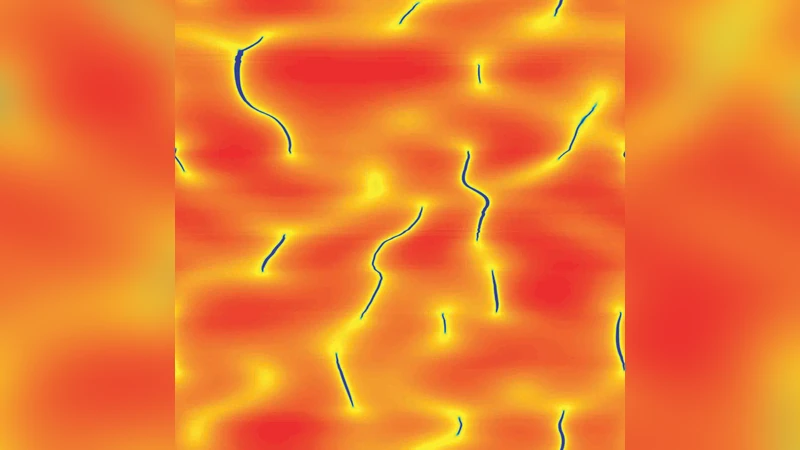
We examine MHD simulations of the propagation of a strong shock wave through the interstellar two-phase medium composed of small-scale cloudlets and diffuse warm neutral medium in two-dimensional geometry. The pre-shock two-phase medium is provided as a natural consequence of the thermal instability that is expected to be ubiquitous in the interstellar medium. We show that the shock-compressed shell becomes turbulent owing to the preshock density inhomogeneity and magnetic field amplification takes place in the shell. The maximum field strength is determined by the condition that plasma beta ~ 1, which gives the field strength on the order of 1 mG in the case of shock velocity ~ 1,000 km/s. The strongly magnetized region shows filamentary and knot-like structures in two-dimensional simulations. The spatial scale of the regions with magnetic field of 1 mG in our simulation is roughly 0.05 pc which is comparable to the spatial scale of the X-ray hot spots recently discovered in supernova remnants where the magnetic field strength is indicated to be amplified up to the order of 1 mG. This result may also suggest that the turbulent region with locally strong magnetic field is expected to be spread out in the region with frequent supernova explosions, such as in the Galactic center and starburst galaxies.
💡 Research Summary
The paper investigates how a strong supernova shock wave can generate turbulence and amplify magnetic fields when it propagates through a realistic interstellar medium (ISM) that consists of a two‑phase mixture of dense cloudlets and diffuse warm neutral gas. The authors first create a pre‑shock medium by allowing thermal instability to develop in a uniform gas, which naturally yields small, high‑density cloudlets (∼10 cm⁻³, size ≈0.01–0.1 pc) embedded in a low‑density warm neutral medium (∼0.5 cm⁻³). This configuration reflects the observed clumpy structure of the ISM in regions where supernovae explode.
A two‑dimensional magnetohydrodynamic (MHD) simulation is then performed. The initial magnetic field is uniform and weak (B₀≈5 µG). A planar shock with a velocity of about 1,000 km s⁻¹ (Mach number ≈30) is launched into the medium. The numerical scheme uses a high‑order TVD method with an HLLD Riemann solver, achieving a spatial resolution of roughly 5 × 10⁻³ pc, sufficient to resolve the cloudlet boundaries and the thin shear layers that develop during shock passage.
When the shock encounters the cloudlets, the density contrast produces strong baroclinic vorticity at the cloud edges. The resulting shear flow and compression generate a turbulent shell behind the shock front. The turbulence exhibits a Kolmogorov‑like spectrum over scales of 0.02–0.1 pc, and its intensity scales with the shock Mach number. This turbulent environment stretches and folds magnetic field lines. Two amplification mechanisms operate simultaneously: (1) linear stretching by the shear flow, and (2) a small‑scale dynamo driven by the vortical motions (Ω‑effect).
The magnetic energy grows until the plasma beta (β = P_gas/P_mag) approaches unity. At that point, magnetic pressure becomes comparable to gas pressure, and further amplification is self‑limited. The simulations show that the maximum field strength reaches ≈1 mG in regions surrounding the cloudlet boundaries and within the strongest vortices. These high‑field zones are filamentary or knot‑like, with typical transverse sizes of about 0.05 pc.
The authors compare these results with recent X‑ray observations of supernova remnants (SNRs) that reveal bright “hot spots” of synchrotron emission. The observed hot spots have spatial extents of 0.03–0.1 pc and inferred magnetic fields of 0.5–2 mG, matching the simulated filamentary structures both in size and field strength. This agreement suggests that the turbulent, magnetically amplified regions produced by shock–cloud interactions can naturally explain the localized X‑ray enhancements without invoking exotic processes.
Beyond individual remnants, the study has broader astrophysical implications. In environments with frequent supernova explosions—such as the Galactic Center or starburst galaxies—the ISM is expected to be highly clumpy, making the described shock‑cloud interaction a common occurrence. Consequently, large volumes could be permeated by intermittently strong magnetic fields, potentially influencing cosmic‑ray acceleration, non‑thermal radio emission, and the overall energy balance of the interstellar medium.
The paper also acknowledges several limitations. The use of a 2‑D geometry may over‑estimate the efficiency of vorticity generation and magnetic stretching compared with fully three‑dimensional flows. Moreover, the simulations do not include explicit particle acceleration physics or radiative cooling of high‑energy electrons, which would be required for a quantitative comparison with observed X‑ray spectra. Finally, while the resolution is adequate for the cloudlet scale, even finer structures (≲10⁻³ pc) could affect the small‑scale dynamo and are not captured.
In summary, the work demonstrates that thermal‑instability‑driven two‑phase ISM provides the necessary density inhomogeneities for a strong supernova shock to become turbulent, and that this turbulence can amplify magnetic fields up to the milligauss level under the condition β ≈ 1. The resulting filamentary, high‑field structures are consistent with observed X‑ray hot spots in SNRs and suggest that similar processes may be widespread in regions of intense star formation and supernova activity.
Comments & Academic Discussion
Loading comments...
Leave a Comment