An Assessment of the Systematic Uncertainty in Present and Future Tests of the Lense-Thirring Effect with Satellite Laser Ranging
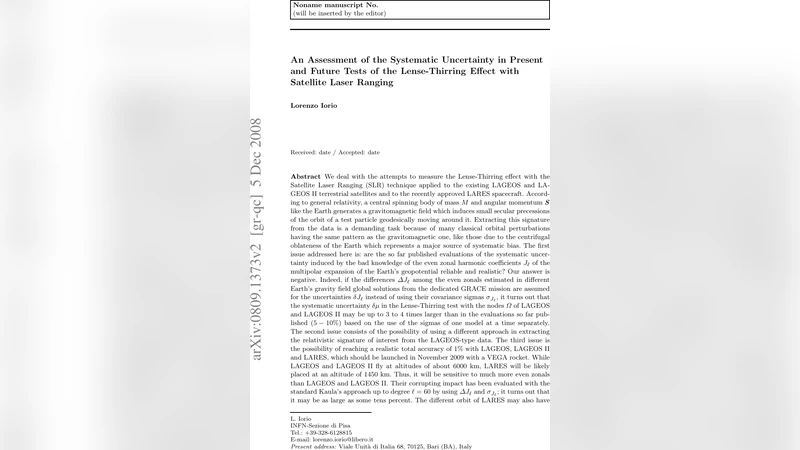
We deal with the attempts to measure the Lense-Thirring effect with the Satellite Laser Ranging (SLR) technique applied to the existing LAGEOS and LAGEOS II terrestrial satellites and to the recently approved LARES spacecraft.The first issue addressed here is: are the so far published evaluations of the systematic uncertainty induced by the bad knowledge of the even zonal harmonic coefficients J_L of the multipolar expansion of the Earth’s geopotential reliable and realistic? Our answer is negative. Indeed, if the differences Delta J_L among the even zonals estimated in different Earth’s gravity field global solutions from the dedicated GRACE mission are assumed for the uncertainties delta J_L instead of using their covariance sigmas sigma_JL, it turns out that the systematic uncertainty \delta\mu in the Lense-Thirring test with the nodes Omega of LAGEOS and LAGEOS II may be up to 3 to 4 times larger than in the evaluations so far published ($5-10%$) based on the use of the sigmas of one model at a time separately. The second issue consists of the possibility of using a different approach in extracting the relativistic signature of interest from the LAGEOS-type data. The third issue is the possibility of reaching a realistic total accuracy of 1% with LAGEOS, LAGEOS II and LARES, which should be launched in November 2009 with a VEGA rocket. While LAGEOS and LAGEOS II fly at altitudes of about 6000 km, LARES will be likely placed at an altitude of 1450 km. Thus, it will be sensitive to much more even zonals than LAGEOS and LAGEOS II. Their corrupting impact has been evaluated with the standard Kaula’s approach up to degree L=60 by using Delta J_L and sigma_JL; it turns out that it may be as large as some tens percent.
💡 Research Summary
The paper conducts a critical reassessment of the systematic uncertainties that affect current and planned measurements of the Lense‑Thirring (LT) frame‑dragging effect using Satellite Laser Ranging (SLR) to the LAGEOS, LAGEOS II, and the newly approved LARES satellites. The LT effect manifests as a tiny secular precession of a satellite’s orbital node (Ω) caused by Earth’s rotation, and its detection hinges on an accurate knowledge of the even zonal harmonics (Jℓ, ℓ = 2, 4, 6, …) of the Earth’s geopotential.
Traditional error budgets have relied on the formal covariance sigmas (σ_Jℓ) supplied by a single Earth‑gravity model (typically a GRACE‑derived solution) and have reported total systematic uncertainties of 5–10 % for the LT signal. The authors argue that this approach is overly optimistic because it ignores the spread among different gravity solutions. By extracting the inter‑model differences ΔJℓ from a suite of publicly available GRACE‑based models (e.g., ITSG‑Grace02, GGM03, EIGEN‑GL04, etc.) and treating these differences as realistic uncertainties δJℓ, they find that the systematic error δμ in the LT measurement using the combined nodes of LAGEOS and LAGEOS II can be three to four times larger—rising to 15–40 % depending on the specific combination of ΔJℓ values.
The analysis proceeds with a Kaula‑type perturbation calculation that includes even zonals up to degree ℓ = 60. This high‑degree expansion is essential when the lower‑altitude LARES satellite (planned orbit ≈ 1450 km, compared with ≈ 6000 km for LAGEOS) is added to the experiment. Because a lower orbit is more sensitive to higher‑order zonals, the inclusion of LARES dramatically amplifies the contribution of the poorly known high‑degree Jℓ coefficients. Using both ΔJℓ‑based and σ_Jℓ‑based uncertainties, the authors demonstrate that the total systematic error could reach several tens of percent, far exceeding the 1 % accuracy goal that has been widely quoted for a three‑satellite configuration (LAGEOS, LAGEOS II, LARES).
Beyond the numerical error budget, the paper discusses methodological alternatives for extracting the LT signature from SLR data. The conventional “node‑combination” technique, which linearly eliminates the first few even zonals, is shown to be vulnerable to residual high‑degree contributions. The authors suggest more sophisticated approaches, such as simultaneous multi‑parameter fits that treat the LT precession as an additional solve‑for parameter, or Bayesian model comparison frameworks that can explicitly account for model‑to‑model variability in the geopotential. These strategies could reduce the dependence on any single gravity model and provide a more robust estimate of the relativistic signal.
In conclusion, the authors make three principal recommendations: (1) Systematic uncertainties must be evaluated using inter‑model differences ΔJℓ rather than the formal σ_Jℓ of a single solution, which raises the realistic error budget by a factor of three to four; (2) The inclusion of LARES, while offering a valuable independent observable, also introduces sensitivity to high‑degree even zonals, potentially inflating the total error to tens of percent unless the geopotential is known to unprecedented precision; (3) Achieving a 1 % measurement of the LT effect will require both continued refinement of Earth‑gravity models (e.g., leveraging GRACE‑FO data) and the adoption of more robust data‑analysis techniques that can mitigate model‑dependent biases. Future work should focus on constructing a ΔJℓ‑based error propagation framework, developing multi‑model combination schemes, and performing an empirical validation once LARES data become available.
Comments & Academic Discussion
Loading comments...
Leave a Comment