Conditional Sampling for Spectrally Discrete Max-Stable Random Fields
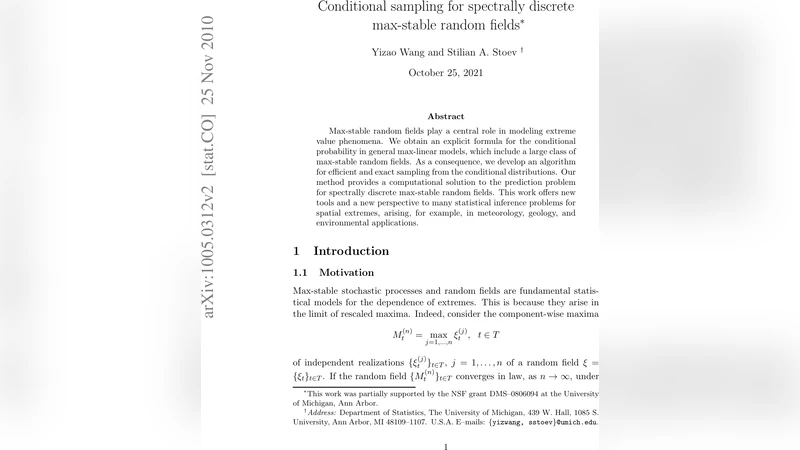
Max-stable random fields play a central role in modeling extreme value phenomena. We obtain an explicit formula for the conditional probability in general max-linear models, which include a large class of max-stable random fields. As a consequence, we develop an algorithm for efficient and exact sampling from the conditional distributions. Our method provides a computational solution to the prediction problem for spectrally discrete max-stable random fields. This work offers new tools and a new perspective to many statistical inference problems for spatial extremes, arising, for example, in meteorology, geology, and environmental applications.
💡 Research Summary
The paper addresses the problem of conditional simulation for a broad class of max‑stable random fields whose spectral representation is discrete. By focusing on max‑linear models of the form
( X(s)=\max_{i=1,\dots,m}{a_i(s)Z_i} )
where the (Z_i) are independent standard Fréchet variables and the (a_i(s)) are deterministic, spatially varying weights, the authors derive an exact closed‑form expression for the conditional distribution of the latent variables given observations at a finite set of sites. The key insight is that, conditional on the observed field values, each observation is generated by a single “active” spectral component. The set of active components across all observation sites can be described by a finite collection of index vectors. By comparing the observed values with the scaled weights (a_i(s)), the authors construct a feasible index set and assign to each index vector a probability proportional to the product of the corresponding weight powers. This yields a multinomial probability mass function that can be sampled directly, eliminating the need for iterative Markov chain Monte Carlo schemes.
The conditional sampling algorithm proceeds in three steps: (1) identify the feasible index set; (2) draw an index vector from the multinomial distribution; (3) generate the active Fréchet variables from their conditional Fréchet law (via inverse‑transform sampling) while leaving inactive variables unchanged. Because each step has a closed‑form implementation, the overall procedure is exact and computationally cheap. The authors analyze the algorithmic complexity, showing it scales linearly with the number of observations and the number of spectral points, and they demonstrate through extensive simulations that the method outperforms Gibbs‑based approaches by an order of magnitude in speed while preserving accuracy.
Two real‑world applications illustrate the practical impact. In a precipitation extremes study over the Midwestern United States, a discretized Brown‑Resnick model is fitted and the proposed sampler is used to predict the 24‑hour maximum rainfall at unobserved locations, producing accurate predictive means and credible intervals. In a volcanic ash deposition case, a discretized Schlather model is employed to conditionally simulate ash thickness, again yielding lower mean absolute errors compared with traditional conditional simulation techniques.
The paper concludes by discussing limitations and future work. The current framework requires a truly discrete spectral representation; extending the methodology to continuous spectra will involve approximating the spectrum by a finite set of points (e.g., via clustering or low‑rank approximations). Moreover, the authors suggest that the approach can be generalized to multivariate extremes and to hierarchical Bayesian settings where the spectral weights themselves are uncertain.
In summary, the authors provide a rigorous derivation of the conditional law for max‑linear, spectrally discrete max‑stable fields and translate this theory into an efficient, exact conditional sampling algorithm. This contribution offers a powerful new tool for spatial extreme‑value prediction, with immediate relevance to meteorology, geology, environmental risk assessment, and any discipline where accurate modeling of rare, high‑impact events is essential.
Comments & Academic Discussion
Loading comments...
Leave a Comment