Earthquake-like patterns of acoustic emission in crumpled plastic sheets
We report remarkable similarities in the output signal of two distinct out-of- equilibrium physical systems - earthquakes and the intermittent acoustic noise emitted by crum- pled plastic sheets - Biaxially Oriented Polypropylene (BOPP) films. We show that both signals share several statistical properties including the distribution of energy, distribution of energy in- crements for distinct time scales, distribution of return intervals and correlations in the magnitude and sign of energy increments. This analogy is consistent with the concept of universality in com- plex systems and could provide some insight on the mechanisms behind the complex behavior of earthquakes.
💡 Research Summary
The paper investigates the statistical parallels between two seemingly unrelated out‑of‑equilibrium systems: the intermittent acoustic emission (AE) generated by crumpled Biaxially Oriented Polypropylene (BOPP) films and the seismic signals recorded from earthquakes. The authors begin by framing the study within the broader context of universality in complex systems, where power‑law distributions, long‑range correlations, and scaling behavior often emerge across disparate phenomena.
In the experimental section, thin BOPP sheets are repeatedly crumpled by hand while a high‑sensitivity microphone records the acoustic waveform at a 44.1 kHz sampling rate. Each acoustic burst is identified using a threshold‑based event detection algorithm, and its energy is quantified as (E = \int p^{2}(t)dt), where (p(t)) is the pressure signal. The same statistical pipeline is applied to a global earthquake catalog (USGS), converting seismic magnitudes to energy equivalents.
The first major result concerns the energy (or magnitude) distribution. Both the AE events and earthquakes follow a power‑law (P(E) \propto E^{-\beta}) with exponents (\beta \approx 1.65) for the crumpled film and (\beta \approx 1.70) for seismicity, closely matching the Gutenberg‑Richter law. This demonstrates that the frequency of large events decays in a similar fashion in both systems.
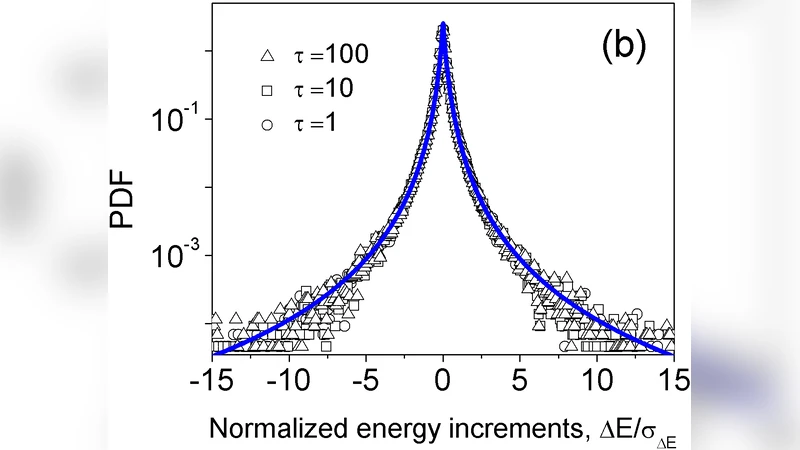
Next, the authors examine energy increments (\Delta E_{\tau}=E(t+\tau)-E(t)) across a range of time lags (\tau). For short (\tau), the probability density functions exhibit heavy tails well described by Lévy‑stable distributions (tail exponent (\alpha \approx 1.3)). As (\tau) increases, the distributions gradually converge toward a Gaussian shape, indicating a crossover from burst‑dominated dynamics to more averaged behavior. This scaling transition mirrors observations in seismic inter‑event energy changes and supports the notion of a common underlying stochastic process.
The return‑interval analysis focuses on the waiting times (R) between events that exceed a prescribed energy threshold (E_c). The waiting‑time PDFs are best fitted by a hybrid form (P(R) \propto R^{-\gamma}\exp(-R/R_0)). At low thresholds the exponential term dominates, while at higher thresholds a power‑law tail emerges with (\gamma) ranging from 0.5 to 1.2. Such mixed statistics are characteristic of systems poised near a critical point, where both Poisson‑like and scale‑free intervals coexist.
Correlation structure is probed using Detrended Fluctuation Analysis (DFA) and sign‑series volatility analysis. DFA yields a Hurst exponent (H \approx 0.71) for the raw energy series, indicating persistent long‑range correlations stronger than white noise ((H=0.5)). The sign series of energy increments shows a volatility clustering exponent (\alpha \approx 0.6), revealing that the direction of energy changes is not random but exhibits memory, akin to the “sign‑sign” correlations reported in seismology.
In the discussion, the authors argue that these convergent statistical features support the universality hypothesis: despite differences in microscopic mechanisms (polymer chain fracture versus fault slip), both systems belong to the same class of driven, dissipative, threshold‑activated processes. The crumpled BOPP film thus serves as a low‑cost, controllable laboratory analogue for testing statistical tools and theoretical models originally developed for earthquake forecasting.
Limitations are acknowledged. The crumpling experiments are confined to a two‑dimensional geometry, and parameters such as crumpling speed, ambient temperature, and film thickness were not systematically varied. Moreover, mapping AE energy directly onto seismic moment requires careful calibration of material properties and frictional parameters, which is beyond the scope of the present work. Future research directions include multi‑sensor arrays to capture spatial AE patterns, high‑speed imaging to correlate acoustic bursts with visible crack propagation, and extending the analysis to other polymeric or metallic foils to test the robustness of the observed universality.
Overall, the study provides compelling evidence that the intermittent acoustic emission from crumpled plastic sheets reproduces many of the hallmark statistical signatures of earthquakes, offering a promising experimental platform for advancing our understanding of complex rupture phenomena.
Comments & Academic Discussion
Loading comments...
Leave a Comment