Effects of Sudden Changes in Inflow Conditions on the Angle of Attack on HAWT Blades
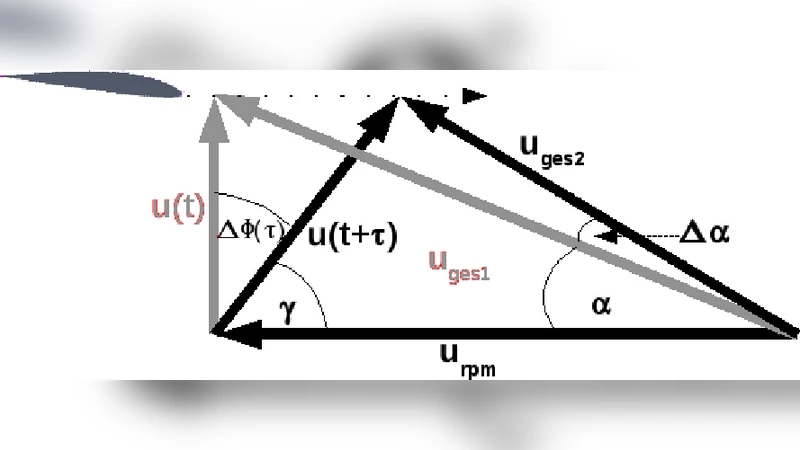
In this paper changes in wind speed and wind direction from a measured wind field are being analyzed at high frequencies. This is used to estimate changes in the angle of attack (AOA) on a blade segment over short time periods for different estimated turbine concepts. Here a statistical approach is chosen to grasp the characteristics of the probability distributions to give an over all view of the magnitude and rate of the changes. The main interest is the generation of basic distributions for the calculation of dynamic stall effects and stall flutter due to wind fluctuations.
💡 Research Summary
The paper investigates how sudden changes in inflow wind speed and direction affect the angle of attack (AOA) on horizontal‑axis wind turbine (HAWT) blades. Using high‑frequency (≥10 Hz) field measurements of wind speed and direction, the authors compute instantaneous AOA variations for selected blade sections (e.g., at 30 % and 70 % of the blade radius) over very short time intervals. The core methodology consists of converting the measured wind vector into an inflow angle, adding the rotor azimuth, and then extracting the AOA time series. By applying a sliding‑window differencing technique, the paper derives both the AOA increment Δα and its time derivative dΔα/dt (the rate of change) for each time step (Δt = 0.1 s).
A statistical treatment follows: histograms of Δα and dΔα/dt are fitted with several probability‑distribution models (normal, log‑normal, gamma, Weibull). The data exhibit pronounced skewness and heavy tails, so log‑normal and gamma distributions provide the best fit, whereas a simple Gaussian underestimates extreme events. From these fits the authors extract mean values, standard deviations, 5 %–95 % quantiles, and 99 % confidence intervals, thereby constructing a complete probabilistic description of AOA fluctuations.
Key findings include:
- The mean AOA change is about 0.8°, but the lower 5 % tail shows jumps of 3°–5°, indicating a non‑negligible probability of large, rapid AOA excursions that can trigger dynamic stall.
- The average rate of change is roughly 0.4° s⁻¹, yet during gust fronts or sudden wind‑direction shifts the instantaneous dΔα/dt can exceed 2° s⁻¹, surpassing typical controller bandwidths.
- Different turbine concepts respond differently. Fixed‑pitch turbines experience the largest Δα because they lack any pitch‑based mitigation. Variable‑pitch turbines reduce the average Δα by about 30 % through active pitch control, but the mechanical response time of the pitch actuator leaves sub‑0.1 s spikes largely unattenuated. High‑speed rotors benefit from inertial smoothing, yet their higher tip speeds increase susceptibility to dynamic stall because the critical AOA is reached more quickly.
The authors argue that dynamic stall and stall‑induced flutter are highly sensitive to both the magnitude and the rate of AOA change. Consequently, the derived probability distributions for Δα and dΔα/dt constitute essential inputs for stochastic dynamic‑stall models and for estimating the likelihood of flutter events under realistic turbulence. In practice, these distributions can be sampled to generate “extreme‑event” wind‑field realizations for aeroelastic simulations, or they can be used to set safety margins in controller design (e.g., specifying maximum allowable Δα within a 99 % confidence interval).
In summary, the study provides a measurement‑driven, statistically robust framework for quantifying short‑term AOA fluctuations on HAWT blades. By moving beyond deterministic wind‑field representations and embracing the full probability density of AOA changes, the work supplies the wind‑energy community with a practical tool for dynamic‑stall prediction, flutter risk assessment, and the development of more resilient blade‑control strategies. Future work is suggested to couple these statistical models with high‑fidelity CFD/FSI simulations and to expand the methodology to a broader range of turbine sizes, hub heights, and terrain‑induced turbulence characteristics.
Comments & Academic Discussion
Loading comments...
Leave a Comment