When an abelian category with a tilting object is equivalent to a module category
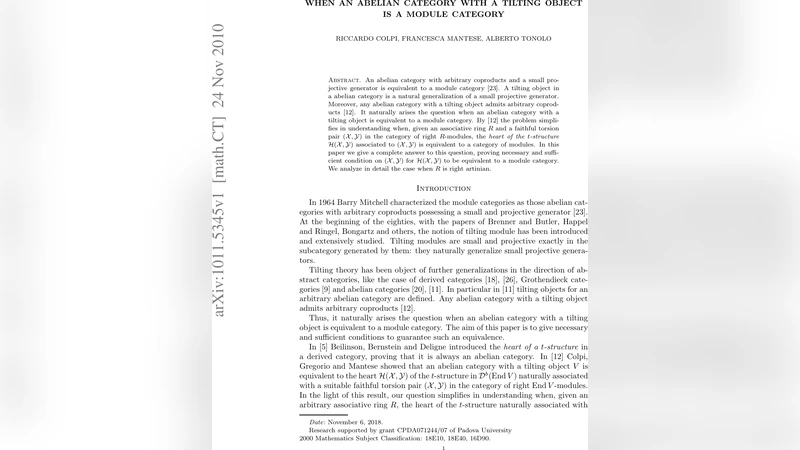
An abelian category with arbitrary coproducts and a small projective generator is equivalent to a module category \cite{Mit}. A tilting object in a abelian category is a natural generalization of a small projective generator. Moreover, any abelian category with a tilting object admits arbitrary coproducts \cite{CGM}. It naturally arises the question when an abelian category with a tilting object is equivalent to a module category. By \cite{CGM} the problem simplifies in understanding when, given an associative ring $R$ and a faithful torsion pair $(\X,\Y)$ in the category of right $R$-modules, the \emph{heart of the $t$-structure} $\H(\X,\Y)$ associated to $(\X,\Y)$ is equivalent to a category of modules. In this paper we give a complete answer to this question, proving necessary and sufficient condition on $(\X,\Y)$ for $\H(\X,\Y)$ to be equivalent to a module category. We analyze in detail the case when $R$ is right artinian.
💡 Research Summary
The paper investigates the precise circumstances under which an abelian category equipped with a tilting object is equivalent to a module category. Mitchell’s classical theorem states that any abelian category with arbitrary coproducts and a small projective generator is equivalent to the category of right modules over some ring. A tilting object generalises the notion of a small projective generator: it guarantees the existence of arbitrary coproducts (as shown by Cline‑Parshall‑Scott‑Solberg) but does not automatically provide a projective generator. Consequently, the natural problem is to determine when a tilting object still yields a module‑category equivalence.
The authors reduce the problem to the study of hearts of t‑structures associated with torsion pairs in module categories. Given a ring (R) and a faithful torsion pair ((\mathcal X,\mathcal Y)) in (\operatorname{Mod}!-!R), the heart (\mathcal H(\mathcal X,\mathcal Y)) is an abelian category sitting inside the derived category (D(R)). The main result is a necessary and sufficient condition for (\mathcal H(\mathcal X,\mathcal Y)) to be equivalent to a module category.
Key ingredients of the criterion
-
Faithfulness and tilting nature of the torsion pair. The pair must be faithful (i.e. (\mathcal X\neq 0) and (\mathcal Y) contains only the zero module) and must arise from a tilting module (T): (\mathcal X=\operatorname{Gen}(T)) and (\mathcal Y=T^{\perp}). This guarantees that the heart is a Grothendieck abelian category.
-
Existence of a small projective generator in the heart. The heart must contain an object (P) that is projective, generates the whole heart under coproducts, and is small (i.e. (\operatorname{Hom}(P,-)) commutes with arbitrary coproducts). When such a (P) exists, its endomorphism ring (S=\operatorname{End}_{\mathcal H}(P)) provides the desired equivalence (\mathcal H(\mathcal X,\mathcal Y)\simeq \operatorname{Mod}!-!S).
-
AB5 and exactness conditions. Both (\mathcal X) and (\mathcal Y) must be closed under arbitrary coproducts and products, ensuring that the heart satisfies the AB5 axiom (direct limits are exact). This is essential for the heart to be a Grothendieck category and for the functor (\operatorname{Hom}(P,-)) to be exact.
When these three conditions hold, the authors construct explicitly the equivalence: the tilting module (T) itself (viewed as a complex concentrated in degree zero) becomes a small projective generator of the heart, and the functor (\operatorname{Hom}_{\mathcal H}(T,-)) identifies (\mathcal H(\mathcal X,\mathcal Y)) with (\operatorname{Mod}!-!S), where (S=\operatorname{End}_R(T)).
Specialisation to right Artinian rings.
If (R) is right Artinian, every right module has finite length, and torsion pairs are completely described by idempotent ideals. The paper shows that a torsion pair ((\mathcal X,\mathcal Y)) yields a module‑category heart precisely when the defining ideal (I) is idempotent ((I^2=I)). In that case the heart is equivalent to (\operatorname{Mod}!-!(R/I)); the quotient ring (R/I) is exactly the endomorphism ring of the small projective generator. If (I) fails to be idempotent, the heart remains a Grothendieck category but lacks a small projective generator, so it cannot be a module category.
Methodology.
The authors combine classical tilting theory, the theory of t‑structures, and the structure theory of Artinian rings. They first recall that a tilting object (T) in (\operatorname{Mod}!-!R) induces a torsion pair ((\operatorname{Gen}(T),T^{\perp})). They then analyse the associated heart inside the derived category, proving that it is Grothendieck and identifying conditions under which it possesses a small projective generator. For the Artinian case, they translate the abstract conditions into concrete statements about idempotent ideals, using the fact that every torsion class in an Artinian module category is generated by a finitely generated module, which in turn corresponds to an ideal.
Examples and applications.
The paper presents explicit examples: for the upper‑triangular matrix ring (R=\begin{pmatrix}k & k\0 & k\end{pmatrix}), the ideal generated by the primitive idempotent yields a torsion pair whose heart is equivalent to (\operatorname{Mod}!-!k). More generally, any finite dimensional algebra over a field admits such a description, allowing one to recognise when a given tilting object gives rise to a module‑category heart.
Conclusion.
The authors deliver a complete characterisation: an abelian category with a tilting object is equivalent to a module category exactly when, after identifying the category with (\operatorname{Mod}!-!R) for some ring (R), the associated faithful torsion pair is tilting and its heart contains a small projective generator. In the right Artinian setting this reduces to the elementary condition that the defining ideal be idempotent, yielding a concrete classification. This work unifies Mitchell’s theorem with modern tilting and t‑structure theory, providing a practical criterion for recognising module‑category equivalences in a broad range of algebraic contexts.
Comments & Academic Discussion
Loading comments...
Leave a Comment