The Surprise Examination Paradox and the Second Incompleteness Theorem
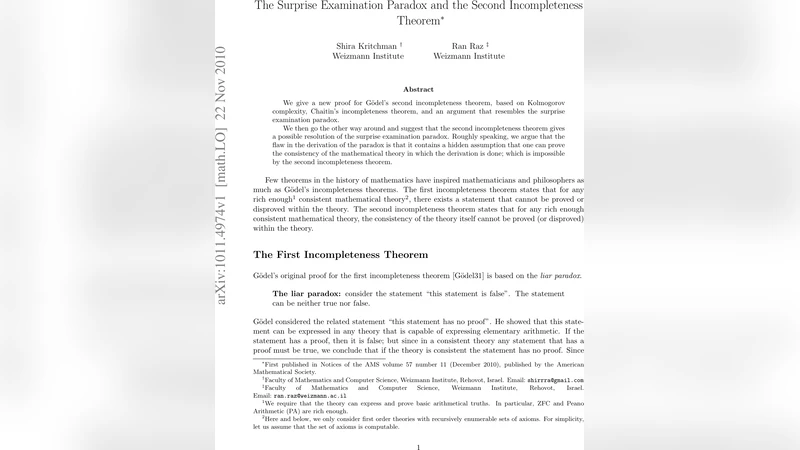
We give a new proof for Godel’s second incompleteness theorem, based on Kolmogorov complexity, Chaitin’s incompleteness theorem, and an argument that resembles the surprise examination paradox. We then go the other way around and suggest that the second incompleteness theorem gives a possible resolution of the surprise examination paradox. Roughly speaking, we argue that the flaw in the derivation of the paradox is that it contains a hidden assumption that one can prove the consistency of the mathematical theory in which the derivation is done; which is impossible by the second incompleteness theorem.
💡 Research Summary
The paper presents a novel proof of Gödel’s second incompleteness theorem by exploiting Kolmogorov complexity and Chaitin’s incompleteness theorem, and then shows how this proof mirrors the structure of the surprise examination paradox. The authors begin with a concise review of the traditional self‑reference proof of the second incompleteness theorem and the classic formulation of the surprise exam paradox, highlighting the long‑standing mystery surrounding the paradox’s apparent logical inconsistency.
In the technical preliminaries, the authors formalize a sufficiently strong arithmetical theory T, the provability predicate ⊢, Kolmogorov complexity K(x), and Chaitin’s theorem, which states that for some constant c (depending on T) there are infinitely many natural numbers n such that T cannot prove the statement “K(n) > c”. This constant c is interpreted as the maximal complexity that T can certify.
The core of the paper is the new proof of the second incompleteness theorem. Assuming T proves its own consistency, the authors construct a sufficiently large natural number N whose Kolmogorov complexity exceeds c. Because T can prove its own consistency, it can also prove that “K(N) > c”. This directly contradicts Chaitin’s theorem, which forbids T from proving any such inequality beyond the bound c. Hence T cannot prove its own consistency, reproducing Gödel’s result without explicit self‑referential sentences; the argument rests entirely on a complexity bound.
Next, the surprise examination paradox is formalized. The teacher’s announcement is rendered as a meta‑statement E: “There will be an exam next week, and on the day of the exam it will not be expected.” The student’s standard backward‑induction argument is translated into a sequence of formal deductions: if the exam were on Monday, the student would expect it on Monday, contradicting E; therefore Monday is eliminated, and the same reasoning is applied to each subsequent day, concluding that no exam can occur. The authors identify a hidden premise in this reasoning: the student implicitly assumes that the underlying theory T (the student’s reasoning system) can prove its own consistency, because only a consistent theory can reliably eliminate each day without contradiction. By the second incompleteness theorem, this premise is unprovable, and thus the paradoxical derivation collapses.
The paper then turns the implication around: the second incompleteness theorem itself can be seen as a formal resolution of the paradox. The statement “the exam’s date cannot be predicted” is shown to be equivalent, within T, to “T cannot prove its own consistency”. Consequently, the impossibility of predicting the exam’s day is just another manifestation of the same complexity‑based limitation that prevents T from proving its consistency. This equivalence provides a unified perspective: both Gödel’s theorem and the surprise exam paradox stem from the same meta‑mathematical barrier.
In the discussion, the authors argue that the complexity‑based proof offers a more intuitive route to Gödel’s result, avoiding the intricate construction of self‑referential Gödel sentences. They also suggest that similar techniques could be applied to other paradoxes that involve expectations or predictions, such as the “unexpected hanging” or various epistemic puzzles. The paper concludes by emphasizing the deep connection between algorithmic information theory and formal logic, and by calling for further exploration of complexity‑driven methods in meta‑mathematical investigations.
Comments & Academic Discussion
Loading comments...
Leave a Comment