Bayesian Analysis of $C_{x}$ and $C_{z}$ Double Polarizations in Kaon Photoproduction
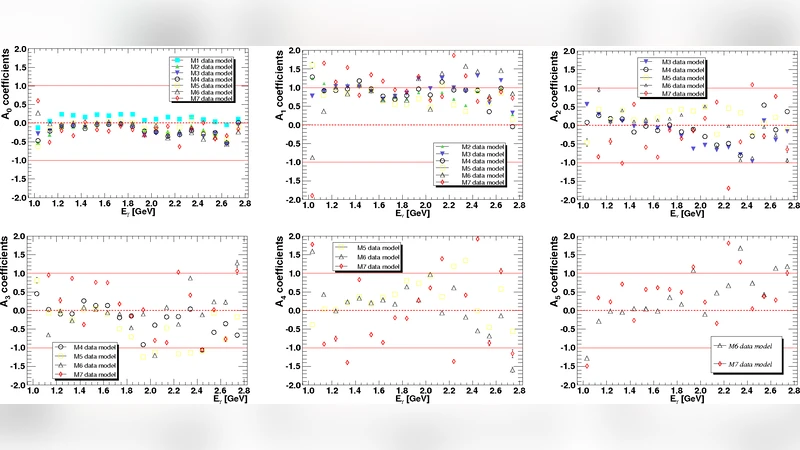
Have been analyzed the latest experimental data for $\gamma + p \to K^{+} + \Lambda$ reaction of $C_{x’}$ and $C_{z’}$ double polarizations. In theoretical calculation, all of these observables can be classified into four Legendre classes and represented by associated Legendre polynomial function itself \cite{fasano92}. In this analysis we attempt to determine the best data model for both observables. We use the bayesian technique to select the best model by calculating the posterior probabilities and comparing the posterior among the models. The posteriors probabilities for each data model are computed using a Nested sampling integration. From this analysis we concluded that $C_{x’}$ and $C_{z’}$ double polarizations require two and three order of associated Legendre polynomials respectively to describe the data well. The extracted coefficients of each observable will also be presented. It shows the structure of baryon resonances qualitatively
💡 Research Summary
The paper presents a Bayesian model‑selection study of the double‑polarization observables (C_{x’}) and (C_{z’}) measured in the reaction (\gamma + p \rightarrow K^{+} + \Lambda). The authors adopt the formalism introduced by Fasano et al. (1992), which classifies all photoproduction observables into four Legendre classes. Within each class the observable can be expressed as a finite sum of associated Legendre polynomials (ALPs) (P_{\ell}^{m}(\cos\theta)) with coefficients that encode the underlying partial‑wave interferences. The central question is how many terms (i.e., up to which order (\ell)) are required to describe the experimental data without over‑fitting.
To answer this, the authors employ Bayesian evidence (also called the marginal likelihood) as the quantitative criterion for model comparison. For a given model (M_{N}) that includes ALPs up to order (N), the evidence is \
Comments & Academic Discussion
Loading comments...
Leave a Comment