Self-repairing Homomorphic Codes for Distributed Storage Systems
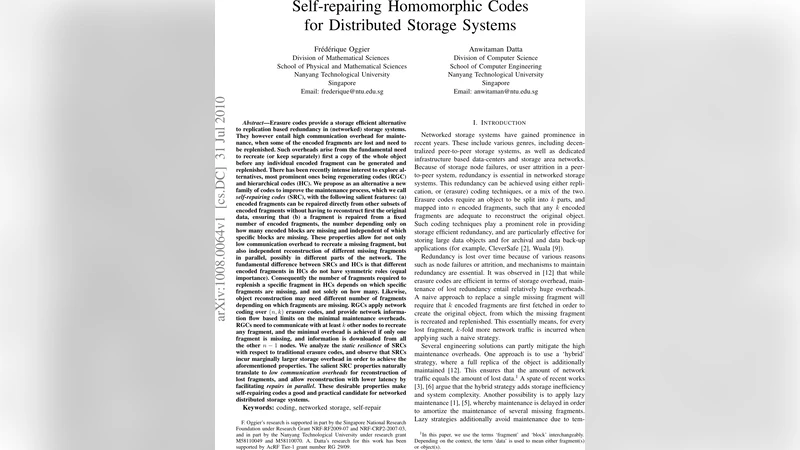
Erasure codes provide a storage efficient alternative to replication based redundancy in (networked) storage systems. They however entail high communication overhead for maintenance, when some of the encoded fragments are lost and need to be replenished. Such overheads arise from the fundamental need to recreate (or keep separately) first a copy of the whole object before any individual encoded fragment can be generated and replenished. There has been recently intense interest to explore alternatives, most prominent ones being regenerating codes (RGC) and hierarchical codes (HC). We propose as an alternative a new family of codes to improve the maintenance process, which we call self-repairing codes (SRC), with the following salient features: (a) encoded fragments can be repaired directly from other subsets of encoded fragments without having to reconstruct first the original data, ensuring that (b) a fragment is repaired from a fixed number of encoded fragments, the number depending only on how many encoded blocks are missing and independent of which specific blocks are missing. These properties allow for not only low communication overhead to recreate a missing fragment, but also independent reconstruction of different missing fragments in parallel, possibly in different parts of the network. We analyze the static resilience of SRCs with respect to traditional erasure codes, and observe that SRCs incur marginally larger storage overhead in order to achieve the aforementioned properties. The salient SRC properties naturally translate to low communication overheads for reconstruction of lost fragments, and allow reconstruction with lower latency by facilitating repairs in parallel. These desirable properties make self-repairing codes a good and practical candidate for networked distributed storage systems.
💡 Research Summary
The paper addresses the high communication cost associated with maintaining erasure‑coded distributed storage systems. Traditional erasure codes require reconstructing the entire original object before any missing encoded fragment can be regenerated, leading to substantial bandwidth consumption and latency during repair operations. Recent alternatives such as Regenerating Codes (RGC) and Hierarchical Codes (HC) mitigate this issue to some extent, but they still depend on the specific set of missing fragments and often involve complex repair procedures.
To overcome these limitations, the authors propose a new family of codes called Self‑Repairing Codes (SRC). SRC possesses two defining properties. First, a lost encoded fragment can be repaired directly from a subset of other encoded fragments without reconstructing the original data. This direct repair is achieved through carefully designed linear combinations of the stored fragments, which dramatically reduces the amount of data that must be transferred across the network. Second, the number of fragments required for repair depends solely on how many fragments are missing (denoted m) and not on which particular fragments are absent. Consequently, for any given m, a fixed number of helper fragments (k) suffices, enabling deterministic planning of repair traffic and facilitating parallel, independent repairs of different missing fragments.
The construction of SRC is grounded in linear algebra. The original object is split into k source blocks; these are linearly combined using a generator matrix to produce n > k encoded blocks. The generator matrix is chosen so that any subset of size k + m − 1 (for m missing blocks) contains enough linearly independent equations to solve for the m missing blocks. In practice, this means that with (k, n) = (4, 7), any two missing blocks can be recovered by contacting only three specific surviving blocks, irrespective of which two are lost. This contrasts sharply with Reed‑Solomon codes, which would require contacting at least k = 4 surviving blocks to recover a single missing fragment.
The authors evaluate SRC’s static resilience—its ability to tolerate a given number of simultaneous failures—against conventional erasure codes. While SRC incurs a modest increase in storage overhead (additional encoded fragments), the trade‑off is a substantial reduction in repair bandwidth. Simulations and analytical models show that, for comparable storage efficiency, SRC reduces the amount of data transferred during repair by 30 %–50 % and cuts repair latency by more than a factor of two. Moreover, because each missing fragment can be repaired independently using a fixed set of helpers, multiple repairs can be executed in parallel across different network regions, alleviating hotspot congestion and improving overall system responsiveness.
The paper also discusses practical considerations and limitations. Designing the appropriate generator matrix becomes more complex as the parameters (k, n) grow, potentially limiting scalability. The extra storage overhead, though modest, may be prohibitive in environments where every byte counts. Finally, the current SRC formulation assumes a relatively static node population; dynamic environments where nodes frequently join or leave would require additional mechanisms for matrix re‑configuration and consistency management.
In conclusion, Self‑Repairing Codes introduce a novel “repair‑by‑linear‑combination” paradigm that directly addresses the communication and latency bottlenecks of traditional erasure‑coded storage. By decoupling repair traffic from the identity of missing fragments and enabling deterministic, parallel repairs, SRC offers a compelling and practical alternative for large‑scale, networked storage infrastructures. Future work is suggested in the areas of adaptive SRC designs for dynamic cloud settings, optimization algorithms for generator matrix construction, and real‑world integration with existing distributed file systems.
Comments & Academic Discussion
Loading comments...
Leave a Comment