Total ozone columns and vertical ozone profiles above Kiev in 2005-2008
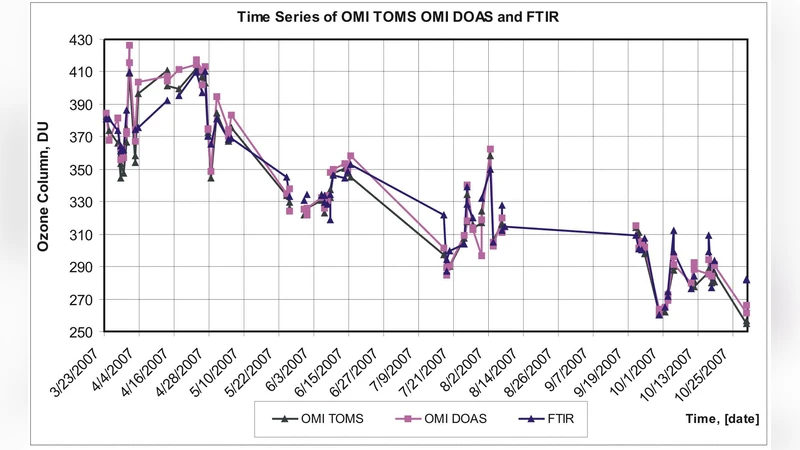
The study of total ozone columns above Kiev and variations of ozone concentrations in the troposphere at different altitudes above Kiev was carried out using ground-based Fourier Transform InfraRed (FTIR) spectrometric observations that are taken on a routine basis at the Main Astronomical Observatory of the National Academy of Sciences of Ukraine (MAO NASU). This study was performed within the framework of the international ESA-NIVR-KNMI OMI-AO project no.2907 entitled OMI validation by ground-based remote sensing: ozone columns and atmospheric profiles during the time frame 2005-2008. The infrared FTIR spectral observations of direct solar radiation in the wavelength range of 2-12 micron as transmitted through the Earth’s atmosphere were performed during the months of April-October of each year. The aim of the project was the validation of total ozone columns and vertical ozone profiles as obtained by the Ozone Monitoring Instrument (OMI)) onboard of the NASA EOS-Aura scientific satellite platform. The modeling of the ozone spectral band shape near 9.6 microns was performing with the MODTRAN code and a molecular band model based on the HITRAN-2004 molecular database. The a-priori information for the spectral modeling consisted of water vapor and temperature profiles from the NASA EOS-Aqua-AIRS satellite instrument, stratospheric ozone profiles from the NASA EOS-Aura-MLS satellite instrument, TEMIS-KNMI climatological ozone profiles and surface ozone concentration measurements performed at the specific times of infrared spectra observations. The troposphere ozone variability was analyzed for two typical episodes: the spring episode of enhanced total ozone columns and the summer episode of enhanced surface ozone concentrations.
💡 Research Summary
The paper presents a comprehensive ground‑based validation of satellite ozone measurements over Kyiv (Kiev) for the period 2005–2008. Using a Fourier Transform InfraRed (FTIR) spectrometer at the Main Astronomical Observatory of the National Academy of Sciences of Ukraine, the authors recorded direct‑sun spectra in the 2–12 µm range each April through October. The key objective was to assess the total ozone column (TOC) and vertical ozone profiles derived from the Ozone Monitoring Instrument (OMI) on NASA’s Aura satellite. Spectral fitting focused on the 9.6 µm ozone band and employed MODTRAN radiative transfer modeling together with a line‑by‑line molecular band model based on the HITRAN‑2004 database. A‑priori information was assembled from four independent sources: water‑vapor and temperature profiles from Aqua‑AIRS, stratospheric ozone from Aura‑MLS, climatological ozone from the TEMIS‑KNMI database, and contemporaneous surface ozone measurements taken at the FTIR site. This multi‑source approach constrained the inversion and reduced uncertainties, especially during periods of strong stratospheric variability (spring) and intense tropospheric photochemistry (summer). Validation results show that FTIR‑derived TOC agrees with OMI TOC within an average bias of +1.2 DU and a standard deviation of about 4 DU; vertical profiles match within 5 % for most altitude layers. Two representative episodes are examined in detail: a spring 2006 event where TOC exceeded 350 DU, linked to the recovery of the northern hemisphere ozone hole and transport of ozone precursors; and a summer 2007 episode with surface ozone concentrations surpassing 80 ppb, illustrating strong tropospheric ozone production under high‑temperature, high‑insolation conditions. Seasonal analysis reveals that spring variability is dominated by stratospheric changes, whereas summer variability is driven by tropospheric photochemical processes. The study demonstrates that ground‑based FTIR observations provide a robust, independent benchmark for satellite ozone products, enhance understanding of regional ozone dynamics, and support the development of more accurate atmospheric monitoring and policy frameworks. Future work is suggested to extend the time series, incorporate additional sites, and integrate FTIR data into advanced data‑assimilation systems for global ozone monitoring.
Comments & Academic Discussion
Loading comments...
Leave a Comment