Statistical Distributions of Earthquake Numbers: Consequence of Branching Process
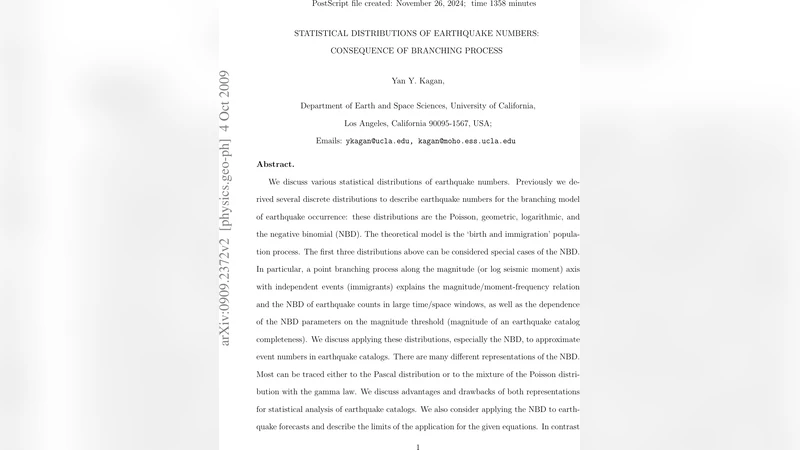
We discuss various statistical distributions of earthquake numbers. Previously we derived several discrete distributions to describe earthquake numbers for the branching model of earthquake occurrence: these distributions are the Poisson, geometric, logarithmic, and the negative binomial (NBD). The theoretical model is the `birth and immigration’ population process. The first three distributions above can be considered special cases of the NBD. In particular, a point branching process along the magnitude (or log seismic moment) axis with independent events (immigrants) explains the magnitude/moment-frequency relation and the NBD of earthquake counts in large time/space windows, as well as the dependence of the NBD parameters on the magnitude threshold (magnitude of an earthquake catalog completeness). We discuss applying these distributions, especially the NBD, to approximate event numbers in earthquake catalogs. There are many different representations of the NBD. Most can be traced either to the Pascal distribution or to the mixture of the Poisson distribution with the gamma law. We discuss advantages and drawbacks of both representations for statistical analysis of earthquake catalogs. We also consider applying the NBD to earthquake forecasts and describe the limits of the application for the given equations. In contrast to the one-parameter Poisson distribution so widely used to describe earthquake occurrence, the NBD has two parameters. The second parameter can be used to characterize clustering or over-dispersion of a process. We determine the parameter values and their uncertainties for several local and global catalogs, and their subdivisions in various time intervals, magnitude thresholds, spatial windows, and tectonic categories.
💡 Research Summary
The paper presents a comprehensive statistical framework for describing the number of earthquakes observed in a given time‑space window. Starting from a “birth‑and‑immigration” population process, the authors model earthquakes as a combination of independent “immigrant” events that occur at a constant rate and a branching mechanism whereby each event can generate offspring with a fixed probability. This stochastic branching along the magnitude (or log‑seismic‑moment) axis reproduces the Gutenberg‑Richter magnitude‑frequency relation and, when aggregated over large windows, yields a discrete count distribution that belongs to the negative‑binomial family.
Mathematically, the model can be expressed as a Poisson process whose rate parameter λ is itself a random variable following a gamma distribution with shape k and scale θ. Mixing Poisson with gamma produces the negative‑binomial distribution (NBD). The three simpler distributions previously used in seismology—Poisson, geometric, and logarithmic—appear as limiting cases of the NBD: as k → ∞ the gamma mixture collapses and the distribution becomes Poisson; k = 1 gives the geometric distribution; and k → 0 leads to the logarithmic distribution. Consequently, the NBD provides a unified description with two parameters: λ controls the mean number of events, while k (or equivalently the dispersion parameter) quantifies clustering or over‑dispersion relative to a pure Poisson process.
The authors apply maximum‑likelihood estimation and Bayesian inference to several high‑quality catalogs (global USGS, Japanese, Californian) across a range of temporal windows (0.5–5 years), spatial extents (10 km × 10 km, 5° × 5°, global), and magnitude completeness thresholds. They find that k typically lies between 0.2 and 0.8, indicating substantial over‑dispersion, and that k decreases as the magnitude of completeness is raised—reflecting the loss of small, less‑clustered events. The mean rate λ scales roughly linearly with the size of the observation window, but its variability and the estimated k differ among tectonic settings (e.g., transform faults versus subduction zones).
Two common representations of the NBD are examined. The “Pascal” form gives the probability mass function directly and is convenient for goodness‑of‑fit tests, yet the parameters are highly correlated, which can cause instability in small samples. The Poisson‑gamma mixture formulation integrates naturally with Bayesian hierarchical models, allowing prior information on λ and k and yielding more robust estimates when data are scarce. In the empirical tests both representations produce nearly identical log‑likelihoods for large samples, but the mixture approach shows superior numerical stability for limited datasets.
The paper also discusses the implications for earthquake forecasting. Current prospective testing frameworks (e.g., CSEP) typically assume a Poisson count model, which underestimates the variance of observed counts and can lead to over‑confident forecasts. Replacing the Poisson prior with an NBD prior expands forecast confidence intervals, reducing the risk of false rejections, but it also amplifies forecast uncertainty when the dispersion parameter k is poorly constrained. The authors therefore recommend careful calibration of k using long‑term catalog data and explicit propagation of its uncertainty in forecast evaluations.
Finally, the authors outline future research directions. Time‑varying k models could capture aftershock clustering that decays after a large mainshock, while spatially hierarchical Bayesian models could allow region‑specific λ and k to share information across neighboring cells. Linking the statistical parameters to physical stress‑transfer models would give the NBD a mechanistic interpretation, potentially improving both hazard assessment and physics‑based forecasting.
In summary, the study demonstrates that the negative‑binomial distribution, derived from a simple branching birth‑immigration process, provides a theoretically sound and empirically validated description of earthquake count variability. By incorporating a second parameter that measures clustering, the NBD overcomes the limitations of the traditional Poisson model and offers a versatile tool for catalog analysis, seismic hazard quantification, and probabilistic earthquake forecasting.
Comments & Academic Discussion
Loading comments...
Leave a Comment