Comparison of Cubical and Simplicial Derived Functors
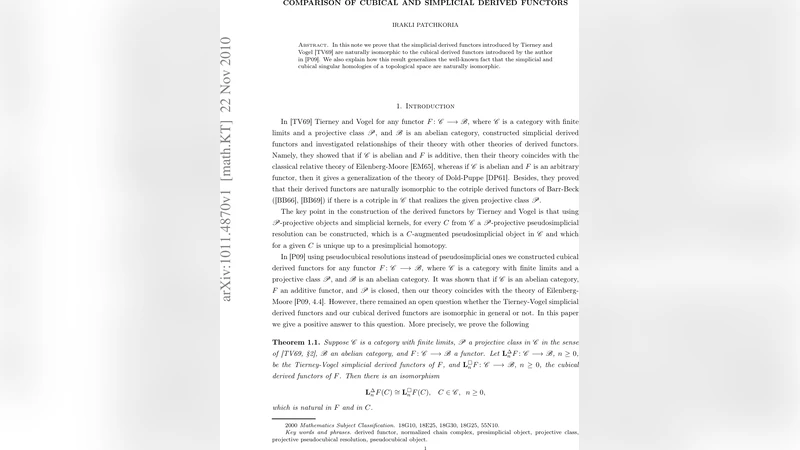
In this note we prove that the simplicial derived functors introduced by Tierney and Vogel [TV69] are naturally isomorphic to the cubical derived functors introduced by the author in [P09]. We also explain how this result generalizes the well-known fact that the simplicial and cubical singular homologies of a topological space are naturally isomorphic.
💡 Research Summary
The paper establishes a precise equivalence between two historically distinct constructions of left derived functors in an abelian setting: the simplicial derived functors introduced by Tierney and Vogel in the late 1960s and the cubical derived functors defined by the author in a 2009 preprint. After recalling the general framework of derived functors—namely, a left exact functor (F:\mathcal{A}\to\mathcal{B}) between abelian categories and the need to replace objects of (\mathcal{A}) by “good” resolutions before applying (F)—the author reviews the two resolution theories. The simplicial approach uses simplicial objects and their associated chain complexes; the cubical approach replaces them with cubical objects, which are built from iterated applications of the functor to the faces of an (n)-cube. Both give rise to chain complexes (C_\bullet) (simplicial) and (D_\bullet) (cubical) that compute the same homology when (F) is applied.
The core technical contribution is the construction of explicit natural transformations—called the normalization map (N:\text{Simp}\to\text{Cub}) and its inverse denormalization map (D:\text{Cub}\to\text{Simp})—that convert a simplicial resolution into a cubical one and vice‑versa. These maps are defined on the level of objects and morphisms in the respective diagram categories and are shown to be chain homotopy equivalences. Consequently, for any object (A\in\mathcal{A}) the two resolutions are linked by a chain isomorphism (\phi:C_\bullet(A)\xrightarrow{\cong} D_\bullet(A)). Applying the left exact functor (F) yields a natural isomorphism \
Comments & Academic Discussion
Loading comments...
Leave a Comment